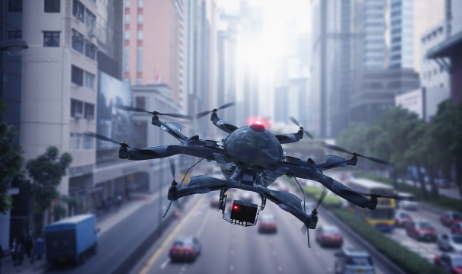
Drone detection technology is the set of sensors and software that find, track, and identify unmanned aircraft in a protected airspace. Four sensor families do the finding, radio frequency, radar, cameras, and acoustics, and a command-and-control platform turns their separate signals into one picture an operator can act on. No single one of them solves the problem. Understanding why is the difference between buying a system that works and buying a box that produces alarms.
This guide covers the full landscape: how each detection technology works, what it uniquely delivers, where it fails, how fusion resolves those failures, what the technology cannot do at all, and how to evaluate a system against your site. It is written for the security directors and program managers doing the evaluating, not for engineers. We build multi-sensor detection systems, so we will be direct about the limits of every layer, including the ones we sell.
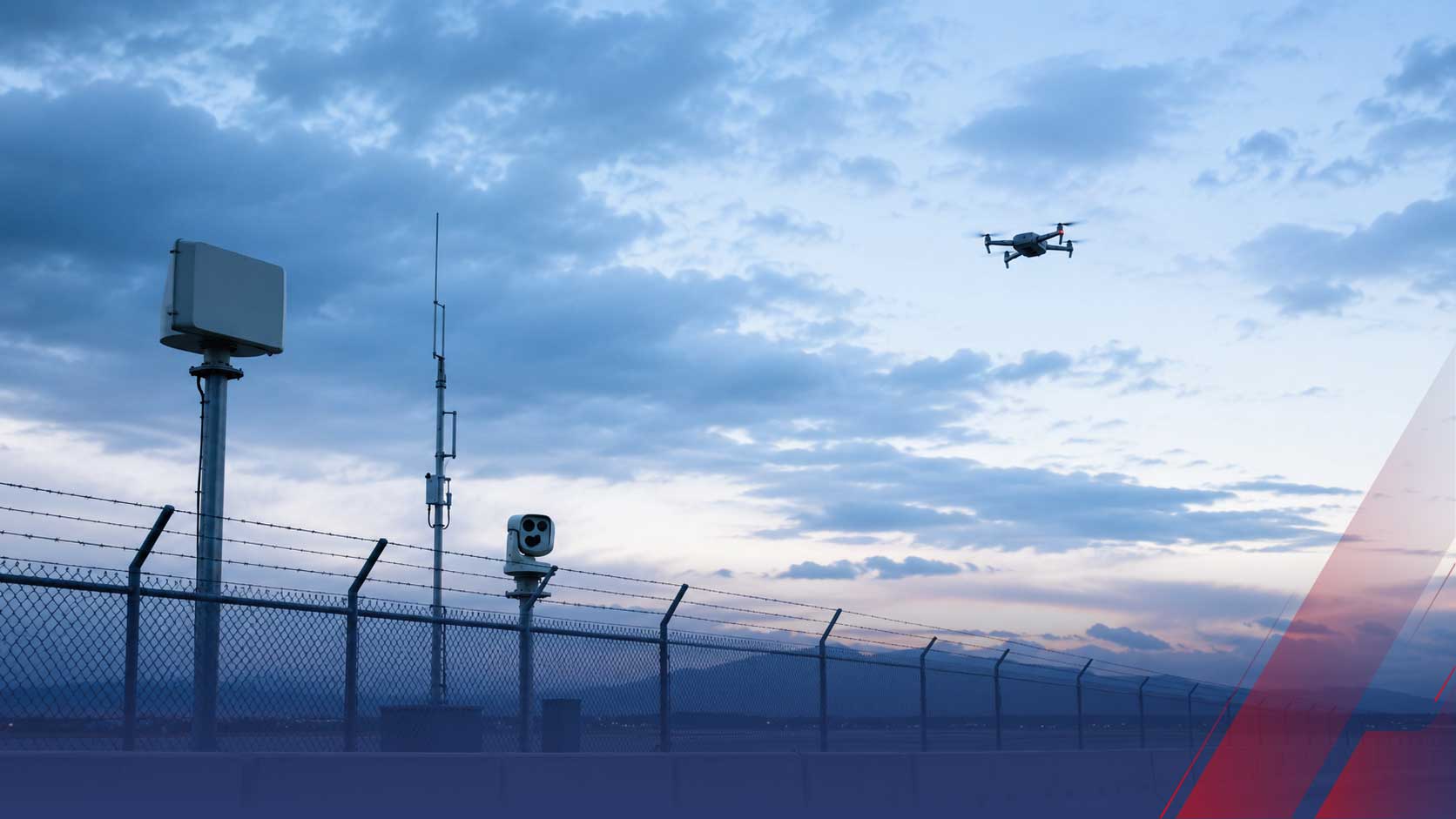
The Four Drone Detection Technologies
Every drone detection system in commercial use is built from some combination of four sensing approaches. The US Government Accountability Office identifies radio frequency and radar as the two most common detection technologies, with cameras and acoustics filling specific roles alongside them.
-
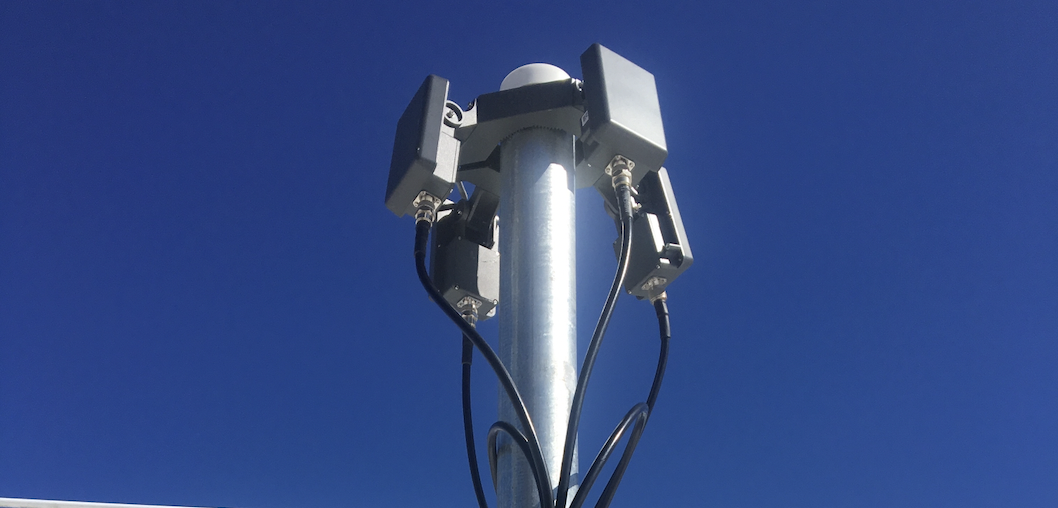
Radio frequency (RF). Passive receivers listen for the drone's command link, video downlink, and Remote ID broadcast across a wide spectrum. RF identifies the drone's make and model from its protocol signature and, with multiple sensors, locates the pilot. Detailed in our guide to RF drone detection.
-
Radar. Transmits radio energy and measures the reflection off the airframe, detecting the drone as a physical object regardless of what it transmits. Micro-Doppler analysis of rotor blades separates drones from birds. Covered in our drone detection radar guide.
-
Electro-optical and infrared cameras. Provide visual confirmation of what a sensor detected: the aircraft type, whether it carries a payload, and evidentiary imagery. Cameras cannot search wide airspace alone, so they are cued to coordinates by radar or RF.
-
Acoustic sensors. Listen for the distinctive rotor signature of a drone. Short range and vulnerable to ambient noise, which limits them to specific close-in applications rather than perimeter coverage.
Our comparison of how drone detectors work breaks down each sensor family in technical detail.
What Each Technology Uniquely Delivers
The reason serious systems layer sensors is that each answers a different question, and no facility needs only one answer.
RF answers who. It is the only passive technology that produces identity: this is a DJI-class aircraft, and its operator is transmitting from these coordinates. For contraband interdiction at correctional facilities, the pilot location is the entire objective.
Radar answers where, always. It detects the airframe whether or not the drone emits anything, which makes it the only passive sensor that finds autonomous and fiber-optic aircraft. It also delivers the continuous, updating track that turns a detection into custody of a target.
Cameras answer what. A radar track says an object is inbound at 200 feet. A camera slewed to those coordinates says it is a quadcopter with a package slung underneath, and records the footage that supports prosecution.
Why No Single Technology Is Enough
Each technology has a blind spot that another covers, and the blind spots are not edge cases.
RF goes deaf against silence. Autonomous drones flying pre-programmed routes emit no control link, and fiber-optic drones, now fielded in more than 80 models, carry their control signal inside a physical cable. Radar sees these aircraft; RF never will.
Radar goes anonymous. It detects and tracks an object and, with micro-Doppler, classifies it as a drone, but a reflection carries no serial number, no model, and no operator location. Radar also struggles with the small radar cross-section of micro-drones and can lose targets in the Doppler notch when they fly tangentially.
Cameras go blind in weather and darkness without thermal, and cannot search a wide area unaided. Acoustics degrade in any noisy environment. And the GAO has cautioned that detection technologies have a limited ability to detect and track small UAS under 55 pounds, with birds and interference generating false detections, which is a caution about single-sensor deployments more than about the technologies themselves.
Fusion: The Technology That Makes the Others Work
The layer that converts four imperfect sensors into one reliable picture is the command-and-control platform, and it is the least discussed and most decisive component in any system. Each sensor produces its own track with its own update rate, coordinate frame, and error characteristics. Fusion software correlates them, determining that the radar track at one position and the RF detection at a slightly different position are the same aircraft, and presents the operator with a single confident target rather than three competing alarms.
This is where false alarms actually get solved. A radar return that might be a bird becomes a confirmed drone when the RF sensor simultaneously reports a DJI protocol on the same bearing. A system that cries wolf trains operators to ignore it, which is worse than no system, and fusion is the mechanism that keeps the alarm rate operationally survivable. Our guide to how a drone detection system works covers the full architecture from sensor to operator.
What Drone Detection Technology Cannot Do
One boundary is absolute and belongs in every evaluation: detection technology detects. It does not stop drones. Jamming, cyber-takeover, capture, and kinetic defeat are mitigation technologies, and in the United States they are restricted under federal law to the Departments of Defense, Energy, Justice, and Homeland Security, plus state and local agencies certified under the SAFER SKIES framework that took effect this month. Our guide to drone mitigation and the new authorization path covers who qualifies and how certification works.
For every other organization, detection is not the consolation prize. It is the entire lawful toolkit, and it is more capable than most buyers expect: identify the aircraft, locate the operator, document the pattern, and hand a case file to the agencies that can act. The joint DOJ, FAA, DHS, and FCC interagency advisory on detection technology also draws one line inside detection itself: passive sensing is broadly lawful, while systems that intercept or decode the content of drone communications may implicate federal surveillance statutes. Ask vendors which side of that line their identification method sits on.
Choosing Detection Technology for Your Site
Sensor selection follows the threat profile and the geography, not a universal template:
-
Start with RF. It is passive, license-free, affordable relative to radar, and it catches the everyday threat: a consumer drone with a standard control link. It answers what is flying here and how often, which is the question most first deployments actually have.
-
Add radar where silence is the threat. Facilities facing deliberate, planned incursions, critical infrastructure, prisons, and high-value targets, need the sensor that works when the drone transmits nothing.
-
Add cameras for evidence and confirmation. Anywhere the output has to survive a courtroom, an insurance claim, or an FAA enforcement referral.
-
Insist on a site survey. Terrain, structures, RF congestion, and the local threat profile determine real coverage. Published ranges are ceilings measured in ideal conditions, and no honest vendor will quote your coverage without walking your site.
Detection equipment across all four technologies qualifies at 100 percent federal cost share under the FEMA Counter-UAS Grant Program for eligible public agencies. For a view of the companies building these systems, see our counter-drone vendor landscape.
The Technology Is the Layers, Not the Box
Drone detection technology is not a product category with a best option. It is four sensing approaches with complementary strengths and honest weaknesses, joined by the fusion software that makes them coherent. RF names the aircraft and finds the pilot. Radar sees what stays silent. Cameras confirm and record. Fusion turns all of it into one track an operator trusts.
We believe the buyers who get this right stop asking which technology is best and start asking which combination covers their specific threat at their specific site. That answer comes from a survey, not a datasheet, and it changes as the threat does, which is why the architecture matters more than any single sensor in it. The complete practical walkthrough is in our guide to detecting drones.
Evaluating drone detection technology for your facility? Talk to our team about a site survey and a sensor mix built for your threat profile.
Related reading: