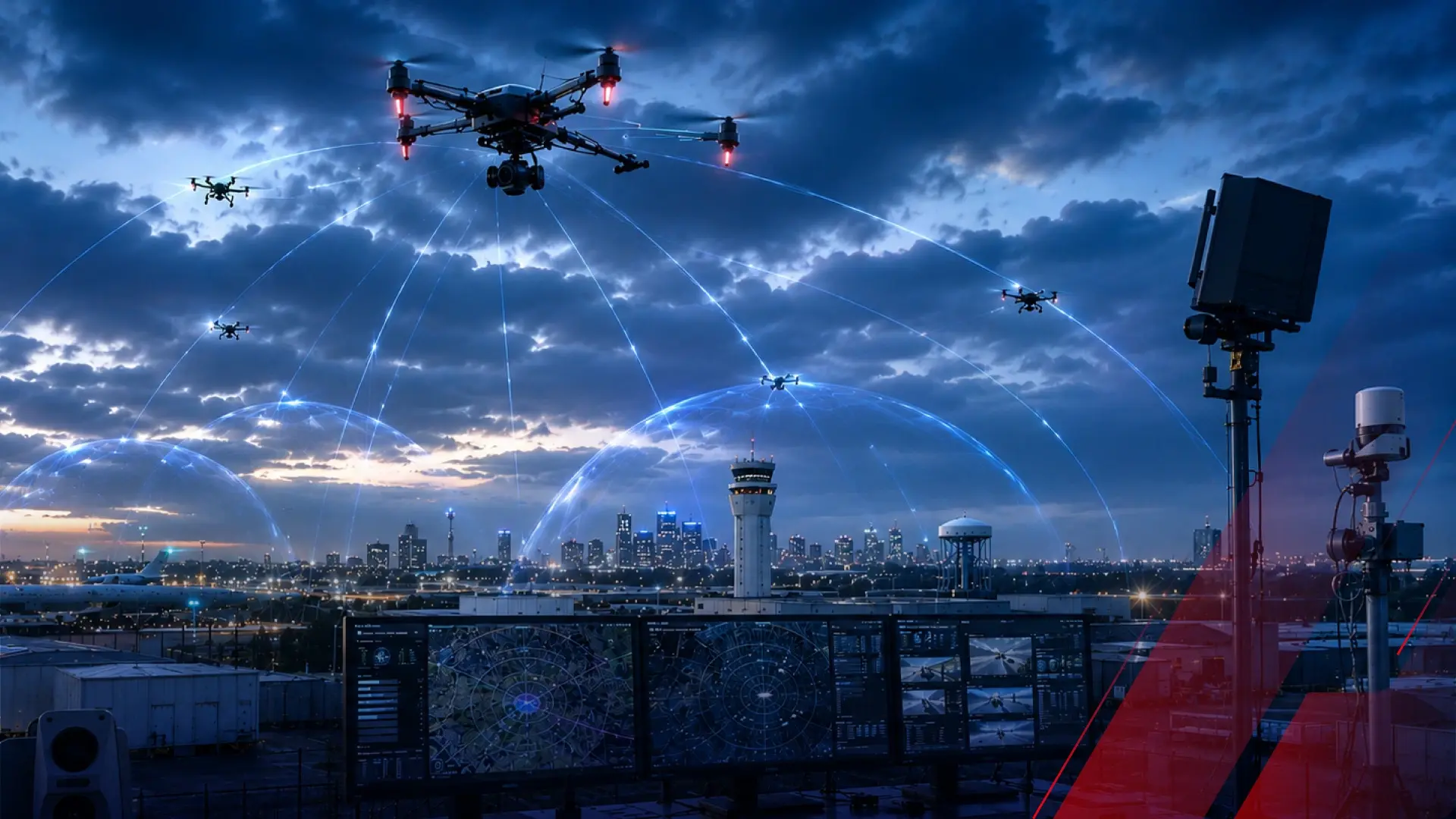
The counter-drone market is projected to grow from $3.88 billion in 2026 to $16.45 billion by 2034, a CAGR of 19.79%. The SAFER SKIES Act opened counter-drone authority to state and local agencies for the first time. FEMA is distributing $500 million in C-UAS grants over two years. The Pentagon's JIATF-401 just awarded Anduril an $87 million counter-UAS command-and-control contract within a $20 billion ceiling. The result is an explosion of companies, products, and marketing claims that makes it genuinely difficult for buyers to understand who does what.
We compete in this market. AirSight builds detection and command-and-control software for airports, correctional facilities, and critical infrastructure. We are not a neutral analyst. But we talk to buyers every day who struggle to make sense of this market, and we believe the industry needs a guide that categorizes companies by what they actually do rather than what their marketing says. This is that guide.
How to Read This Guide: Four Technology Categories
Counter-drone companies fall into four functional categories based on what their technology does within the detect-track-identify-mitigate (DTIM) workflow. Most vendors specialize in one or two categories. A few span multiple categories. No single company dominates all four.
-
Category 1: Detection Sensor Manufacturers - companies that build the physical sensors (RF analyzers, radar, cameras, acoustic sensors, Remote ID receivers) that find drones in the airspace.
-
Category 2: Command-and-Control (C2) Platform Providers - companies that build the software platforms that fuse data from multiple sensors into a single operating picture. This is the brain of the system.
-
Category 3: Mitigation System Manufacturers - companies that build the tools that neutralize drone threats: jammers, spoofers, net-capture interceptors, directed-energy weapons, and cyber-takeover systems.
-
Category 4: Defense Primes and System Integrators - large defense contractors that package sensors, C2 platforms, and mitigation into turnkey military systems.
The critical insight for buyers: detection is legal for any organization. Mitigation requires federal certification under the SAFER SKIES Act. If your agency does not yet have FBI NCUTC-certified personnel, your procurement should focus on Categories 1 and 2. Mitigation (Category 3) comes later, after certification.
Category 1: Detection Sensor Companies
These companies build the hardware that physically detects drones. Each specializes in a different sensor modality. For a technical comparison of each sensor type, read our guide on how drone detectors work.
RF Detection
-
CACI International (US) - SkyTracker RF detection family used by US military, intelligence, and homeland security. Protocol-level RF analysis is increasingly relevant under the SAFER SKIES Act, which requires establishing a "credible threat" before taking mitigation action. SkyTracker is one of the sensors supported natively in AirGuard.
-
MyDefence (Denmark) - Compact RF detection units designed for portable and vehicle-mounted deployments. Strong in the European military market.
-
Aaronia AG (Germany) - High-frequency spectrum analyzers capable of detecting drones on encrypted or non-standard frequencies. Niche but technically differentiated.
Radar Detection
-
Robin Radar Systems (Netherlands) - Micro-Doppler radar that distinguishes drones from birds based on propeller rotation signatures. Deploys at airports and critical infrastructure. Robin's "10 Counter-Drone Technologies" blog ranks on the first page for multiple counter-drone keywords.
-
Blighter Surveillance Systems (UK) - Electronic scanning radar with detection ranges exceeding 8 kilometers. Strong in military and border security applications.
-
Echodyne (US) - Metamaterial electronically scanning array (MESA) radar. Compact form factor used in both counter-drone and autonomous vehicle applications.
Acoustic Detection
-
Squarehead Technology / DroneShield Acoustic - Microphone array systems that detect propeller noise. Effective in quiet environments where RF interference or radar clutter limits other sensor types.
Category 2: Command-and-Control Platform Companies
The C2 platform is the most strategically important layer in a counter-drone deployment. It determines how sensor data is fused, how alerts are managed, how reports are generated, and how the system integrates with existing security infrastructure. The choice of C2 platform increasingly drives the rest of the procurement decision.
-
Dedrone / Axon (US/Germany) - DedroneTracker C2 platform. Acquired by Axon in 2024. One of the most widely deployed commercial counter-UAS systems in the US with over 700 installations worldwide. Integrates multiple sensor types. Strong in airports, prisons, and federal facilities. Dedrone spans both the detection (RF) and C2 categories.
-
Anduril Industries (US) - Lattice AI-powered C2 platform. In March 2026, JIATF-401 selected Lattice as the tactical C2 backbone for military counter-drone operations. Primarily serves the DOD and federal market, though commercial applications are emerging.
-
AirSight (US) - AirGuard platform that unifies radar, RF sensors, and Remote ID data into a single operating picture. Multi-vendor data fusion correlates detections from overlapping sensors into one track per physical drone. Serves airports, critical infrastructure, stadiums, and event venues. Full disclosure: this is our company.
-
DroneShield (Australia/US) - DroneSentry C2 platform that integrates with their own DroneSentry-X and DroneSentinel hardware. Primarily serves military and government markets. Over 1,000 units deployed globally.
Why C2 matters most: A facility can switch radar vendors or upgrade an RF sensor without replacing the entire system if the C2 platform supports open integration. But switching the C2 platform means retraining operators, re-integrating every sensor, and rebuilding every alert workflow. The C2 platform is the layer that creates vendor lock-in or preserves vendor flexibility. Ask every vendor whether their platform integrates sensors from other manufacturers, or only their own.
Category 3: Mitigation System Companies
These companies build the tools that neutralize drone threats. Under the SAFER SKIES Act, mitigation technology may only be deployed by agencies with FBI NCUTC-certified personnel using equipment from the federally authorized technology list. For a deep dive on how drone jammers work and who can legally use them, read our guide.
-
D-Fend Solutions (Israel/US) - EnforceAir RF-cyber takeover platform. Detects hostile drones and then takes control by exploiting their communication protocols, enabling controlled safe-landing rather than an uncontrolled crash or shoot-down. One of the most technically sophisticated mitigation approaches.
-
Sentrycs (Israel/US) - CoRF protocol-based drone takeover system. Communicates directly with the drone in its own protocol language to sever the link with the original operator and command a safe landing. Recently won contracts for 2026 FIFA World Cup venue protection. Systems range from a $65,000 handheld unit to $250,000-$400,000 long-range systems.
-
Fortem Technologies (US) - DroneHunter autonomous net-capture interceptor. A drone that catches other drones with a net. Selected for the Pentagon's Replicator-2 initiative and awarded a contract for FIFA World Cup venue protection. Claims 4,700 safe takedowns.
-
SkySafe (US) - Protocol-based drone takeover and safe-landing technology. Government and military deployments.
-
AeroVironment (US) - Recently unveiled the LOCUST X3, a 20-30 kW laser counter-UAS system designed to defeat drones up to Group 3 (25-55 lbs) without the logistics burden of physical interceptors.
Structural truth about mitigation: Every mitigation system depends entirely on upstream detection and tracking to provide targeting data. A jammer that does not know where to point, a laser without a target track, or an interceptor drone without a flight vector are expensive liabilities. This is why we tell every buyer: invest in detection first.
Category 4: Defense Primes and System Integrators
Large defense contractors package sensors, C2 platforms, and mitigation into turnkey military systems. These companies primarily serve the DOD and allied militaries rather than state and local agencies:
-
RTX / Raytheon (US) - Coyote interceptor drone and integrated C-UAS systems.
-
Lockheed Martin (US) - Modular, open-architecture counter-UAS system with AI-driven detection.
-
Leonardo (Italy) - Falcon Shield multi-sensor system with long-term sustainment packages.
-
Saab (Sweden) - Giraffe radar family and the new Nimbrix dedicated counter-UAS missile.
-
L3Harris (US) - Electronic warfare and counter-UAS systems for military deployment.
For SLTT agencies receiving FEMA grants, defense primes are rarely the right vendor. Their systems are designed for military operating environments, carry military price points, and require military-grade sustainment. The specialized counter-drone companies in Categories 1-3 are typically better suited for civilian law enforcement, correctional, and critical infrastructure deployments.
How to Evaluate Counter-Drone Companies for Your Mission
We published a four-question vendor evaluation framework that covers the full process. Here are the five criteria that separate credible vendors from marketing:
-
1. Does the vendor conduct a site survey before quoting? Detection range on a datasheet assumes ideal conditions. Your site has buildings, terrain, RF interference, and wildlife that degrade performance. If a vendor quotes equipment without visiting your site, move on.
-
2. Does the C2 platform support multi-vendor sensor integration? If the platform only works with the vendor's own sensors, you are locked into their hardware ecosystem for every future upgrade. Ask for a list of supported third-party sensors.
-
3. Does the vendor have deployments in your vertical? A company that specializes in military base defense may not understand the operational constraints of a correctional facility or a stadium event. Ask for case studies in your specific environment.
-
4. What is the total five-year cost of ownership? Hardware is often less than half the lifetime cost. Software licenses, firmware updates, calibration, spare parts, and operator training accumulate over the grant performance period. Require a five-year TCO quote.
-
5. Can the system scale from event to permanent? Many agencies start with event-based deployments (FIFA World Cup, SEAR 1 events) and transition to fixed installations. The system should support both modes without re-procurement. Our detection equipment buyer's guide covers this integration requirement.
Start With Detection: The First Procurement for Every New Buyer
If you are evaluating counter-drone companies for the first time, begin with detection. It is the only phase of the DTIM chain that is universally legal, requires no federal certification, and qualifies for FEMA grant funding at 100% federal coverage. Every mitigation technology, every response protocol, and every compliance report depends on the detection system producing reliable, accurate data.
The FEMA C-UAS Grant Program covers detection, tracking, identification, and monitoring equipment. The CISA UAS Detection Technology Guidance provides the framework that FEMA's NOFO references for evaluating detection solutions. And our counter-drone technology guide maps the full technology landscape from detection through mitigation, including the SAFER SKIES Act authorization pathway.
The vendor landscape will continue to consolidate and evolve. The vendors listed in this guide represent the market as of May 2026. We update this page as the market shifts, and we will note any material changes. For a walkthrough of how any of these vendors' products compare against your specific mission requirements, talk to our team. We will give you an honest assessment, even if the right answer is not us.
Related reading: