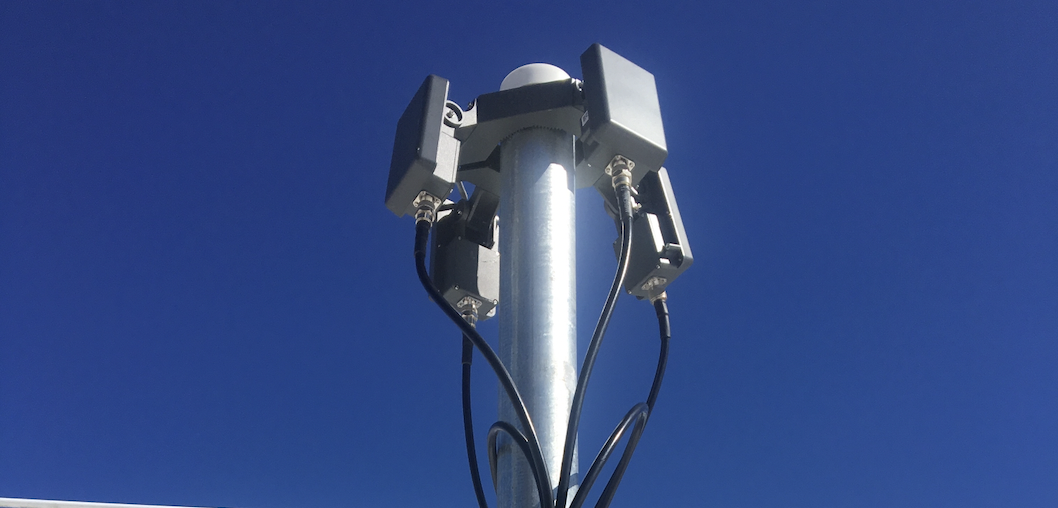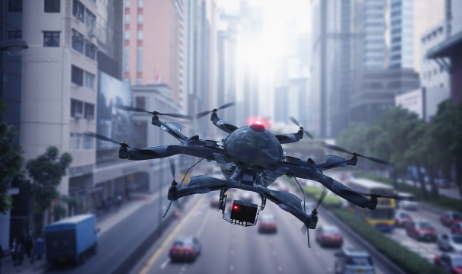
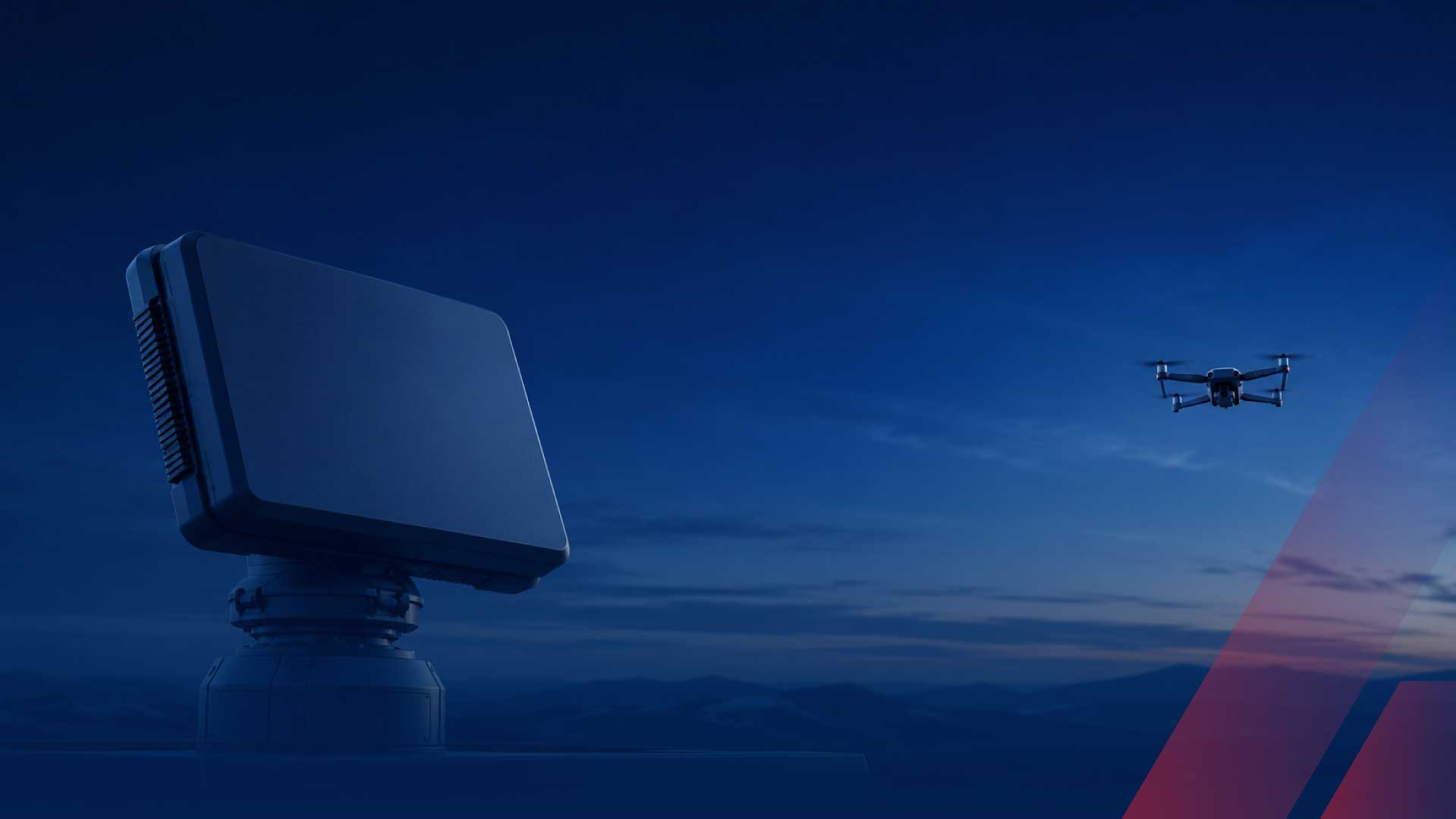
Drone detection radar is the sensor that finds a drone by its physical presence rather than its radio emissions. That single distinction is why radar matters. A radio frequency sensor listens for the link between a drone and its controller, and a Remote ID receiver reads the identification a compliant drone broadcasts. Both go silent against a drone flying a pre-programmed route with its radio link cut. Radar does not, because it detects any object that moves and reflects energy, whether or not the drone is transmitting anything at all.
That makes radar the workhorse for the drones security teams worry about most: the autonomous, the modified, and the deliberately quiet. It is also the most misunderstood sensor in the counter-drone toolbox, wrapped in jargon about bands, waveforms, and Doppler shifts that vendors rarely explain. This guide breaks down how drone detection radar actually works, why small drones are such difficult targets, the types of radar on the market and which one fits your site, what it costs, and the one thing radar cannot do on its own. We build multi-sensor detection systems that use radar as a core layer, so this is the explanation we wish every buyer had before their first vendor call.
What Is Drone Detection Radar?
Radar, short for radio detection and ranging, transmits pulses of radio frequency energy and listens for the echoes that bounce back off objects in its path. The time it takes an echo to return gives the object's range, and the shift in the echo's frequency reveals how fast the object is moving toward or away from the sensor. For airspace security, radar is the one detection method that senses a drone as a physical body in the sky rather than as a signal it chooses to emit.
This is what separates radar from the other sensor families covered in our guide to how drone detectors work. The US Government Accountability Office reports that radio frequency and radar systems are the most common detection technologies, and the two are paired so often precisely because they cover each other. RF catches the cooperative, broadcasting drone cheaply. Radar catches the one that RF cannot hear. Without radar in the mix, a detection system has a hole shaped like every drone flown to avoid being detected.
How Drone Detection Radar Works
The core physics is straightforward. The radar emits energy, the energy reflects off a target, and the system measures both the delay and the frequency change of the return. Delay yields distance. Frequency change, the Doppler shift, yields velocity. A conventional air surveillance radar uses this to track airliners moving fast across open sky, filtering out anything slow enough to be ground clutter.
That filtering is exactly why ordinary radar struggles with drones. A quadcopter hovering in place produces almost no bulk Doppler shift, so a conventional system reads it as static background and discards it. Research on drone detection is blunt about the limitation, noting that radar signals reflected from hovering drones have near-zero Doppler shift and can remain undetected by conventional radars. Purpose-built drone detection radar solves this with micro-Doppler analysis: instead of measuring only the drone's overall motion, it reads the tiny, rapid frequency modulations created by the spinning rotor blades. Those micro-Doppler signatures are what let modern radar see a drone that a legacy system would ignore, and they are the foundation of how radar tells a drone apart from a bird.
Why Small Drones Are Hard Radar Targets
Radar performance depends heavily on radar cross-section, a measure of how much energy an object reflects back to the sensor. A commercial airliner has an enormous radar cross-section. A two-pound consumer drone has a tiny one. Academic research on the problem is direct: conventional radar systems often perform poorly against micro-drones because of their considerably smaller radar cross-section compared with standard aircraft, which is why detecting them requires a dedicated system with far greater sensitivity.
Three factors compound the challenge. Small drones fly low and slow, hugging terrain and buildings where they blend into ground clutter. Many are built largely from plastic and carbon composites that reflect less energy than metal airframes, a stealth-by-material effect we examine in our analysis of detecting carbon-fiber and FPV drones. And they are simply small. The GAO cautions that some counter-drone technologies have a limited ability to detect and track small UAS under 55 pounds, the exact weight class most likely to appear over a stadium, a prison yard, or a substation. None of this makes radar ineffective. It makes radar a specialized instrument, where the right design and processing separate a system that reliably sees small drones from one that does not.
The Types of Drone Detection Radar
"Radar" is not one thing. Drone detection radars differ along three axes, and understanding them is the key to matching a system to your site.
Waveform: pulsed versus continuous
Pulse-Doppler radar sends discrete pulses and listens between them, a design well suited to longer ranges. Frequency-modulated continuous-wave (FMCW) radar transmits continuously while sweeping its frequency, which excels at short-range precision and low-power operation. Much of the research on small-drone detection uses FMCW radar to extract micro-Doppler signatures, and FMCW units are common in compact, site-level drone detection systems.
Beam steering: mechanical, electronic, and staring
A mechanically scanning radar rotates a physical antenna, which is proven and cost-effective but revisits any given point only once per rotation. An electronically scanned array, often called AESA, steers its beam electronically with no moving parts, revisiting targets far faster and tracking many drones at once. A staring or holographic radar illuminates its entire coverage volume continuously, offering the fastest possible update rate, which matters when a fast, erratic drone can change course between sweeps.
Frequency band: the range-versus-resolution trade
Lower-frequency bands such as S-band reach farther but resolve small targets less sharply. Higher-frequency bands resolve small drones better at the cost of range and greater sensitivity to weather. Research demonstrating drone micro-Doppler classification has been carried out across K-band and W-band and other higher frequencies, which is why many dedicated small-drone radars operate in these higher bands where a quadcopter's signature is easiest to isolate.
Telling Drones from Birds: Micro-Doppler and Classification
The single most common question buyers ask about radar is whether it will alarm every time a flock of birds passes. It is the right question, because birds are the reason naive radar deployments fail. Birds share a drone's approximate size, altitude, and speed, giving them a comparable radar cross-section, so distinguishing the two using cross-section information alone is genuinely difficult.
Micro-Doppler is what makes the distinction possible. A drone stays aloft with rigid, fast-spinning rotor blades. A bird flaps flexible wings. Those two modes of flight produce distinct frequency signatures, and a radar tuned to read them can classify a target rather than merely detect it. As one micro-Doppler radar maker explains, the technology identifies the distinctive patterns created by rotating propellers, enabling classification with significantly fewer false alarms, including for hovering and autonomous drones that emit no radio signal. This matters operationally because the GAO warns that electromagnetic interference and small airborne objects such as birds can generate false detections, and a radar that cries wolf at every starling quickly trains operators to ignore it. Classification quality, not raw detection range, is what separates a radar that protects a site from one that generates noise.
What Drone Detection Radar Costs
There is no single price, because drone radar spans a compact perimeter unit and a long-range military array. As a rough guide, compact short-range radars suited to a defined perimeter typically start in the tens of thousands of dollars per unit. Mid-range systems with wider coverage and higher update rates run into the low hundreds of thousands. Long-range, military-grade radars capable of tracking multiple targets across many kilometers can exceed one million dollars.
The more useful way to budget is by coverage and threat rather than by the radar unit alone. Radar is almost always one layer in a larger drone detection system, not a standalone purchase, and datasheet detection ranges assume ideal conditions that your site will not replicate. A site survey is the only reliable way to translate a specification into real coverage. For agencies, cost is often less of a barrier than it appears: the FEMA Counter-UAS Grant Program covers detection equipment at 100 percent federal funding for eligible state and local agencies. Our drone detection equipment buyer's guide walks through the full procurement framework.
Radar Alone Is Not Enough: Detection Versus Identification
Radar has a hard limit that no amount of processing removes. It can tell you that something is in your airspace, where it is, how fast it is moving, and, with micro-Doppler, that it is probably a drone. It cannot tell you the make and model, read the serial number, or locate the operator. Radar detects and tracks. It does not identify.
This is why radar is never the whole answer. RF sensors add the drone's model and often the pilot's location. Under the FAA's Remote ID rule, most drones over 0.55 pounds broadcast identification and location that a receiver can read for compliant flights. Cameras add visual confirmation. The value comes from fusing all of these into one picture, where radar holds the track on a non-emitting drone, RF and Remote ID attach an identity when the aircraft offers one, and a camera confirms what the other sensors found. That fusion is the entire purpose of a command-and-control platform, and it is what turns a radar return into a decision an operator can act on. For the fundamentals of combining sensors, our complete guide to detecting drones lays out the approach.
Which Type of Radar You Need for Your Site
The right radar depends on your environment, your threat, and the drones you actually expect to face.
-
Airports and open approaches: Wide, unobstructed airspace favors longer-range electronically scanned or staring radar with the update rate to track fast-moving targets across approach corridors. See our work on airport drone detection.
-
Correctional facilities and defined perimeters: A prison's contraband threat is usually a consumer drone crossing a known boundary, which compact FMCW radar covers well and affordably as part of a perimeter system. See drone detection for prisons.
-
Dense urban and critical infrastructure sites: Buildings and terrain create clutter and line-of-sight gaps, so these sites need radar with strong clutter rejection and careful placement, often several units for full coverage. See critical infrastructure drone detection.
The same lesson runs through every case. There is no universally best radar, only the radar that fits your site, and the only way to know is a survey that accounts for your terrain, clutter, and threat profile. For a broader view of the vendors building these systems, see our counter-drone vendor landscape.
The Legal Line: Radar Detection Is Legal, Mitigation Is Not
One point every buyer should be clear on before deploying anything. Using radar to detect, track, and classify drones is lawful for any organization in the United States. It is a passive sensing activity that raises none of the legal issues that surround mitigation. Actively stopping a drone by jamming, spoofing, or interception is a different matter entirely, restricted under federal law to the Departments of Defense, Energy, Justice, and Homeland Security. For the authorities now extended to certain law enforcement agencies, see our explainer on the SAFER SKIES Act. For nearly every operator, radar detection paired with coordinated law enforcement response is both the lawful posture and the effective one.
Radar Is the Layer That Sees the Quiet Ones
Radar is the sensor that answers the hardest question in airspace security: what about the drone that is not transmitting anything? RF and Remote ID cover the cooperative aircraft. Radar covers the rest, the autonomous, the modified, and the deliberately silent, which are disproportionately the drones that justify a detection program in the first place. It is a specialized instrument with real limits, small targets are hard, birds cause false alarms, and identification requires other sensors, but those limits are engineering problems that a well-designed system solves.
We believe the organizations that get airspace security right treat radar not as a silver bullet but as the indispensable layer that makes the rest of the system honest. Detect the physical object, identify it with RF and Remote ID, confirm it with cameras, and fuse the three into one picture. That is what complete airspace awareness looks like, and radar is where it starts for the threats that matter most.
Want to know which radar configuration would actually cover your airspace? Talk to our team about a site survey for your facility.
Related reading: