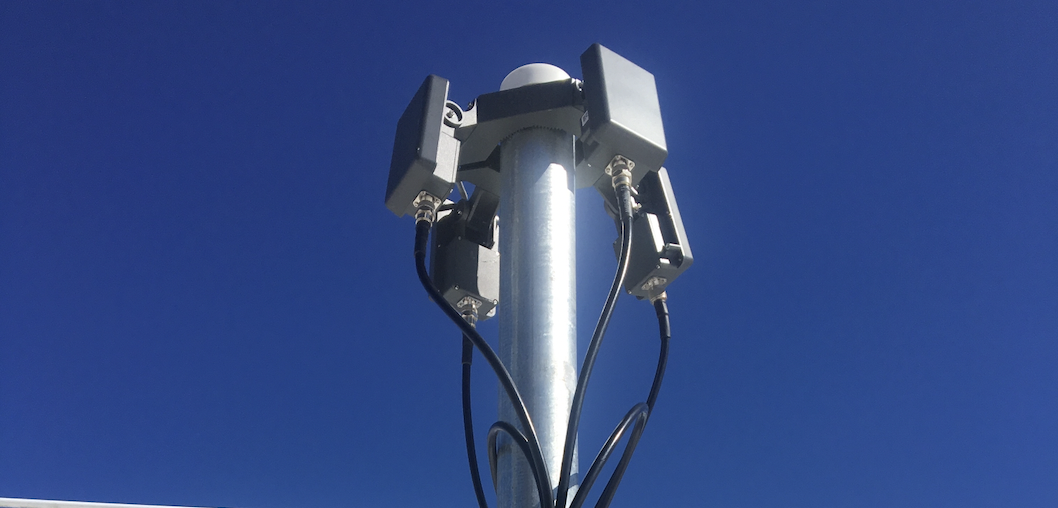
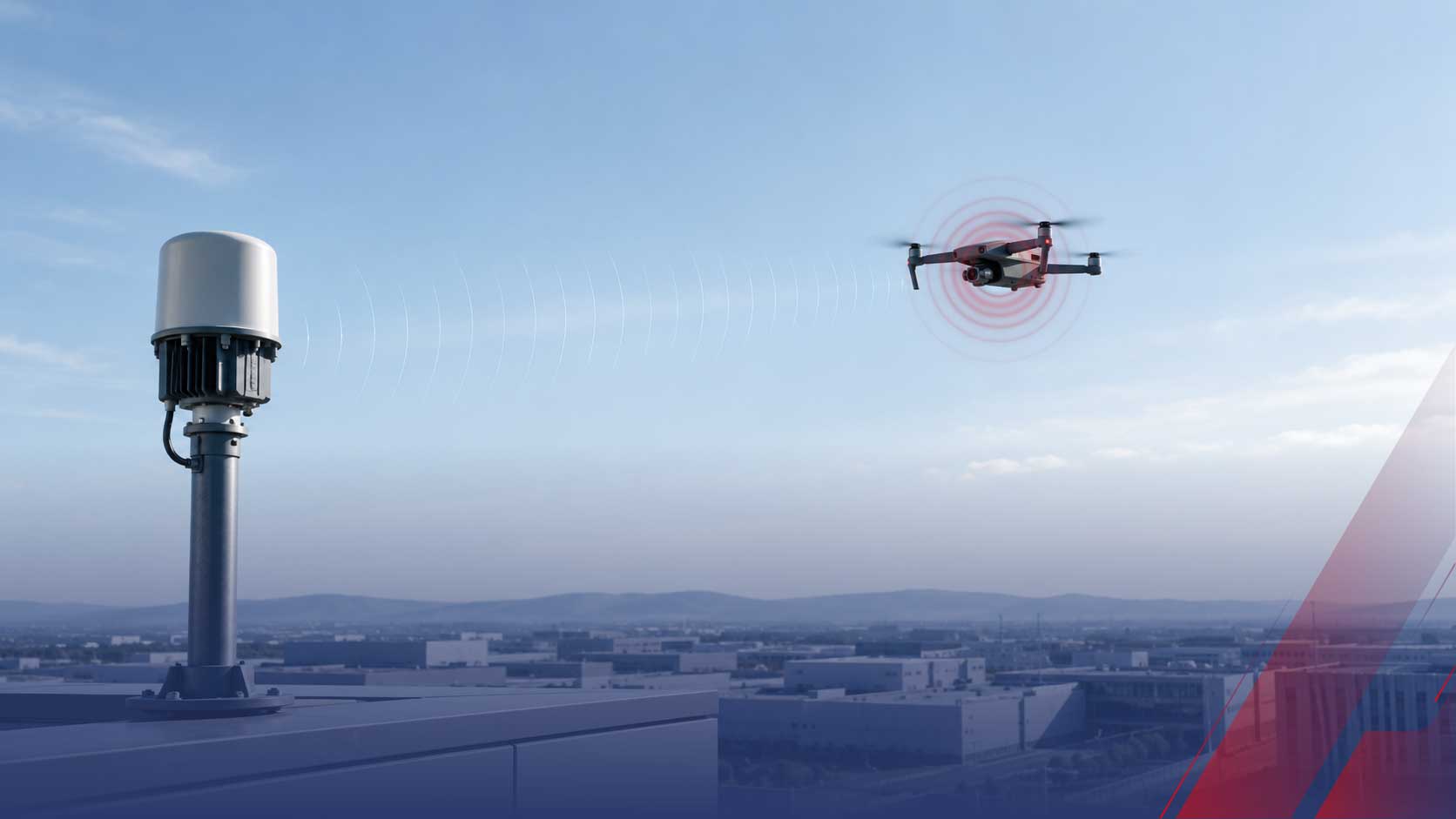
RF drone detection is the practice of finding drones by listening for their radio emissions: the command link between the aircraft and its controller, its video downlink, and its Remote ID broadcast. Among every sensor in the counter-drone toolkit, RF holds one capability nothing else offers: because the signal it hears has two ends, RF detection can locate not just the drone but the person flying it. Radar tracks an aircraft. A camera photographs it. Only RF points to the pilot standing in a parking lot three blocks away.
That is why RF sensors are the foundational layer of nearly every serious detection deployment, and why understanding how they actually work matters before buying anything. This guide covers the full mechanics: how a passive sensor turns radio noise into a drone's make and model, how direction finding and time-difference math produce a pilot location, the legal distinction between listening and decoding that most vendors skip, and the growing category of drones RF cannot hear at all. We build multi-sensor detection systems with RF at the base of the stack, so this is the plain-language version of how the listening layer earns its place.
What Is RF Drone Detection?
Nearly every consumer and commercial drone is a flying radio station. It maintains a command-and-control link with its remote, streams video back to the pilot, and, if compliant with FAA rules, broadcasts a Remote ID signal identifying itself. RF drone detection places passive receivers in and around a protected site to listen for those transmissions. Passive is the operative word: an RF sensor emits nothing, monitoring a wide spectrum from 433 MHz to 5.8 GHz in all directions simultaneously, which means it needs no spectrum license, creates no interference, and is lawful for any organization to operate.
The US Government Accountability Office identifies radio frequency and radar as the two most common drone detection technologies, and they divide the problem neatly between them: radar senses the drone as a physical object, RF senses it as a transmitter. The transmitter half is where identity lives, and identity is what turns an unknown blip into an actionable track.
From Radio Noise to Make and Model: How the Sensor Classifies
An RF detection system works through a defined sequence. It monitors the wideband spectrum for electromagnetic activity, scans for transmissions that match known drone communication patterns, then classifies the signal against a signature library to determine the drone's protocol and brand. Every drone family speaks a recognizable radio dialect: the frequency-hopping pattern of a DJI OcuSync link looks nothing like an Autel or Parrot protocol, and the library is what tells them apart. A good sensor does not just say something is transmitting. It says a DJI Mavic-class aircraft is operating northeast of the fence line.
The signature library is also the sensor's dependency. A drone speaking a protocol the library does not contain, a homebuilt aircraft on a novel waveform, a modified link, is harder to classify and may register only as an unidentified emitter. This is why library depth and update cadence are real evaluation criteria when comparing RF detection systems, and why the honest vendors publish what their libraries cover.
Finding the Pilot: Direction Finding and TDOA
Detection tells you a drone is present. Localization tells you where, and RF has two established methods. The first is direction finding, or angle of arrival: a directional sensor measures the bearing a signal arrives from, giving a single sensor a pointing vector toward the target, and multiple direction-finding sensors placed around a site triangulate those bearings into a position. Our directional DF sensors work exactly this way, adding a precise vector to the drone on top of standard RF identification. The second is time difference of arrival, or TDOA: several time-synchronized sensors record the same transmission, and the tiny differences in when the signal reaches each sensor are converted into hyperbolic position math that fixes the transmitter's location. Public safety agencies use exactly this approach, with multiple networked receivers providing real-time geolocation through triangulation before a drone reaches restricted airspace.
Here is the payoff that justifies the entire RF layer: the same math that locates the drone locates its controller, because the controller is transmitting too. A security team that knows the pilot's position can dispatch officers to a person, not chase an aircraft. In contraband-delivery scenarios at correctional facilities, the pilot location is the arrest. No other passive sensor produces it.
The Legal Nuance Most Vendors Skip: Listening Versus Decoding
Not all RF detection is legally equal, and buyers should understand the distinction. Some systems classify drones by decoding the content of the control link, extracting telemetry like GPS coordinates from inside the transmission. Reading the content of a private radio communication raises federal wiretap concerns in the United States: the joint DOJ, FAA, DHS, and FCC interagency advisory on UAS detection technology explicitly warns that systems which access or intercept drone communications may implicate federal criminal surveillance statutes. Localization by angle of arrival or TDOA sidesteps the problem entirely: it measures where a signal comes from without ever reading what it says, which keeps it lawful, and it cannot be defeated by encryption, because there is nothing to decrypt when you are only timing the signal's arrival.
Remote ID is the clean exception: it is a public broadcast that federal rule requires drones to transmit precisely so it can be received, a digital license plate carrying the drone's identity and the operator's live location, readable without touching any private link. A well-architected RF layer combines the two cleanly: Remote ID reception for compliant drones, and pattern-based signal identification with AoA or TDOA localization for everything else. What it should not depend on is content decoding, both because of the legal exposure and because encryption is steadily closing that door anyway.
What RF Detection Cannot Hear
RF detection has one absolute boundary, and it is the most important sentence in this guide: a sensor that listens cannot detect a drone that is not transmitting. Three categories of aircraft fall into that silence. Autonomous drones flying pre-programmed waypoint routes with no live link. Drones whose operators deliberately cut or minimize emissions. And fiber-optic drones, now fielded in more than 80 models, whose control signal travels inside a physical cable that no RF sensor can hear and no jammer can touch.
Beyond outright silence, real-world RF performance degrades at the margins: very low-power links, intermittent transmissions, novel proprietary waveforms outside the signature library, and dense urban RF noise all reduce detection confidence. None of this makes RF optional. It makes RF one layer, with its blind spot covered by the sensor that needs no emissions at all: radar, which detects the physical airframe regardless of what it transmits.
RF First, RF Plus: Where the Listening Layer Fits
For most facilities, RF is the right first sensor: it is passive, license-free, affordable relative to radar, and it answers the questions early deployments ask most, what drones are operating here, how often, and flown by whom. The everyday threat, a consumer drone with a standard control link and Remote ID, is exactly what RF hears best. A complete drone detection system then grows around that base: radar to catch the silent aircraft, cameras for visual confirmation, and a command-and-control platform that fuses every sensor's track into one picture.
The layering is not vendor upsell. It is the documented consensus of the counter-drone field, reflected in GAO's caution that individual detection technologies have limited ability against small UAS and generate false detections that fusion resolves. RF tells you who. Radar tells you where, always. Cameras tell you what. Our guide to how drone detectors work compares all four sensor families in depth.
Deploying RF Detection: What Buyers Should Know
Four practical points for anyone specifying an RF layer:
-
It is legal everywhere, for everyone. Passive RF detection requires no certification, no spectrum license, and no special authority. Under the SAFER SKIES framework, detection is the tier open to all, and for agencies pursuing mitigation authority, the RF detection record is the credible-threat evidence that authority runs on.
-
Expect miles of range, not feet. Typical performance runs 2 to 3 miles for Remote ID reception and 3 to 5 miles for RF and direction-finding sensors, omnidirectional, though terrain and RF congestion shape real coverage. A site survey, not a datasheet, sets expectations.
-
Localization needs geometry. One sensor gives presence and, if directional, a bearing. Pilot-location precision comes from multiple sensors placed with deliberate geometry around the protected area. Budget for the array, not the single box.
-
It is fundable. Detection equipment, including RF sensors, qualifies at 100 percent federal cost share under the FEMA Counter-UAS Grant Program for eligible public agencies.
The Sensor That Hears Intent
RF drone detection earns its place at the base of the stack because it answers the question every incident ultimately turns on: who is flying. A radar track is anonymous. An RF detection carries a make, a model, a protocol, and, with direction finding or TDOA, a pilot standing at a set of coordinates. That is the difference between watching a drone and building a case against its operator.
We believe the right way to buy RF detection is with clear eyes about both halves of its nature: it is the identity layer nothing else replaces, and it is deaf to the silent aircraft that radar exists to catch. Deploy it first, deploy it honestly, and fuse it with the sensors that cover its blind spot. That is how the listening layer becomes the foundation of complete airspace awareness, covered end to end in our complete guide to detecting drones.
Want to know which drones, and whose, are operating over your facility? Talk to our team about an RF detection site survey.
Related reading: