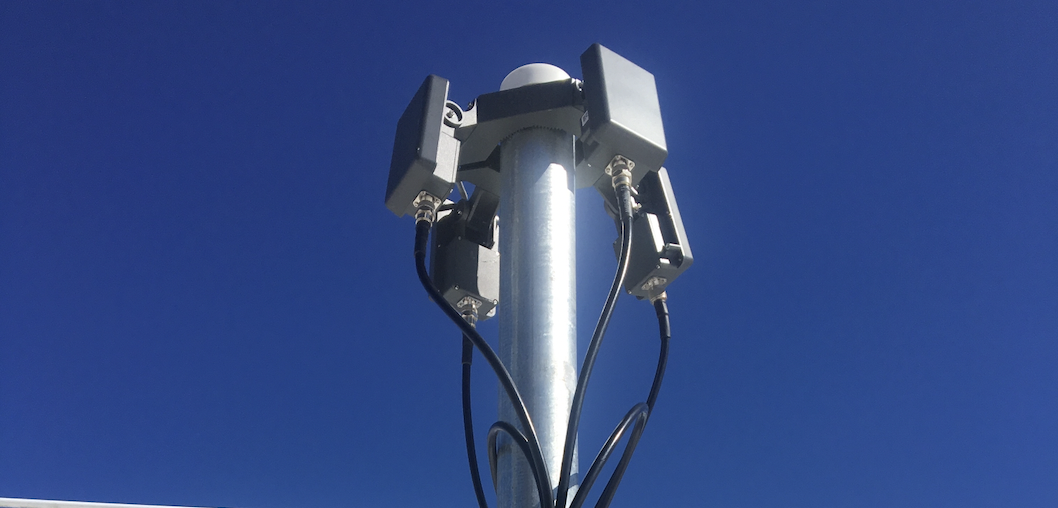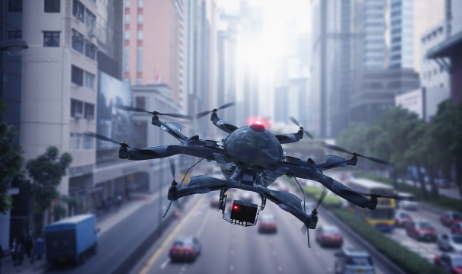
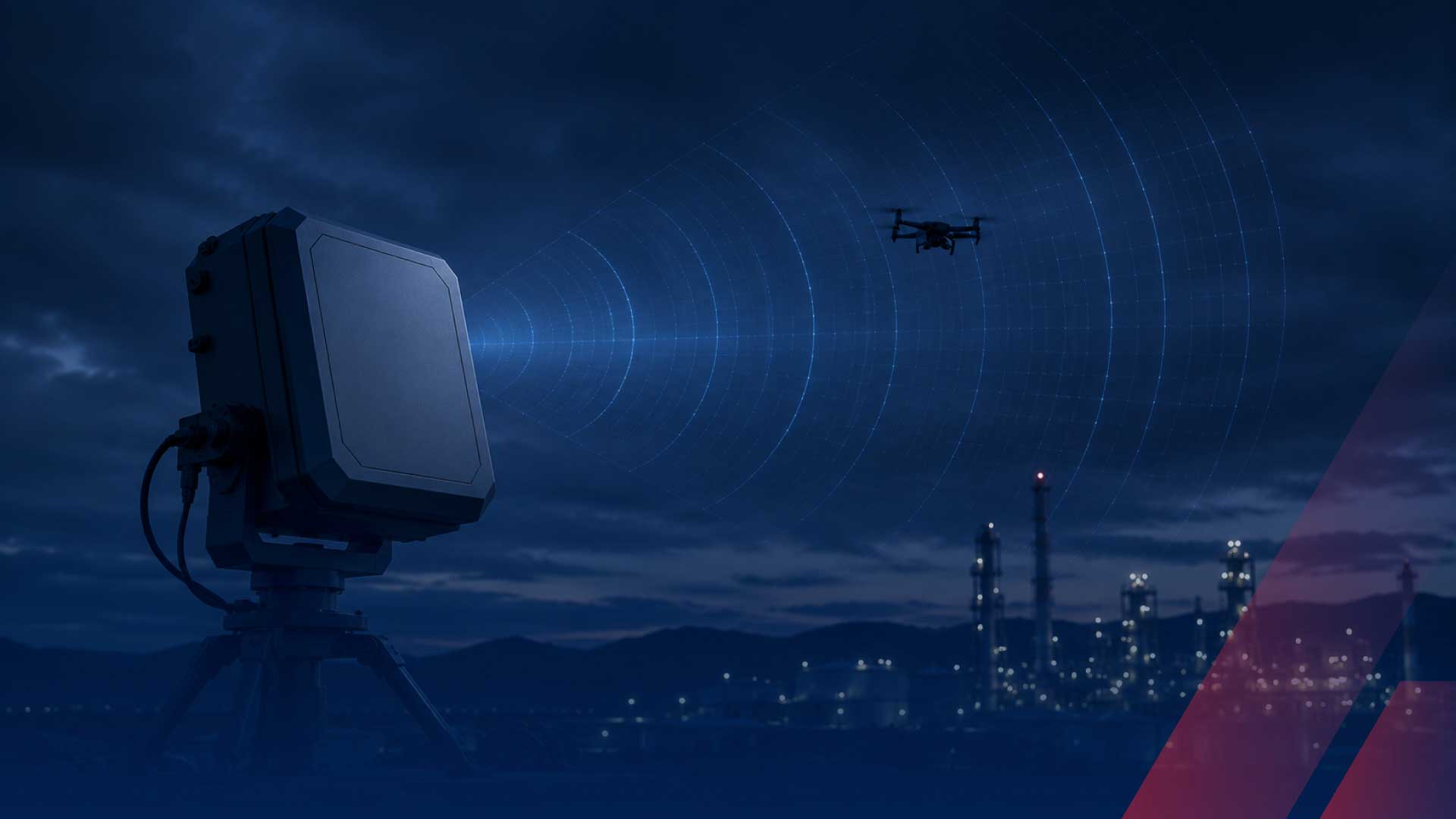
UAV radar detection is the use of radar to find, track, and classify unmanned aerial vehicles, and it is the detection method that carried over from the battlefield to protect domestic critical infrastructure. The threat drove that transfer. Modern attack UAVs are engineered to defeat radar: they fly low to hide in ground clutter, and small fixed-wing types can present a radar cross-section as low as 0.07 square meters, roughly the size of a large bird and well below the detection floor of systems built for conventional aircraft. Detecting a target that small, that low, and often that quiet is a military-grade problem, and the radar built to solve it is now securing airports, energy sites, and government facilities.
This guide covers UAV radar detection from the defense perspective: how the military classifies the UAV threat, why small UAVs demand purpose-built radar, the systems fielded to counter them, and how that capability has migrated to critical infrastructure protection. It is written for the security directors, program managers, and procurement teams who evaluate these systems, and it draws the same conclusion the defense community has reached: radar is essential, but only as part of a fused, multi-sensor architecture. We build multi-sensor detection systems on that principle.
Understanding the UAV Threat: DoD Group Classification
The US Department of Defense classifies unmanned aircraft into five groups by weight, speed, and altitude, and the distinction matters for radar because detection difficulty scales inversely with size. Under DoD policy, and as summarized by the Congressional Research Service, a small UAS is defined as a Group 1, 2, or 3 aircraft weighing up to 1,320 pounds, with the Army designated as the executive agent for countering them. Group 1 covers the smallest drones, generally under 20 pounds, which includes the vast majority of commercial quadcopters that threaten civilian sites.
This classification frames the entire detection challenge. A Group 3 UAV is a substantial aircraft that most radar can see. A Group 1 micro-drone is the hardest target in the airspace, and it is also the one most likely to appear over a stadium, a substation, or a prison. Congress has specifically pressed the Pentagon on whether counter-UAS systems are tested against operationally realistic targets rather than larger, easier surrogates, and on whether they can handle drone swarms. The same questions apply to any radar a civilian operator evaluates: can it detect the small end of the threat, under real conditions, at the scale an incident might present?
Why UAV Radar Detection Is a Military-Grade Problem
Small UAVs are difficult radar targets for reasons that defense engineers have spent years working against. Their radar cross-section is tiny, comparable to a bird, which puts them below the detection threshold of radar designed for aircraft. They fly low and slow, blending into the clutter of terrain and structures. And adversaries fly them low deliberately: attack drones like the Shahed family are flown at low altitude specifically to defeat radar coverage.
Defense-grade UAV radar detection is evaluated by a hard standard. As one defense-grade analysis puts it, military, government, and critical-infrastructure customers judge these systems not by laboratory performance but by how they behave under real operational conditions: cluttered environments, electromagnetic interference, low-altitude threats, and evolving tactics. A radar that detects a cooperative test drone on an open range in clear weather has proven very little. The bar is detection of a Group 1 UAV in a real, cluttered, contested environment.
How Military UAV Radar Detection Works
Defense-grade radar overcomes the small-UAV problem through a combination of techniques that also define the best commercial systems. It applies Doppler processing, micro-motion analysis, and adaptive clutter suppression to pull a tiny, slow target out of the background. Micro-Doppler analysis, which reads the frequency signature of a UAV's spinning rotor blades, allows the radar to detect and classify a drone that a conventional system would discard. For the full mechanics, see our guide to drone detection radar.
The defense community is also clear that radar does not work alone. The governing principle of defense-grade architecture is concise: radar sees the object, RF explains the intent, and fusion creates confidence. Radar detects and tracks the physical UAV, including autonomous and non-emitting types that RF cannot hear. RF monitoring adds identity and intent for cooperative drones. Multi-sensor fusion is treated as mandatory, not optional, because no single sensor produces a confident, actionable picture on its own. This is the same conclusion reached in our guide to how drone detectors work.
Fielded Military UAV Radar Systems
A generation of UAV radar detection systems has been proven in military service and combat. Active electronically scanned array radars using gallium nitride technology now provide hemispheric coverage and track hundreds of simultaneous targets with update rates fast enough for engagement-quality tracking. Purpose-built staring radars track more than 100 targets at once while distinguishing drones from birds. Defense primes have made this a competitive field: Leonardo DRS, for example, fields systems that detect, identify, track, and defeat Group 1 to 3 UAS and won first place in a DoD counter-UAS competition.
The Ukraine conflict has provided combat validation at scale. A notable design philosophy that emerged there is classification-focused: some fielded radars accept reduced raw detection range in exchange for higher-confidence identification of DJI-class drones at 2 to 2.2 kilometers, which reduces the false-alarm burden on operators. That trade, favoring confident classification over maximum range, is exactly the lesson civilian critical-infrastructure operators need, because a radar that floods a control room with false alarms is a liability regardless of its detection range.
The Migration from Battlefield to Critical Infrastructure
The most important development in UAV radar detection is that it has come home. Below the military-grade tier, a growing ecosystem of commercial counter-UAS radars now serves critical infrastructure protection, airport security, and event security. The threat migrated first: the same low-flying UAVs that targeted energy infrastructure in overseas conflicts defined the threat that domestic operators now face.
Federal policy has accelerated the transfer. The Pentagon's JIATF-401 task force is building a centralized marketplace, standardized testing, and faster procurement that give vendors a more direct route to defense and interagency buyers, which pulls proven military capability toward broader deployment. On the civilian side, the Department of Homeland Security committed $115 million in counter-drone investment for the 2026 FIFA World Cup and America250 celebrations. The capability that was once exclusive to military installations is now the standard for protecting high-value civilian sites. For more on that lineage, see our guide to military drone detection.
UAV Radar Detection for Critical Infrastructure
For critical infrastructure operators, the UAV threat is concrete. In one documented case, federal investigators found a modified commercial drone near a Pennsylvania electrical substation that had been stripped of identifying components and rigged to short-circuit high-voltage equipment. A federal bulletin called it a clear proof-of-concept that inexpensive commercial drones can be weaponized for sabotage.
A drone modified this way, stripped of Remote ID and potentially flown autonomously, is precisely the target that RF detection can miss and radar can catch, because radar senses the airframe regardless of emissions. Modern fusion platforms combine radar with RF and cameras, using techniques such as Kalman filtering for trajectory prediction to reduce false positives to operationally manageable levels. For critical infrastructure sites and airports, radar built for Group 1 UAVs, layered with other sensors, is now the baseline for airspace security.
What UAV Radar Detection Cannot Do Alone
The defense community's hardest-won lesson is the one civilian buyers should internalize: radar is necessary but never sufficient by itself. Radar detects and tracks a UAV and, with micro-Doppler, classifies it, but it cannot read a serial number, determine the specific model, or locate the operator, because that information is not in a radar return. Defense-grade doctrine holds that systems never rely on radar alone, and never rely on RF alone, because fusion is what creates confidence.
This is why a complete drone detection system fuses radar with RF detection, Remote ID, and cameras into a single operating picture. Radar finds the UAV including the silent ones, RF and Remote ID identify the cooperative ones and locate operators, and cameras confirm the target visually. A command-and-control platform merges them so an operator sees one confident track rather than competing sensor feeds. The full approach is covered in our complete guide to detecting drones and our overview of counter-unmanned aircraft systems.
Procurement and Funding for UAV Radar Detection
For government and critical-infrastructure buyers, funding pathways for UAV radar detection are well established. The FEMA Counter-UAS Grant Program covers detection equipment, including radar, at 100 percent federal funding for eligible state and local agencies. Federal and defense buyers increasingly procure through the JIATF-401 marketplace and its standardized testing framework. And event-security funding, like the DHS World Cup investment, flows to venue and infrastructure protection.
The procurement guidance follows from everything above. Specify radar purpose-built for Group 1 small UAVs, not a repurposed air-traffic or general-surveillance system. Require evaluation under realistic conditions rather than open-range demonstrations. Insist on multi-sensor fusion rather than a radar-only solution. And demand a site survey, because terrain, clutter, and the local threat profile determine real-world coverage. Our counter-drone vendor landscape maps the companies building these systems.
The Legal Line
For UAV radar detection, the legal position is favorable. Using radar to detect, track, and classify UAVs is lawful for any organization in the United States. Active mitigation, defeating a UAV by jamming, spoofing, or kinetic means, is restricted under federal law to the Departments of Defense, Energy, Justice, and Homeland Security, with narrow authorities extended to certain law enforcement agencies under the SAFER SKIES Act. For nearly every critical-infrastructure operator, radar detection integrated with coordinated law enforcement response is both the lawful posture and the effective one.
Military-Grade Detection, Now Protecting Home
UAV radar detection began as a battlefield necessity, forced by attack drones engineered to slip beneath conventional radar. The technology that answered that challenge, purpose-built radar for low, slow, small targets, is now the standard for protecting the airports, energy sites, and government facilities that face the same threat at home. The DoD classifies the small-UAV problem, defense primes have fielded the systems, combat has validated them, and federal policy is accelerating their spread to civilian critical infrastructure.
We believe the critical-infrastructure operators who get airspace security right adopt the defense community's discipline: radar built for the real Group 1 threat, evaluated under real conditions, and fused with RF and cameras into one confident picture. Radar sees the object. Fusion makes it actionable. That is the architecture that protects a forward operating base, and it is the architecture that protects a substation.
Evaluating UAV radar detection for a critical-infrastructure or government site? Talk to our team about a site survey and a fused multi-sensor design.
Related reading: