A complete counter-UAS system is built from four layers: a sensor layer that detects and tracks drones, a fusion and command layer that turns sensor data into one operating picture, a response layer that converts detections into action, and a compliance layer that records everything defensibly. Most systems marketed as counter-UAS include only the first layer and part of the second. The gap between a sensor purchase and a complete C-UAS stack is where programs quietly fail, usually eighteen months after installation, when an incident demands the layers nobody specified.
This guide walks the full stack layer by layer: what belongs in each, what it does operationally, where the new federal rules reach into the architecture, and how to tell a complete system from a partial one before signing anything. It is the systems-level companion to our complete counter-UAS guide, written for the people who have moved past what the category is and need to know what to actually build.
Layer 1: The Sensor Layer
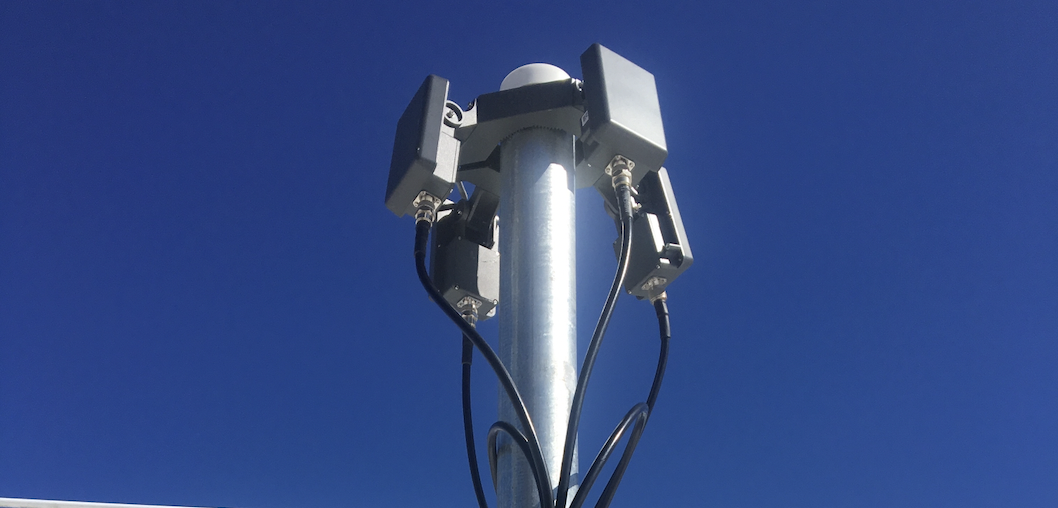
The foundation is the hardware that perceives the airspace, and the US Government Accountability Office identifies radio frequency and radar as the two most common detection technologies, with cameras and acoustics in supporting roles. Each sensor contributes something the others cannot: RF sensors identify a drone's make and model from its signals and locate its pilot, radar tracks the physical airframe even when the drone transmits nothing, and cameras produce the visual confirmation and evidence a case runs on.
The design question at this layer is never which sensor is best. It is which combination covers your threat profile at your site, which is why serious deployments start with a survey rather than a datasheet, and why an RF-only quote, however attractive its price, leaves the system blind to the growing category of autonomous and fiber-optic aircraft that emit nothing at all. The full sensor comparison is in our drone detection technology guide.
Layer 2: The Fusion and Command Layer
Raw sensor feeds are not a capability. Three sensors watching the same drone produce three separate tracks with different update rates, coordinate frames, and error characteristics, and an operator staring at three competing alarms trusts none of them. The fusion layer correlates every feed into a single confident track per aircraft, classifies it, filters the birds and the compliant traffic, and presents one picture a human can act on in seconds.
This layer is where false-alarm rates are actually decided, and false-alarm rate is the metric that determines whether a system is still being used a year after installation. It is also where multi-site programs live or die: a corrections department or airport group running one command view across many facilities is operating a system, while one running separate screens per site is operating a collection of sensors. Our walkthrough of how a drone detection system works covers this architecture end to end, and it is the layer where AirGuard does its work.
Layer 3: The Response Layer
A detection that reaches nobody is a log entry. The response layer is the workflow that converts a confirmed track into action: alert routing that reaches a named person on a device at 3 a.m., escalation when the first contact does not answer, zone-based priorities so a perimeter transit logs quietly while an approach to a critical asset escalates loudly, and a defined handoff to law enforcement with the track data attached. None of this is hardware, all of it must be designed before the first incident, and our guide to drone monitoring programs covers building it.
For certified public agencies, this layer now extends into mitigation, and the architecture is regulated in detail. Under the DOJ and DHS rule that took effect July 1, 2026, agencies may deploy only equipment on the federal Authorized Technologies and Authorized Systems Lists, mitigation actions require Tier 2 certification through the FBI's training center, radio-emitting systems need FCC authorization on top of DOJ and DHS requirements, and every mitigation action triggers reporting obligations. The stack implication is direct: the mitigation layer must sit on a detection layer capable of producing the credible-threat determination the authority legally requires. Our drone mitigation guide covers the certification path.
Layer 4: The Compliance and Records Layer
The least marketed layer is the one that decides whether anything the system saw can be used. A complete stack retains every track with timestamps and sensor attribution, exports incident reports a prosecutor or FAA investigator can work from, and accumulates the pattern record, incursion frequency, timing, approach corridors, repeat aircraft, that justifies budgets, supports FAA flight-restriction petitions for critical infrastructure, and anchors grant applications. For certified agencies the records layer is not optional at all: the federal framework's reporting, oversight, and privacy requirements assume the system underneath can document what happened, when, and on whose authority.
There is a quieter argument for this layer too. The joint federal advisory on UAS detection technology cautions that systems intercepting the content of drone communications can implicate federal surveillance statutes, which makes the lawfulness of your identification method itself a compliance property of the stack. A records layer built on passive pattern analysis and Remote ID reception documents cleanly. One built on content decoding documents a problem.
Complete Versus Partial: How to Tell Before You Buy
Five questions expose where a proposed system sits on the completeness spectrum:
-
1. What happens against a drone that transmits nothing? If the answer depends entirely on RF, the sensor layer is partial.
-
2. How many tracks does an operator see for one drone? If each sensor has its own screen, there is no fusion layer, whatever the brochure says.
-
3. Who receives the 3 a.m. alert, on what device, with what escalation? No named answer means no response layer.
-
4. Show me an exported incident report. If the system cannot produce one on demand in the demo, the records layer is a roadmap item, not a feature.
-
5. Which of these costs are in the quote? Installation, integration, calibration, training, licensing, and support typically add 30 to 60 percent to hardware, and a quote that omits them is describing a partial program at a complete-looking price.
Building the Stack in the Right Order
Complete does not mean everything on day one. The stack builds in sequence: survey the site, deploy the sensor and fusion layers scaled to the documented threat, stand up the response workflow before the first incident rather than during it, and let the records layer accumulate the evidence that justifies each expansion. Public agencies get a funding tailwind for exactly this sequence: the FEMA Counter-UAS Grant Program's $250 million FY 2027 round funds detection capability for all 56 states and territories with no cost share requirement, and its published performance measures, 90 percent classification, investigations on every violation, reward precisely the fusion and records layers partial systems skip.
A Stack, Not a Box
A counter-UAS system is four layers doing four jobs: sensors that perceive, fusion that decides, response that acts, and records that prove. Buy them as a stack and each layer multiplies the others. Buy a box and you own a very expensive way to generate unread log entries.
We believe the completeness questions above belong in every evaluation, including evaluations of us, because the failure mode in this category is not choosing the wrong vendor. It is specifying half a system and discovering the missing half during an incident. Start with the full stack on paper, build it in the order the evidence justifies, and the program will still be working, and still being used, five years in. The practical walkthrough is in our complete guide to detecting drones.
Want to see what a complete four-layer stack looks like scoped to your site? Talk to our team about a survey and system design.
Related reading: