Anti-drone systems come in two families and eight types. The detection family, radio frequency sensors, radar, cameras, and acoustic sensors, finds, tracks, and identifies drones and is lawful for any organization in the United States. The mitigation family, jamming, navigation takeover, physical capture, and interceptor drones, stops them and is lawful only for four federal departments and a small set of state and local agencies certified under rules that took effect this summer. Nearly every bad purchase in this market comes from confusing the two families or buying a type built for a threat the buyer does not actually face.
This guide covers each type: how it works, what it catches, what it misses, and who may legally operate it. It closes with a decision guide by facility, because the right anti-drone system for a correctional facility is not the right one for an airport, and neither is the right one for a police department pursuing certification. The category-level view is in our complete counter-UAS guide; this is the systems-level map.
Detection Systems: The Four Types Anyone Can Operate
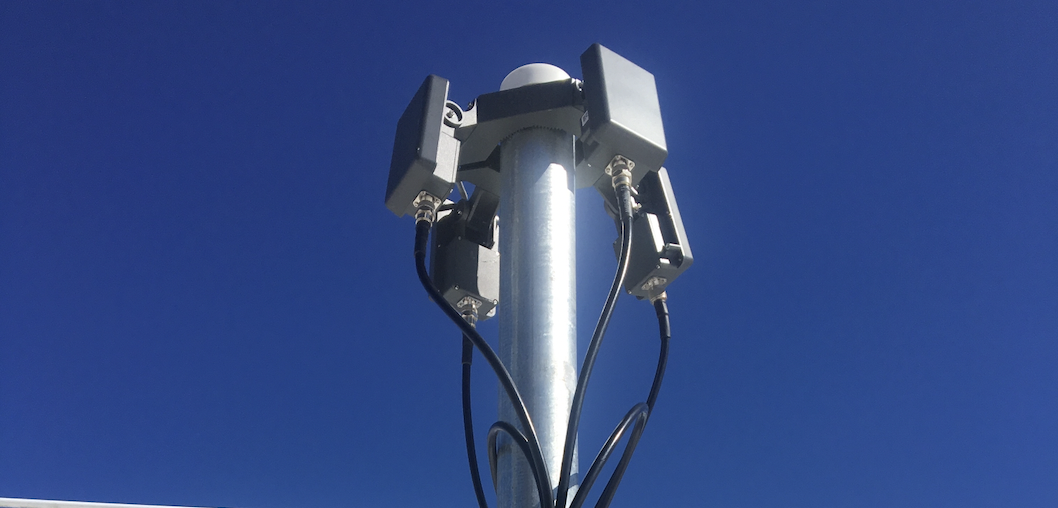
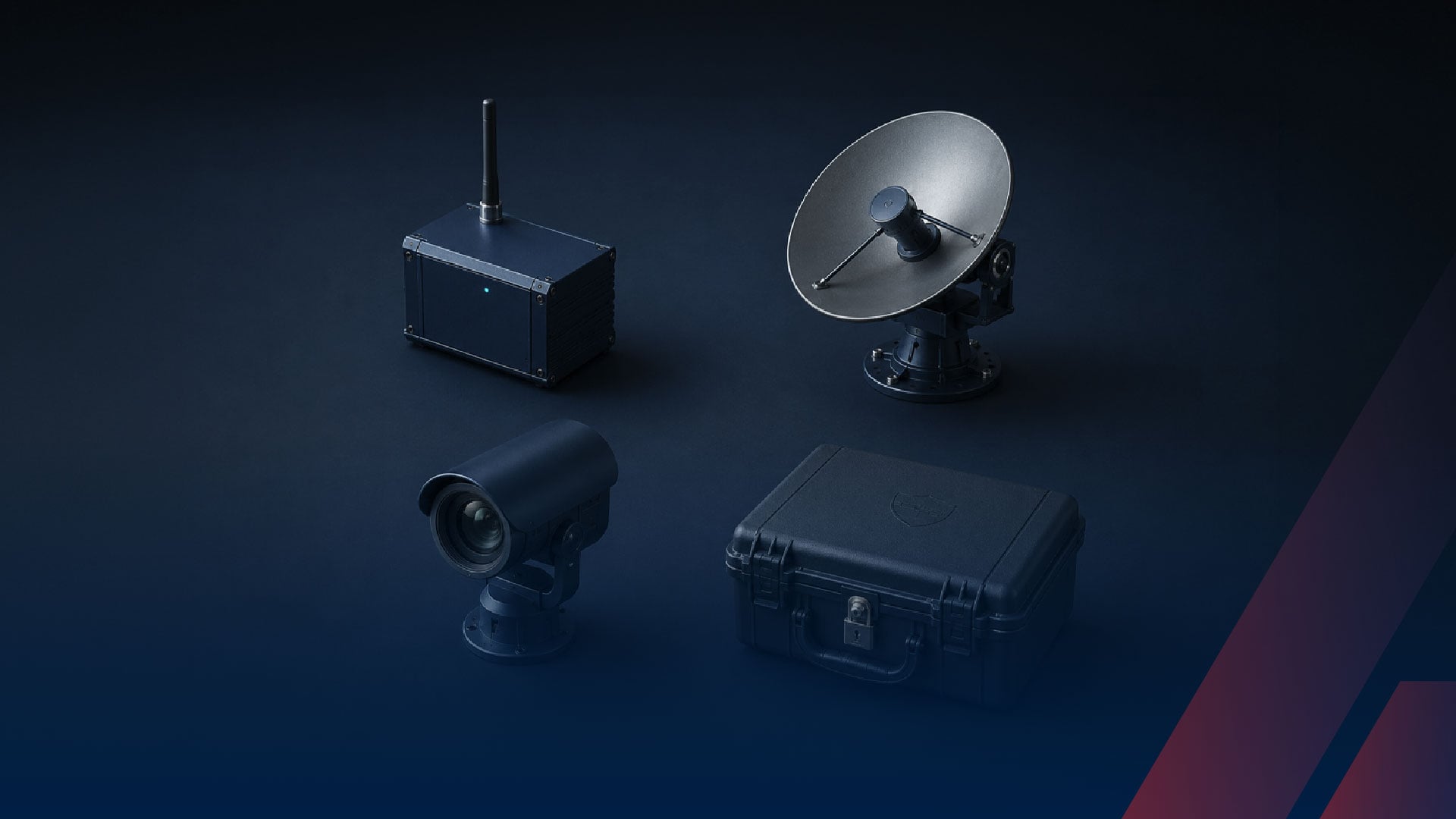
Radio frequency detection. Passive receivers listen across the 433 MHz to 5.8 GHz spectrum for a drone's control link, video feed, and Remote ID broadcast, match the signal against a library of known drone protocols to identify make and model, and, with direction-finding across multiple sensors, locate the pilot. Catches: the majority of commercial and consumer drones, with identity attached. Misses: any drone that transmits nothing. The most common type in civilian deployments, and the only one that finds the operator. Full mechanics in our RF drone detection guide.
Radar. Active sensing: the system transmits radio energy and reads the reflection off the airframe, using micro-Doppler signatures from spinning rotors to separate drones from birds. Catches: the physical aircraft regardless of what it transmits, which makes radar the only detection type that sees autonomous and fiber-optic drones, now fielded in more than 80 models. Misses: identity and pilot location. Radar requires standard spectrum licensing but no special counter-drone authority. Details in our drone detection radar guide.
Cameras. Electro-optical and infrared cameras confirm a detection visually, identify payloads, and produce the evidence a prosecution runs on. Catches: proof. Misses: everything it is not already pointed at, which is why cameras are cued by RF or radar rather than searching the sky alone.
Acoustic sensors. Microphone arrays recognize rotor sound signatures. Catches: drones at short range in quiet environments. Misses: nearly everything in urban or industrial noise, and anything beyond a few hundred meters. A niche type, useful as a supplementary layer at specific perimeter points.
The US Government Accountability Office identifies RF and radar as the two most common detection technologies, and the reason serious deployments combine them is visible in the catches-and-misses above: each type's blind spot is another type's strength. The software that fuses them into one picture is covered in our guide to drone detection technology.
Mitigation Systems: The Four Types Almost Nobody May Operate
Jamming. Transmits noise on the drone's control and navigation frequencies, forcing it to land, hover, or return home. The most marketed mitigation type, sold as handheld guns and fixed installations. Fails entirely against drones with no radio link.
Navigation spoofing and takeover. Feeds the drone false positioning data or exploits its control protocol to redirect or land it. More surgical than jamming, protocol-dependent, and useless against aircraft that ignore external signals.
Physical capture. Net launchers and net-carrying interceptor drones that entangle the target. Effective against single small drones at close range, and the only mitigation type that works against silent aircraft, because it does not depend on the target's electronics.
Kinetic and directed-energy defeat. Projectiles, high-power microwave, and lasers that disable or destroy the aircraft. Military-grade, expensive, and carrying obvious risks over populated areas.
The Legality Line: Who May Operate What
All four detection types are lawful for any organization, with one caveat the joint federal advisory on detection technology makes explicit: detecting and locating a drone's signals is lawful, but decoding the content of its communications can implicate federal surveillance statutes. Buyers should know which side of that line a system sits on before purchase.
All four mitigation types are restricted. For private organizations, jamming carries FCC penalties up to $112,500 per act and physical destruction of a drone is destroying an aircraft under federal law, as our guides to anti-drone guns and shooting down drones detail. Lawful mitigation authority belongs to the Departments of Defense, Energy, Justice, and Homeland Security, and, since the federal rule effective July 1, 2026, to state, local, Tribal, and territorial law enforcement and correctional agencies certified at Tier 2 through the FBI's National Counter-UAS Training Center. Even then, only equipment on the federal Authorized Technologies and Systems Lists may be deployed, emitting systems need FCC authorization, and every action requires a credible-threat determination built from detection evidence. The certification path is in our drone mitigation guide.
The practical translation: for roughly 99 percent of organizations reading this, an anti-drone system means a detection system, and the mitigation family is a category to understand rather than shop.
Which Anti-Drone System Do You Need?
-
Correctional facilities: RF detection with pilot location first, because the contraband mission is won at the operator, not the aircraft; radar added as fiber-optic contraband drones spread. Corrections agencies are also first in line for Tier 1 certification. See our prison drone detection page.
-
Airports: radar-led detection fused with RF, because the decision that matters is whether an aircraft is where it should not be, and that decision needs a positional track regardless of what the drone transmits. Cameras for confirmation before operational holds.
-
Stadiums and event venues: RF plus cameras during events, with temporary flight restrictions as the legal layer and a rehearsed law enforcement handoff. Detection windows are short and crowds make every false alarm expensive.
-
Critical infrastructure: radar and RF with a records layer built for evidence, because the strategic goal is the Section 2209 flight-restriction petition, and petitions are won on documented incursions.
-
Police departments: detection first even when the ambition is mitigation, because Tier 2 authority is exercised on credible threats established by the detection layer. Roughly 1,500 agencies are expected at Tier 1 within two years and only about 150 at Tier 2; the detection system is the program, and certification sits on top of it.
The Three Purchases That Go Wrong
Buying mitigation without authority. A private facility with a jammer owns a federal violation, not a capability. Buying RF alone against a silent threat. The drones designed to evade detection are exactly the ones a single-type system cannot see. Buying sensors without the rest of the system. Fusion, an alert workflow that reaches a person at 3 a.m., and exportable records are what make sensors a system, and they add 30 to 60 percent to hardware cost whether or not the first quote shows them. What a complete stack includes is in our guide to counter-UAS systems.
Two Families, One Decision
Every anti-drone system on the market is one of eight types in two families, and the first question is never which vendor. It is which family the law allows you to operate, which types your actual threat requires, and whether what you are buying is a system or a sensor. Answer those three and the vendor conversation gets short.
We build detection systems, and we say plainly that detection is the whole lawful mission for most organizations and the prerequisite for the rest. The practical walkthrough of deploying one is in our complete guide to detecting drones, and the AirGuard platform is how we fuse RF, radar, and camera types into one operating picture with the pilot's location attached.
Not sure which types your facility needs? Book a site survey and we will map the threat, the terrain, and the lawful options before anyone quotes a number.
Related reading: