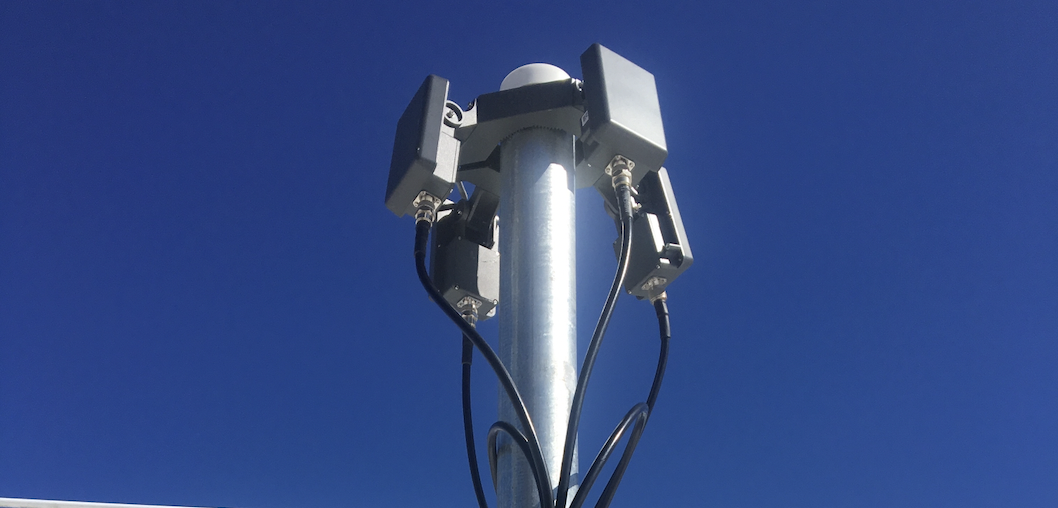

Drone monitoring is the continuous, ongoing observation of an airspace rather than the one-time act of detecting an aircraft. A detection system tells you a drone appeared. A monitoring program tells you your airspace had 47 incursions last quarter, 60 percent of them between one and four in the morning, three of them from the same aircraft, all approaching from the same direction. The first is an event. The second is intelligence, and only one of them changes decisions.
The gap between the two is almost never the sensors. It is everything around them: uptime, alert routing at three in the morning, who acts on an alarm, what gets recorded, and whether anyone reviews the accumulated data. This guide covers what continuous drone monitoring actually requires operationally, why most deployments fall short of it, and how to build a program that earns its budget. We build drone detection and monitoring systems, and the honest lesson from deploying them is that the hardware is the easy part.
Monitoring Versus Detection: An Ongoing Program, Not an Event
Detection is a capability. Monitoring is a practice. The distinction matters because facilities routinely buy the first and assume they have the second, then discover the difference during an incident.
A detection system installed and left alone produces alerts nobody routes, records nobody reviews, and coverage gaps nobody notices until an aircraft slips through one. A monitoring program treats the same equipment as an instrument that runs continuously, reports into a defined workflow, and produces analysis on a schedule. The sensors are identical. The outcomes are not remotely comparable, which is why drone tracking and detection technology decisions should always be made alongside the operational plan for using them.
What 24/7 Actually Means
Every vendor claims continuous coverage. The claim is only meaningful if four things are true, and buyers should ask about each one specifically.
-
Sensor uptime and redundancy. What happens when a sensor fails, loses network, or loses power? A system without failover has coverage gaps that appear exactly when someone is exploiting them. Ask about redundancy, backup power, and how outages are detected and alerted.
-
Overnight and weekend alert routing. Most drone incursions at correctional facilities happen at night. If alerts route to a dashboard nobody watches at 3 a.m., the system is monitoring nothing. Alerts need to reach a person on a device, with an escalation path when the first contact does not respond.
-
Defined response ownership. Who acts on an alert, and what are they authorized to do? Detection without an assigned responder produces logs, not security.
-
Continuous recording, not just alerting. A system that alarms but does not retain flight paths, timestamps, and sensor data cannot support the pattern analysis that makes monitoring valuable, or the evidentiary record that supports enforcement.
What Continuous Monitoring Produces That Detection Cannot
The payoff of running detection as a program rather than an installation is accumulated data, and it delivers three things a single detection never will.
Pattern intelligence. Incursion frequency, time-of-day clustering, approach corridors, and repeat aircraft signatures only emerge across weeks and months. That analysis tells a security team where to place the next sensor, when to staff differently, and whether activity is escalating.
Evidence that justifies budget. Security programs get renewed on demonstrated need. Documented incursion counts are the argument, and they are also increasingly a formal requirement: the FAA's proposed process for facilities to petition for drone flight restrictions over critical infrastructure asks applicants to demonstrate specific vulnerability, which is a monitoring record, not an anecdote.
The legal predicate for action. For agencies pursuing counter-drone authority under the SAFER SKIES framework, action is authorized against a credible threat, and establishing one requires documented data about what has been flying and how it behaved. Our guide to drone mitigation and authorization covers how that evidence requirement works in practice.
The Alert Fatigue Problem
The most common failure mode in drone monitoring is not missed detections. It is too many detections. A system that alarms on every passing bird, every Wi-Fi anomaly, and every compliant delivery drone trains its operators to dismiss alerts, and a dismissed alert is functionally identical to no alert at all. The GAO has specifically cautioned that detection technologies have limited ability against small UAS and that birds and electromagnetic interference generate false detections.
Three mechanisms keep the alarm rate survivable. Multi-sensor fusion resolves ambiguity by corroboration: a radar return that might be a bird becomes a confirmed drone when an RF sensor reports a matching protocol on the same bearing. Zone-based alerting assigns priority by geography, so a transit through the outer boundary is logged while an approach to a critical asset escalates. And classification filtering separates aircraft types, so a compliant drone broadcasting Remote ID on a known route does not generate the same response as an unidentified aircraft loitering at night. Our overview of drone detection technology covers how fusion produces that confidence.
Monitoring Coverage Has Gaps You Should Know About
Honest monitoring means knowing what your program does not see. Two gaps matter most.
The first is sensor blind spots. RF monitoring hears nothing from autonomous and fiber-optic drones that transmit no signal, and a monitoring program built on RF alone will report a quiet airspace that is not actually quiet. Radar covers that silence, which is why the sensor mix determines what your monitoring statistics actually mean.
The second is the boundary of the practice itself. Monitoring detects, tracks, identifies, and documents. It does not stop drones, and in the United States mitigation authority is restricted to four federal departments plus agencies certified under SAFER SKIES. For everyone else, the monitoring record is the deliverable: it identifies the aircraft, often locates the operator, and produces the case file that law enforcement and the FAA can act on.
Building a Drone Monitoring Program
Five steps that turn detection hardware into an actual monitoring practice:
-
1. Define the coverage requirement. Which assets, which approaches, and what altitude band? A site survey establishes real coverage against terrain and RF conditions rather than datasheet figures.
-
2. Choose the sensor mix for your threat. RF for identity and everyday consumer drones, radar where deliberate non-emitting incursions are plausible, cameras where evidence has to survive scrutiny. Critical infrastructure and correctional facilities typically need all three.
-
3. Design the alert workflow before installation. Who receives which alerts, on what device, at what hour, and what do they do next? Write it down and test it at 3 a.m., not during the first incident.
-
4. Set a review cadence. Monthly pattern review turns accumulated detections into intelligence. Without a scheduled review, the data accumulates and nobody learns anything from it.
-
5. Fund it correctly. Detection and monitoring equipment qualifies at 100 percent federal cost share under the FEMA Counter-UAS Grant Program for eligible public agencies.
Awareness Is a Practice, Not a Purchase
Drone monitoring is what happens after the sensors are installed: continuous uptime, alerts that reach a person who can act, records that accumulate into pattern intelligence, and a review cadence that turns that data into decisions. The facilities with effective airspace awareness are rarely the ones with the most expensive hardware. They are the ones that treated monitoring as an operational program instead of a procurement.
We believe the right question during evaluation is not which system detects the most drones, but what your organization will actually do at 3 a.m. when one appears, and whether anyone will read the report in ninety days. Answer those two questions first, and the sensor decisions become straightforward. The full practical walkthrough is in our complete guide to detecting drones.
Building a continuous drone monitoring program for your facility? Talk to our team about a site survey and an alert workflow designed for your operation.
Related reading: