
Counter-UAS, abbreviated C-UAS and sometimes written CUAS, is the set of technologies, procedures, and legal authorities used to defend airspace against unmanned aircraft systems. A complete counter-UAS capability spans four functions: detecting that a drone is present, tracking where it is and where it is going, identifying what it is and who is flying it, and, for the small number of organizations authorized to do so, mitigating it. The first three are legal for anyone in the United States. The fourth is tightly restricted by federal law, and that split defines everything about how counter-UAS actually works in practice.
This guide is the complete map of the category: what each function involves, which technologies perform them, who can lawfully do what as of the new federal rules that took effect this summer, what a program costs, how it gets funded, and how an organization actually starts. We build counter-UAS detection systems for airports, correctional facilities, and critical infrastructure, and this is the guide we wish every buyer had read before their first vendor call.
The Four Functions of Counter-UAS
Detect. Establish that a drone is operating in or near the protected airspace. This is the foundation function: nothing else in the stack can happen without it, and it runs continuously rather than on demand.
Track. Maintain a continuous position on the aircraft: altitude, heading, speed, and flight path over time. Tracking is what separates an isolated alert from an understanding of intent, because a drone transiting past a facility and a drone circling its fuel storage look identical as detections and completely different as tracks.
Identify. Determine the drone's make and model, distinguish it from birds and other aircraft, and, where the technology allows, locate the person flying it. Identification is what turns an airspace event into an actionable case.
Mitigate. Stop the drone: jam its control link, take over its navigation, capture it, or defeat it physically. This is the function most people picture when they hear counter-UAS, and it is the one almost nobody is legally permitted to perform.
C-UAS Detection Technologies: The Layer Open to Everyone
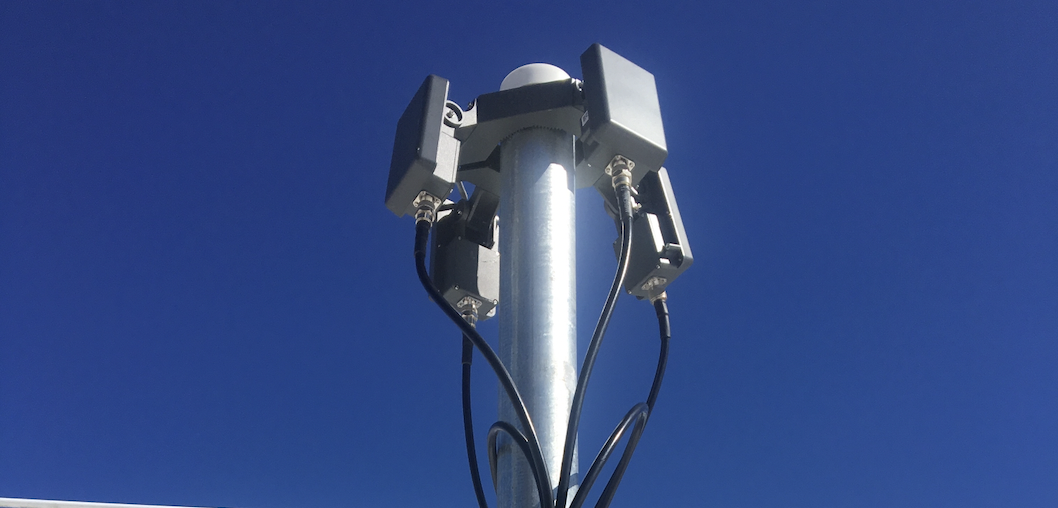
Four sensor families perform detection, tracking, and identification, and the US Government Accountability Office identifies radio frequency and radar as the two most common. Radio frequency sensors passively listen for a drone's control link, video feed, and Remote ID broadcast, identifying its make and model from the signal pattern and, with multiple sensors, locating its pilot, covered in depth in our guide to RF drone detection. Radar detects the physical airframe regardless of whether the drone transmits anything, which makes it the only sensor that finds autonomous and fiber-optic aircraft, explained in our drone detection radar guide. Cameras confirm visually and produce evidence. Acoustic sensors fill short-range niches.
No single sensor is sufficient, because each has a blind spot another covers, and the software that fuses them into one confident picture is as decisive as any sensor in the stack. Our guide to drone detection technology compares all four families and explains how fusion resolves their individual weaknesses, and our walkthrough of how a drone detection system works covers the full architecture from sensor to operator. The critical legal fact: passive detection requires no certification, no license, and no special authority. It is the counter-UAS layer open to every organization today.
C-UAS Mitigation Technologies: The Restricted Layer
Mitigation technologies divide into electronic and physical approaches. Electronic: jamming the control link to force a landing or return-to-home, spoofing navigation, or cyber-takeover of the aircraft. Physical: net capture, interceptor drones, and kinetic defeat. Under the new federal framework, agencies may only deploy technologies that appear on the government's Authorized Technologies and Authorized Systems Lists, maintained through the FBI, and systems that emit radio energy additionally require FCC authorization before operation.
For private organizations, the line is absolute: operating a jammer carries FCC penalties of up to $112,500 per act, and destroying a drone is a federal crime because a drone is an aircraft under US law. Our guides to anti-drone guns and what happens when people shoot down drones cover the consequences in detail. The practical summary: if your organization is not a certified government agency, mitigation is not in your toolkit, and any vendor suggesting otherwise is selling you a federal violation.
Who Can Legally Conduct Counter-UAS in the United States?
Until this year, full counter-UAS authority belonged to four federal departments: Defense, Energy, Justice, and Homeland Security. That changed on July 1, 2026, when the DOJ and DHS Interim Final Rule implementing the SAFER SKIES Act took effect, creating a certification path for state, local, Tribal, and territorial law enforcement and correctional agencies. The framework is two-tiered: Tier 1 covers detection and warning operations with online certification through the FBI's National Counter-UAS Training Center, and Tier 2 covers mitigation with mandatory in-person training. Tier 1 personnel cannot take any Tier 2 action, even in an emergency, and only an agency's own certified officers may exercise the authority, never contractors.
Two timing details matter right now. The rule is in effect but remains open for public comment through September 4, 2026, so agencies with operational concerns have days, not months, to file them. And the underlying statutory authority sunsets on December 31, 2031 unless Congress extends it, which makes early certification more valuable, not less: the agencies that build certified programs and clean compliance records in the first years will define what the permanent framework looks like. Our complete guide to drone mitigation and the authorization path covers eligibility, the certification process, and how agencies start.
For everyone else, airports, private critical infrastructure, corporations, event venues, the lawful toolkit is detection, documentation, and coordination: identify the aircraft, locate the operator where possible, build the evidentiary record, and hand enforcement to the FAA and law enforcement. That toolkit is more powerful than most organizations assume, and it is also the foundation certified agencies build on, because under the new framework every mitigation action requires a credible threat determination, and credible threats are established with detection data.
What Does Counter-UAS Cost?
Detection hardware ranges from roughly $15,000 to $60,000 per RF sensor, with radar running from tens of thousands for compact units to over a million for long-range systems, and installation, integration, training, licensing, and maintenance adding 30 to 60 percent on top of hardware. The honest budgeting unit is a five-year program cost, not a purchase price, and the full breakdown, including the recurring costs vendors leave off the first slide, is in our drone detection total cost of ownership guide. For a view of who builds these systems, see our counter-drone vendor landscape.
How Counter-UAS Programs Get Funded
Public agencies have a dedicated federal funding stream: the FEMA Counter-UAS Grant Program, created in 2025 with $500 million across two fiscal years for state, local, Tribal, and territorial detection capability. The FY 2026 round is already awarded; the FY 2027 round of $250 million opens to all 56 states and territories, with no cost share requirement and a rule obligating states to pass at least 97 percent of funds to local agencies. Eligibility, the application path, and the preparation checklist are in our complete FEMA C-UAS grant guide.
How to Start a Counter-UAS Program
Five steps, in the order that actually works:
-
1. Survey the site. Terrain, structures, and the local radio environment determine what coverage is achievable and what it costs. Every serious program starts with a survey rather than a catalog.
-
2. Deploy detection first. Passive detection is legal today for every organization, and it answers the question that shapes everything downstream: what is actually flying over your facility, how often, and flown by whom.
-
3. Document everything. Incursion logs, flight paths, timestamps, repeat aircraft. This record justifies budget, supports FAA flight-restriction petitions for critical infrastructure, strengthens grant applications, and establishes the credible-threat basis certified agencies need.
-
4. Decide on certification. Law enforcement and correctional agencies should evaluate SAFER SKIES Tier 1 now: the certification is online, roughly 1,500 agencies are expected to pursue it within two years, and the detection layer you built in step 2 is the prerequisite it runs on.
-
5. Fund it properly. Public agencies should be preparing FY 2027 grant applications before the funding notice publishes, because the FY 2026 round went from notice to award in under three months.
The Category, Clarified
Counter-UAS is not a product you buy. It is a layered capability: sensors that detect and track, software that identifies and fuses, records that build cases, and, for a small and growing set of certified agencies, the authority to act. The organizations that get it right start from the function everyone is allowed to perform, detection, and build outward as their threat, their evidence, and their legal authority justify.
We believe the most useful thing a security leader can know about this category is where the legal line sits and how much capability exists on the lawful side of it. Detection answers who is flying, tracking answers what they are doing, identification builds the case, and for most facilities that is the entire mission, executed completely within the law. The practical end-to-end walkthrough is in our complete guide to detecting drones.
Building a counter-UAS capability for your facility or agency? Talk to our team about a site survey and a detection-first program design.
Related reading: