FEMA has released the FY 2027 Counter-UAS Grant Program Notice of Funding Opportunity, and State Administrative Agencies (SAAs) must submit applications by November 16, 2026 at 5 p.m. ET. This round directs the remaining $250 million to all 56 states and territories, with a defined priority: supporting the 2028 Summer Olympics and Paralympics and securing the Olympic torch relay's route across the country.
That priority changes the equipment question. A torch relay moves through many jurisdictions over many days, and special events end when the crowds leave. Detection that is installed permanently at one site cannot follow either. Agencies planning their FY 2027 projects need coverage that can be towed, set up and moved again.
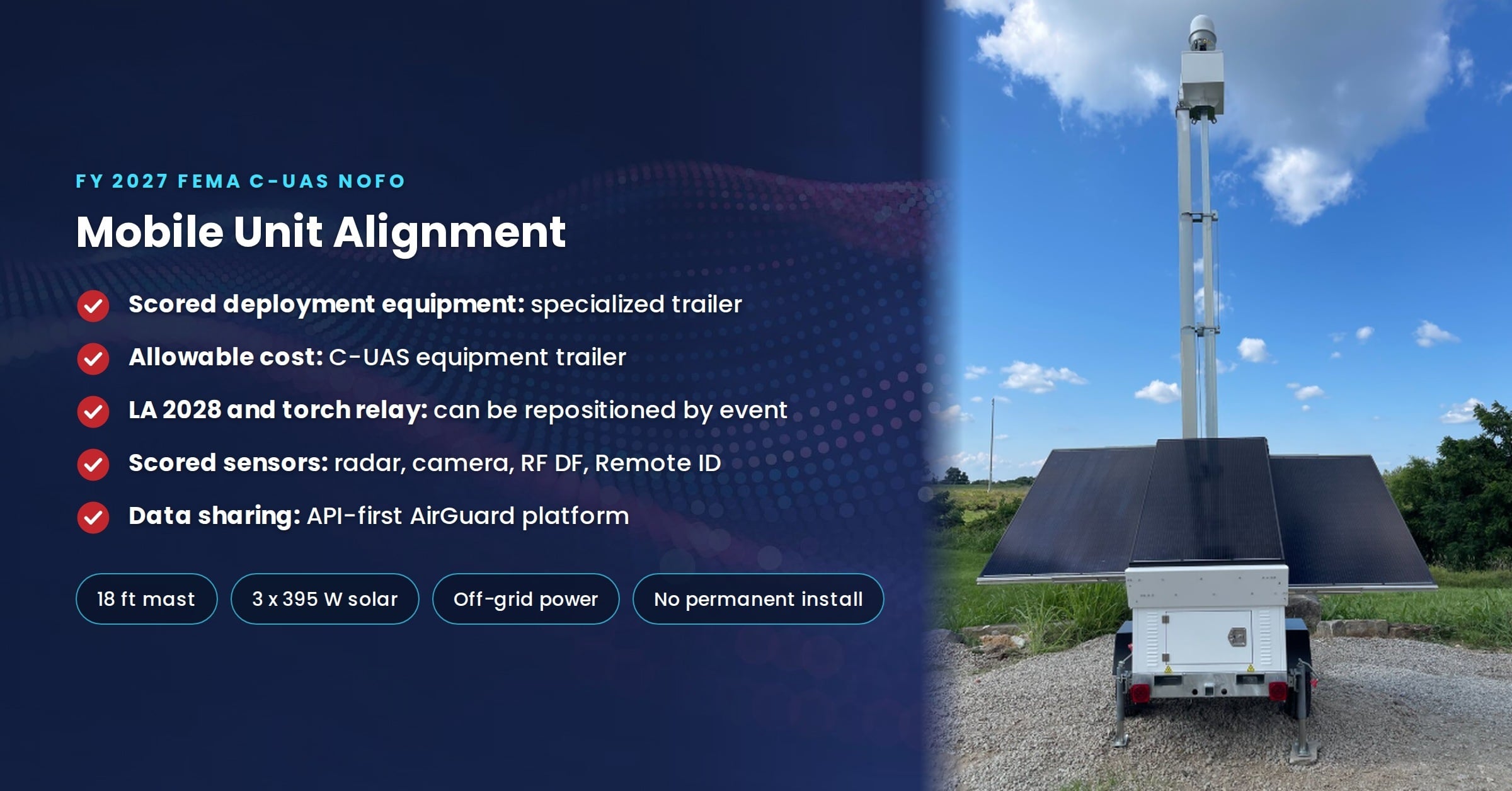
The AirSight mobile detection unit was built for that requirement. It is a solar-powered trailer that carries drone detection sensors on an 18 ft mast, powered entirely off the grid. Below, we explain how it aligns with the NOFO's allowable costs and scoring criteria, and what the AirSight Complete tier adds.
The FY 2027 C-UAS Grant Program at a glance
|
Item |
Detail |
|---|---|
|
Total funding |
$250 million |
|
Eligible applicants |
SAAs for all 56 states and territories |
|
Cost share |
None required |
|
Pass-through |
At least 97% to local units of government |
|
Application deadline |
November 16, 2026, 5 p.m. ET |
|
FY 2027 priority |
2028 Summer Olympics and Paralympics (NSSE), official SEAR events and the Olympic torch relay |
|
Allowable technology |
Detection, identification, monitoring and tracking; mitigation limited to accredited law enforcement and correctional agencies |
Local agencies apply through their SAA, not directly to FEMA, and most SAAs set internal deadlines well ahead of November 16. If you have not yet contacted your SAA, our five-step guide to securing FEMA C-UAS funding explains how to find yours and what to prepare.
How the mobile unit aligns with the NOFO
The NOFO describes how FEMA will review each funded project for effectiveness. Several of its cost rules and scoring categories apply directly to a mobile detection platform.
Deployment equipment is scored. The NOFO awards up to 4 points for deployment and connectivity elements that support the sensors, and it names specialized trailers among them. The AirSight unit integrates power, mast and sensors in one towable platform.
Trailers are an allowable cost. The NOFO lists vehicles and trailers dedicated to transporting C-UAS equipment as allowable. Solar panels and an on-board battery bank allow the unit to operate with no grid connection or fuel deliveries.
Coverage for LA 2028 and the torch relay. The NOFO states that this round of funding must be strategically leveraged to support the Olympic torch relay, and that costs should support NSSE and SEAR events to the extent possible. Projects in states outside the relay route remain eligible, since the round also builds nationwide detection capacity, but every recipient state agrees to provide C-UAS mutual aid to other states, including during the 2028 Games. Projects that support a named NSSE or SEAR 1 or 2 event held between 2027 and 2029, such as the 2028 Games or a Super Bowl, can earn up to 40 points. A mobile unit can be repositioned for each event, venue and route segment, then returned for local use.
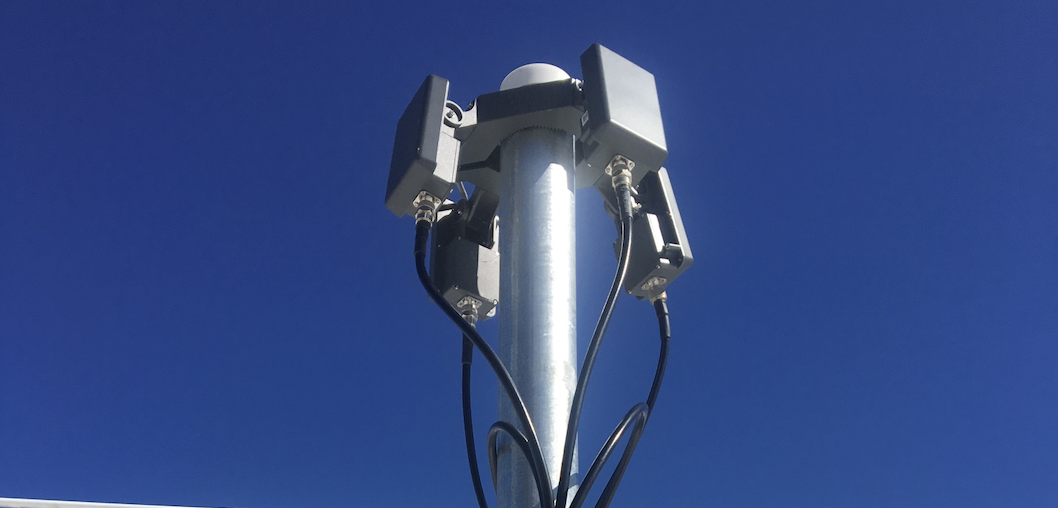
A platform for the sensors FEMA scores. The NOFO awards up to 8 points for detection, tracking and identification capability, and it recognizes radar, cameras, passive RF direction finding and Remote ID. The AirSight Complete tier includes all four sensor types, and AirGuard combines their data into a single operating picture. The number of sensors installed on each mobile unit is agreed with the client during project scoping.
Rapid implementation. Projects fully implemented within six months of award earn the maximum timeliness score. The mobile unit requires no permanent installation or site construction.
Data sharing. Grant-funded detection systems must share relevant detection data with DHS. AirGuard is an API-first platform that sends detection data to other systems, which supports this requirement. Live drone links can also be shared with partner agencies without an AirGuard account.
What the Complete tier includes
The Complete tier pairs AirGuard software with five sensor types. AirSight agrees with each client on which sensors, and how many, are installed on each mobile unit.
|
Sensor |
What it does |
Key specification |
|---|---|---|
|
Remote ID sensor |
Reads broadcast Remote ID from compliant drones |
2 to 3 miles, depending on signal strength |
|
RF sensor |
Detects drone radio signals from 433 MHz to 5.8 GHz |
3 to 5 miles |
|
DF sensor |
Locates drones by direction finding |
3 to 5 miles; up to 35 drones at once |
|
Radar |
Detects and tracks drones larger than 6 in |
1,969 ft for drones under 12 in; 4,921 ft for larger drones; 20 simultaneous tracks |
|
Camera |
Day and night visual confirmation |
1920 x 1080 HD |
Detection ranges vary with drone signal strength and site conditions.
All sensor data feeds into AirGuard, which provides:
- A unified multi-sensor dashboard
- Real-time drone and pilot tracking
- Flight history and forensic playback
- Analytics and heatmaps
- Expanded nationwide drone search
- Whitelisting and flagging of known drones
- Instant alerts
- Integration with existing security systems
Mobile unit specifications
|
Specification |
Value |
|---|---|
|
Solar panels |
3 x 395 W, fixed angle |
|
Battery |
6 x 150A gel |
|
System and inverter |
DC 24V, 24V/120V |
|
Mast height |
18 ft, manual raise (electric or hydraulic optional) |
|
Wind rating |
60 MPH |
|
Operating temperature |
-22 to 140°F |
|
Trailer |
Single axle, 132.7 in long, 106.4 in high |
|
Stabilizers |
5 x manual |
|
Options |
Security camera; strobe light, siren and speaker; spare wheel; tow hitch type |
Plan your project before the SAA deadline
The federal deadline is November 16, 2026, but your SAA's internal deadline is likely earlier. AirSight can help you scope sensors, coverage and a six-month implementation plan for your application.
Book a demo or contact sales@airsight.com to start planning.
Frequently asked questions
Can local agencies apply for the C-UAS Grant Program directly? No. Only SAAs apply to FEMA. Local agencies submit their projects through their state's SAA, which must pass at least 97% of funds to local units of government.
Is a counter-drone trailer an allowable cost? The NOFO lists vehicles and trailers dedicated to transporting C-UAS equipment as allowable costs, and it scores specialized trailers that support sensor deployment.
Does the mobile unit include mitigation? No. The unit is a detection, tracking and identification platform. Under the NOFO, mitigation technology may be operated only by accredited law enforcement and correctional agencies.
How tall is the mast? The mast reaches 18 ft. Electric and hydraulic mast options are available.
Which sensors are installed on the mobile unit? The unit is offered with the AirSight Complete tier. AirSight agrees with each client on the sensors and the number installed on each unit, based on the site and the coverage required.
Can AirGuard share detection data with other systems? Yes. AirGuard is an API-first platform and supports sending detection data to other systems, including those used for the DHS data-sharing requirement.