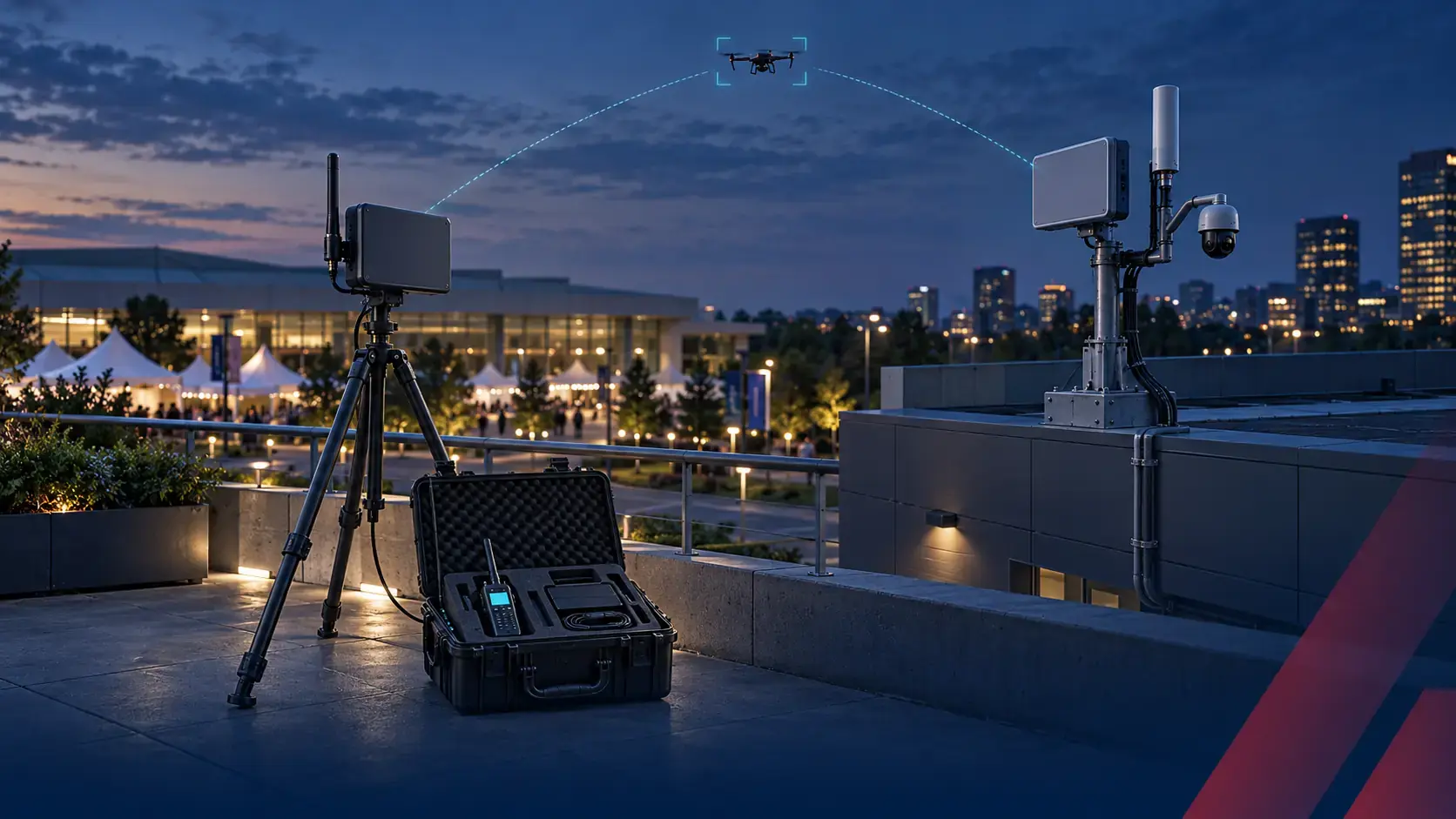
Portable and stationary anti-drone systems do the same core job: they give security teams eyes on the airspace. The difference is where that coverage lives. A stationary anti-drone system is installed permanently and watches one site around the clock. A portable anti-drone system travels with the mission, from a handheld drone detector for a quick sweep to a tripod kit for game day or a towable trailer for a site that needs coverage for weeks. The strongest security programs often use both: permanent coverage where the threat is constant, and portable coverage wherever operations go next.
This guide walks through the portable formats, what a stationary system adds, how the two compare, and which fits each kind of site. For an overview of the technology itself, see our guide to anti-drone system types, and for typical price ranges by device class, see anti-drone devices from handheld detectors to enterprise systems. At AirSight, we build drone detection for the facilities and agencies that keep people and critical operations safe.
Three Ways to Take Drone Detection on the Road
Portable drone detection, sometimes called mobile, comes in three formats, each suited to a different kind of mission.
Handheld drone detectors. The fastest way to get eyes on the sky. Handheld units pick up drone signals and Remote ID broadcasts, and under the FAA's Remote ID rules, most drones must broadcast an identifier and their position, along with the control station location or, for add-on broadcast modules, the takeoff location. That makes a handheld a natural fit for patrols, quick sweeps of a venue before doors open, and incident response.
Tripod and vehicle kits. A step up in reach. Mounting sensors on a tripod or a vehicle raises them for a wider view, and a kit with several sensors covers a much larger area than a single handheld. Teams set up for the operation, run it, and pack it out, which suits concerts, motorcades, outdoor events, and temporary operations.
Trailers. Coverage that stays for days or weeks. Towable units carry sensors on a mast with their own power and networking, giving construction sites, seasonal venues, and temporary facilities near-permanent coverage without a permanent installation. Public agencies can fund this kind of deployment: the FY 2026 FEMA Counter-UAS Grant Program notice listed trailers, generators, vehicles, and point-to-point or mesh network links as allowable deployment items, and its scoring rewarded proposals that included the deployment and connectivity elements their sensors need. Our FEMA grant guide covers the program.
What a Stationary System Adds
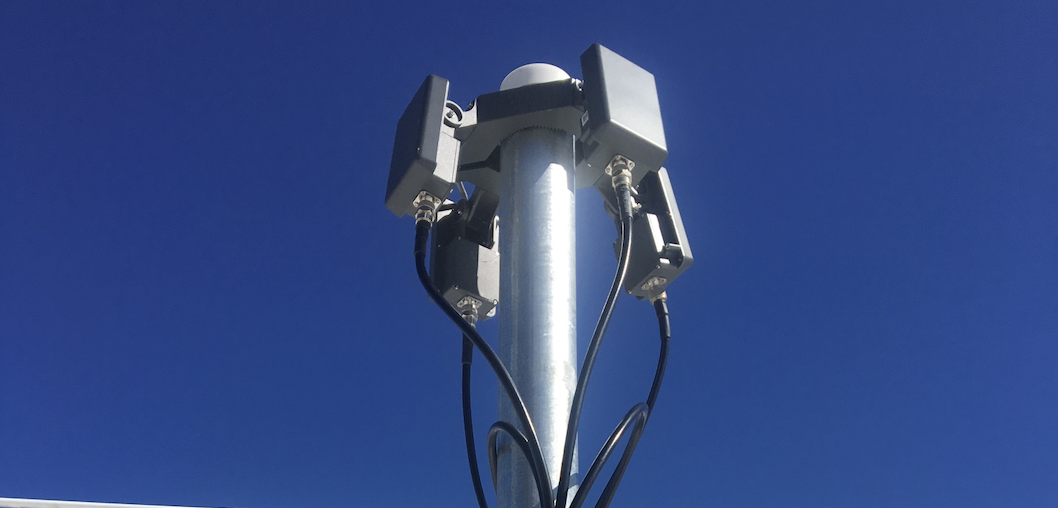
A stationary anti-drone system is permanently installed: sensors on rooftops, towers, or perimeter poles, connected to a command platform and running every hour of the year. That permanence delivers three strengths. Persistence: the airspace is covered at 3 a.m. on a holiday as surely as at noon. Fusion: several sensor types at fixed, surveyed positions combine into one confident track, as our guide to how a drone detection system works explains. And a baseline: months of continuous records reveal incursion frequency, timing, and repeat aircraft, turning individual sightings into a pattern your team can act on.
That baseline also simplifies reporting. Recipients of FEMA's FY 2026 counter-drone grants reported hours of active use, cumulative detections, distinct drones identified, and investigations launched from system data, numbers that come naturally from a system that never turns off. Our drone detection system requirements checklist covers how to specify records and reporting, and our guide to drone monitoring covers the alert workflow.
Portable vs. Stationary at a Glance
| Factor | Portable | Stationary |
| Coverage | Wherever and whenever you deploy it | Around the clock at your site |
| Setup | Done at each deployment | Done once, at installation |
| Operation | Run by your team on site | Runs continuously, with alerts routed to your team |
| Records | Event by event | A continuous record that reveals patterns over months |
| Power and network | Batteries, generators, or site power | Permanent connections |
| Best fit | Events, temporary sites, mutual aid, surge needs | Fixed sites facing a persistent threat |
Which One Fits Your Site
-
Correctional facilities, airports, and critical infrastructure: stationary. The threat is persistent and the site does not move. Prisons, airports, and critical infrastructure sites benefit most from coverage around the clock and a continuous record.
-
Stadiums, concerts, and temporary events: portable, or both. Exposure is concentrated in event windows, and many events happen at changing locations. A venue with a regular season may justify a stationary core; a one-off event is a natural fit for a portable deployment. See our page on drone detection for live events.
-
Police and sheriff's departments: usually both. Fixed sites such as headquarters or a jail call for stationary coverage, while events, incidents, and mutual aid call for something that moves. Applicants for FEMA's FY 2026 counter-drone grants certified that they were willing to support special events outside their normal jurisdiction and to provide mutual aid, work that portable detection is built for. See our page on drone detection for law enforcement.
-
Growing programs: a stationary core with portable surge. Permanent coverage where the threat is constant, plus a kit or trailer for the days that need more.
Lawful Wherever You Deploy It
Detection is lawful wherever you take it. In its FY 2026 grant notice, FEMA set out its analysis that radar, cameras, acoustic sensors, passive RF detection, and Remote ID reception do not implicate the federal Wiretap Act or the pen register and trap and trace statute, and that holds on a rooftop or a tripod. One note for buyers comparing products: many devices marketed as portable anti-drone systems are military jammers, which are not lawful for private use in the United States, as our guide to anti-drone guns explains. Detection is the portable capability every organization can put to work, and certified agencies can learn about response authority in our drone mitigation guide.
Coverage That Moves With Your Mission
Portable or stationary comes down to where and when your airspace needs watching. Fixed sites with a constant threat get a system that never turns off and a record that grows more valuable every month. Events and moving operations get detection that travels with the team. Most programs grow into some of both, starting with the coverage that matters most today.
Planning coverage for a site, an event, or both? Talk to our team about the deployment that fits.
Related reading: