The counter-drone market offers everything from a $2,000 Remote ID receiver you can plug into a laptop to a $1.5 million multi-sensor enterprise deployment spanning an entire airport perimeter. The anti-drone market is projected to grow from $4.48 billion in 2025 to $14.51 billion by 2030, a CAGR of 26.5%, and the number of vendors, device categories, and price points is expanding just as fast. Between those extremes sits a confusing landscape of handheld scanners, portable radar units, vehicle-mounted systems, fixed-installation sensor arrays, and software platforms that promise to tie it all together. For a buyer entering this market for the first time, the challenge is not finding anti-drone devices. It is understanding which device category matches your facility, your threat, and your budget.
We deploy anti-drone systems across correctional facilities, airports, stadiums, and critical infrastructure sites. The most common procurement mistake we see is buyers shopping by device before defining their requirement. This guide organizes anti-drone devices into five tiers by capability and cost, explains what each tier delivers, and helps you identify which tier fits your mission, whether you are a school resource officer who just spotted a drone over a football field or a federal security director building a multi-site defense program.
Detection Devices vs. Mitigation Devices: The Legal Line
Before evaluating any anti-drone device, you need to understand the legal boundary that divides the market in half:
Detection devices find, track, and identify drones. They include RF scanners, radar, Remote ID receivers, cameras, and acoustic sensors. Detection is legal for any organization. No federal certification is required. The FEMA C-UAS Grant Program covers detection equipment at 100% federal funding. For most organizations, detection devices are the first and often only anti-drone investment needed.
Mitigation devices neutralize drones: jammers, spoofers, cyber-takeover systems, net-capture interceptors, and directed-energy weapons. Under the SAFER SKIES Act, mitigation devices may only be deployed by agencies with FBI NCUTC-certified personnel using equipment from the federally authorized technology list. Private companies, schools, stadiums, and hospitals cannot legally deploy mitigation devices. For a detailed comparison of every mitigation type, read our anti-drone weapons guide.
This guide focuses primarily on detection devices, because they represent the legal, funded, and immediately deployable category for 95% of organizations entering the anti-drone market.
Tier 1: Handheld and Personal Devices ($2,000 to $15,000)
The entry point into anti-drone detection. These devices are portable, battery-powered, and operated by a single person.
-
Remote ID receivers: The least expensive anti-drone device. A Remote ID receiver captures the FAA-mandated identification broadcast from compliant drones, displaying the drone's serial number, position, altitude, speed, and operator location. Receivers range from $2,000 to $8,000. They are the fastest to deploy (plug in and scan) and provide the richest identification data for compliant drones. The limitation: non-compliant drones are invisible.
-
Handheld RF detectors: Portable scanners that detect the radio frequency signals between a drone and its controller. Handheld units typically cover 2.4 GHz and 5.8 GHz bands and can indicate direction of arrival. Cost: $5,000 to $15,000. For a deep dive on how RF drone scanners work, read our technical guide.
Best for: Initial threat validation, event security supplementation, and agencies that need to determine whether they have a drone problem before investing in permanent infrastructure. A school resource officer, a private estate manager, or a local police department responding to drone complaints can start here.
Limitation: No data logging, no alert automation, no integration with security infrastructure. Handheld devices require a human operator actively monitoring. They are awareness tools, not security systems.
Tier 2: Standalone Sensor Units ($15,000 to $80,000)
Professional-grade detection sensors designed for fixed or semi-fixed installation at a specific facility.
-
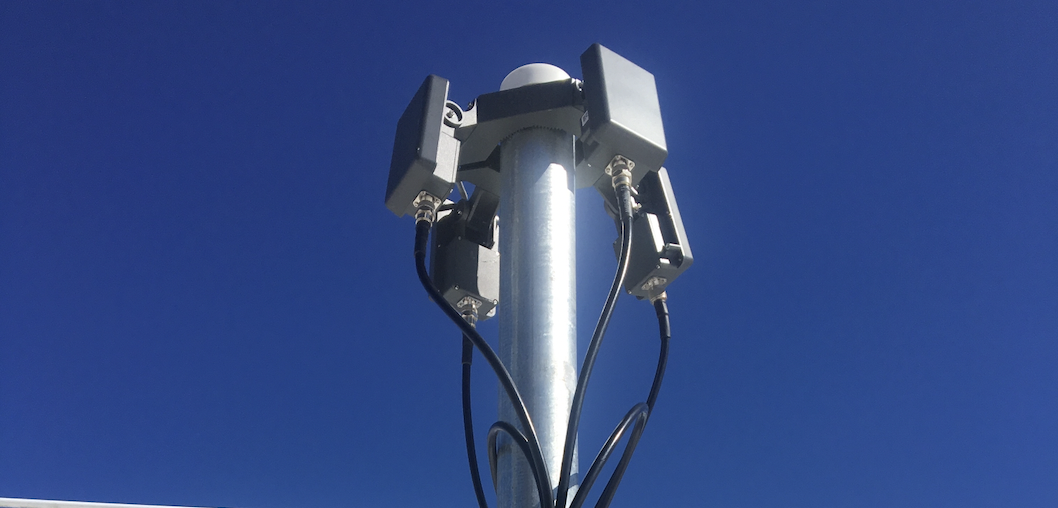
Professional RF sensors: Rack-mounted or pole-mounted RF scanners covering 433 MHz to 5.8 GHz with signature libraries identifying hundreds of drone models. Detection ranges of 1 to 5 km depending on antenna configuration and environment. Data logging, alert output, and basic API integration. Cost: $15,000 to $60,000 per unit.
-
Standalone radar units: Compact radar systems that detect physical objects in the airspace regardless of RF emissions. Essential for autonomous drone coverage. Modern micro-Doppler radar distinguishes drones from birds. Detection ranges of 1 to 8 km. Cost: $30,000 to $80,000 per unit. For detailed radar specifications, read our drone detection radar guide.
-
PTZ camera systems: Pan-tilt-zoom cameras with AI-powered drone classification. Electro-optical for daytime, thermal for nighttime. Used for visual confirmation after RF or radar detection. Cost: $10,000 to $40,000 per unit.
Best for: Correctional facilities with a defined perimeter, small airports, corporate campuses, and event venues. This tier covers the vast majority of commercial drone threats at most facility types.
Limitation: Standalone sensors generate standalone data streams. Without a command-and-control platform to fuse, correlate, and manage alerts, operators must monitor each sensor independently. This works for single-sensor installations but breaks down when multiple sensors are deployed.
Tier 3: Multi-Sensor Systems with C2 Platform ($100,000 to $350,000)
This is where anti-drone devices become an anti-drone system. Tier 3 combines multiple sensor types with a command-and-control platform that fuses their data into a single operating picture.
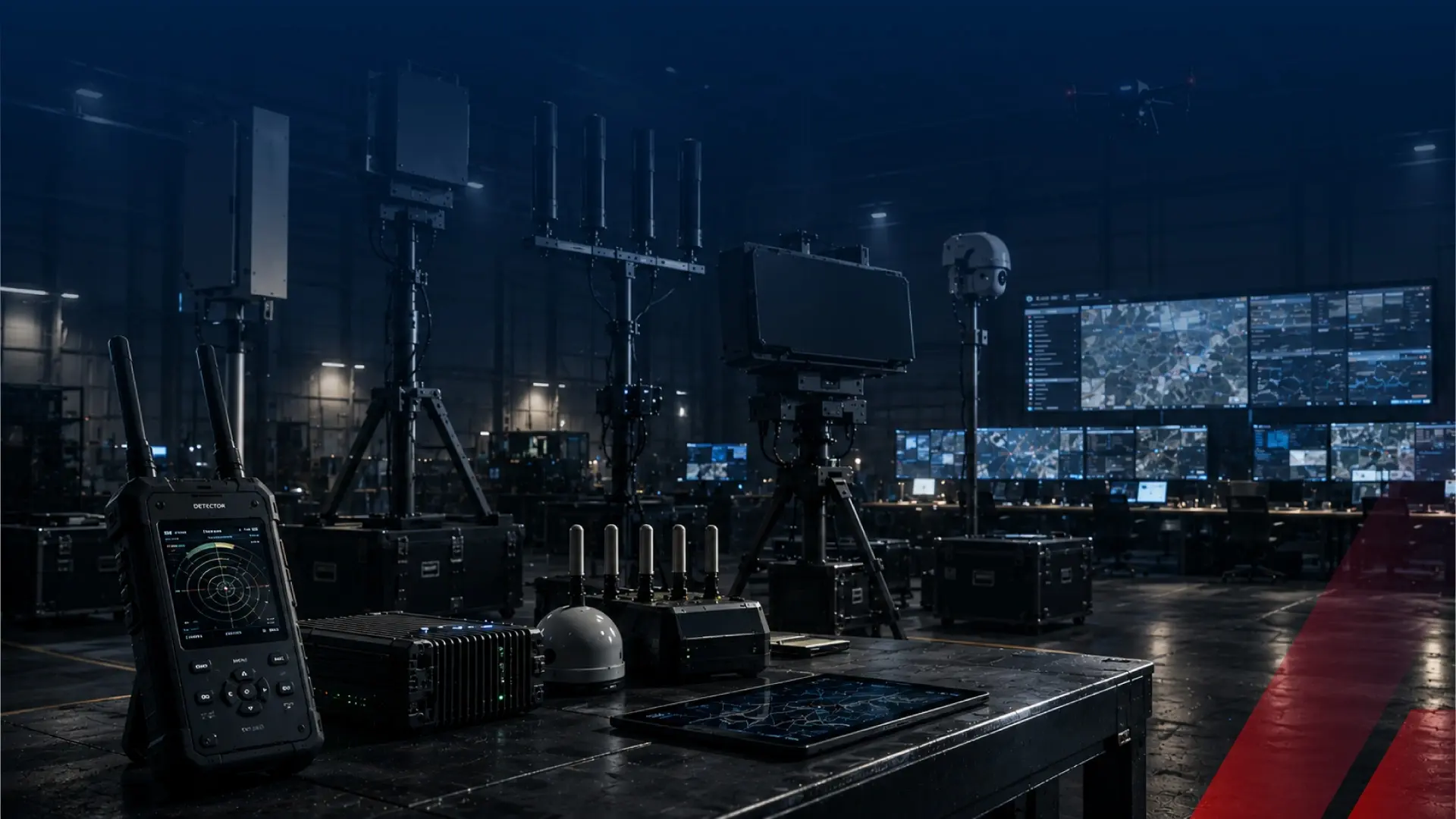
A typical Tier 3 deployment includes two to three RF sensors for overlapping coverage, one or two radar units for autonomous drone detection, a PTZ camera for visual confirmation, Remote ID receivers, and a C2 platform that correlates detections from all sensors into one unified track per physical drone. The platform manages alert zones, triggers automated notifications, logs every detection for historical analysis, and exports data for compliance reporting.
Best for: Airports, large correctional complexes, stadiums, and critical infrastructure with diverse threat profiles that include both commercial and autonomous drones. This tier is the minimum recommended deployment for facilities with FEMA C-UAS grant funding. The CISA UAS Detection Technology Guidance, which FEMA's grant NOFO references as the evaluation framework for applicants, recommends multi-sensor architectures with centralized command-and-control as the standard for critical infrastructure protection.
Why the C2 platform matters more than the sensors: You can upgrade sensors without replacing the platform. You cannot upgrade the platform without retraining every operator and re-integrating every sensor. The C2 platform is the long-term anchor of the system. Choose it first. For our vendor evaluation framework, start there.
Tier 4: Enterprise Multi-Site Deployments ($350,000 to $1.5M+)
Tier 4 scales the Tier 3 architecture across multiple sites, zones, or facilities managed from a centralized operations center. This tier is defined by enterprise-grade C2 capabilities: multi-site dashboards, role-based access control, centralized analytics, and unified reporting across all locations.
A state corrections agency managing drone detection across 15 prisons needs Tier 4 architecture. An airport authority operating detection at three terminals plus approach corridors needs Tier 4. A military installation with a dozen sensor nodes feeding a single operations center needs Tier 4.
Best for: Federal agencies, state-level corrections departments, airport authorities, and any organization managing drone detection across more than two sites.
Tier 5: Detection Plus Mitigation ($500,000+)
Tier 5 adds mitigation devices to the Tier 3 or Tier 4 detection architecture. This is the full-spectrum counter-drone deployment that includes both detection capability and the legal authority to neutralize threats.
Mitigation devices at this tier include RF jammers ($10,000 to $150,000), cyber-takeover systems like D-Fend EnforceAir or Sentrycs CoRF ($65,000 to $400,000), and net-capture interceptors like Fortem DroneHunter ($50,000 to $200,000). The SAFER SKIES Act governs who can deploy these devices and under what conditions.
Best for: Law enforcement agencies with FBI NCUTC certification, federal facilities with existing counter-UAS authority, and military installations. For a complete breakdown of which counter-drone companies build each device category, read our vendor landscape guide.
How to Choose Your Tier
Three questions determine which tier fits your facility:
-
1. What is your threat profile? If 90%+ of your drone threat is commercial DJI models (typical for prisons and stadiums), Tier 2 RF detection may be sufficient. If autonomous or modified drones are a credible threat (airports, military, critical infrastructure), Tier 3 with radar is the minimum. Our protection tier framework maps sensor configurations to threat profiles.
-
2. How many sites and zones? Single-facility, single-zone deployments can operate at Tier 2 or Tier 3. Multi-site or multi-zone deployments need Tier 4 enterprise architecture. The number of sites determines the C2 platform requirements more than the sensor requirements.
-
3. What is your authorization level? If you do not have SAFER SKIES certification, Tiers 1 through 4 (detection only) are your options. If you have certification, Tier 5 adds mitigation. Do not procure mitigation devices before you have both detection capability and legal authorization. A drone defense program builds these capabilities in sequence, not in parallel.
Funding Anti-Drone Devices
Federal funding covers anti-drone detection devices at 100% federal cost share:
-
FEMA C-UAS Grant Program ($500M): Detection, tracking, identification, and monitoring equipment for state and local agencies. $250 million awarded in FY2026 for FIFA World Cup host states. Another $250 million opens to all 56 states and territories in FY2027.
-
FIFA World Cup Grant Program ($625M): Counter-drone equipment for tournament venues. Equipment becomes permanent local infrastructure.
-
Additional channels: Urban Areas Security Initiative (UASI), Port Security Grant Program (PSGP), and the JIATF-401 Counter-UAS Marketplace for military and federal buyers. Our UAV detection procurement guide covers every funding channel and the application process.
The Device Is Not the System
The most important thing to understand about anti-drone devices is that no single device constitutes a defense. A handheld RF scanner detects drones but does not log data or trigger alerts. A radar detects objects but does not identify them. A camera confirms targets but cannot search the sky. An RF sensor finds commercial drones but misses autonomous ones. Every device has a capability and a gap. The system is what fills the gaps.
The detect-track-identify-mitigate workflow requires devices working together through a C2 platform that makes the combination greater than the sum of the parts. Start with the tier that matches your threat and budget. Build toward the tier that matches your mission. And evaluate counter-drone vendors based on how their platform integrates devices, not just which devices they sell.
Need help determining which tier fits your facility and threat profile? Book a walkthrough with our team.
Related reading: