Law enforcement drone detection gives an agency a live view of the drones in its jurisdiction: where each one is flying, where it came from, and, for drones that broadcast Remote ID, where the operator is standing. That turns a call about a drone into a location officers can drive to, and a season of calls into a pattern an agency can plan around. In 2026, agencies gained new authority, new training, and new funding to build that capability.
At AirSight, we build drone detection for law enforcement agencies and the communities they protect. This guide walks through how agencies are building programs that work, from the first coverage decision to the data that proves results. For our overview of agency needs, see our page on law enforcement drone detection.
Why 2026 Changed the Picture for Agencies
The 2026 FIFA World Cup showed what state and local agencies can do with the right tools and training. Ground Intercept Teams made up of federal and local personnel worked at venues to support rapid detection and enforcement, and the FBI and the Department of Homeland Security seized more than 700 drones operating in restricted airspace across all 11 U.S. host cities, according to the FAA. The FAA called it the culmination of more than a year of work through grant funding, legislation, and training that the FBI's National Counter-UAS Training Center provided to state and local law enforcement in every host city.
That foundation now reaches far beyond one tournament. Congress passed the Safer Skies Act in December 2025, extending counter-drone mitigation authority to state, local, tribal, and territorial law enforcement agencies that meet training requirements, and the federal rule implementing it took effect July 1, 2026. Our SAFER SKIES Act explainer and our drone mitigation guide cover how that authority and certification work. Every one of those response capabilities starts in the same place: seeing the drone first.
Six Steps to a Program That Works
-
Start with the mission. List the places and moments that matter most: stadiums and arenas, jails, airports, critical infrastructure, government buildings, and the special events on your calendar. That list decides where coverage goes first.
-
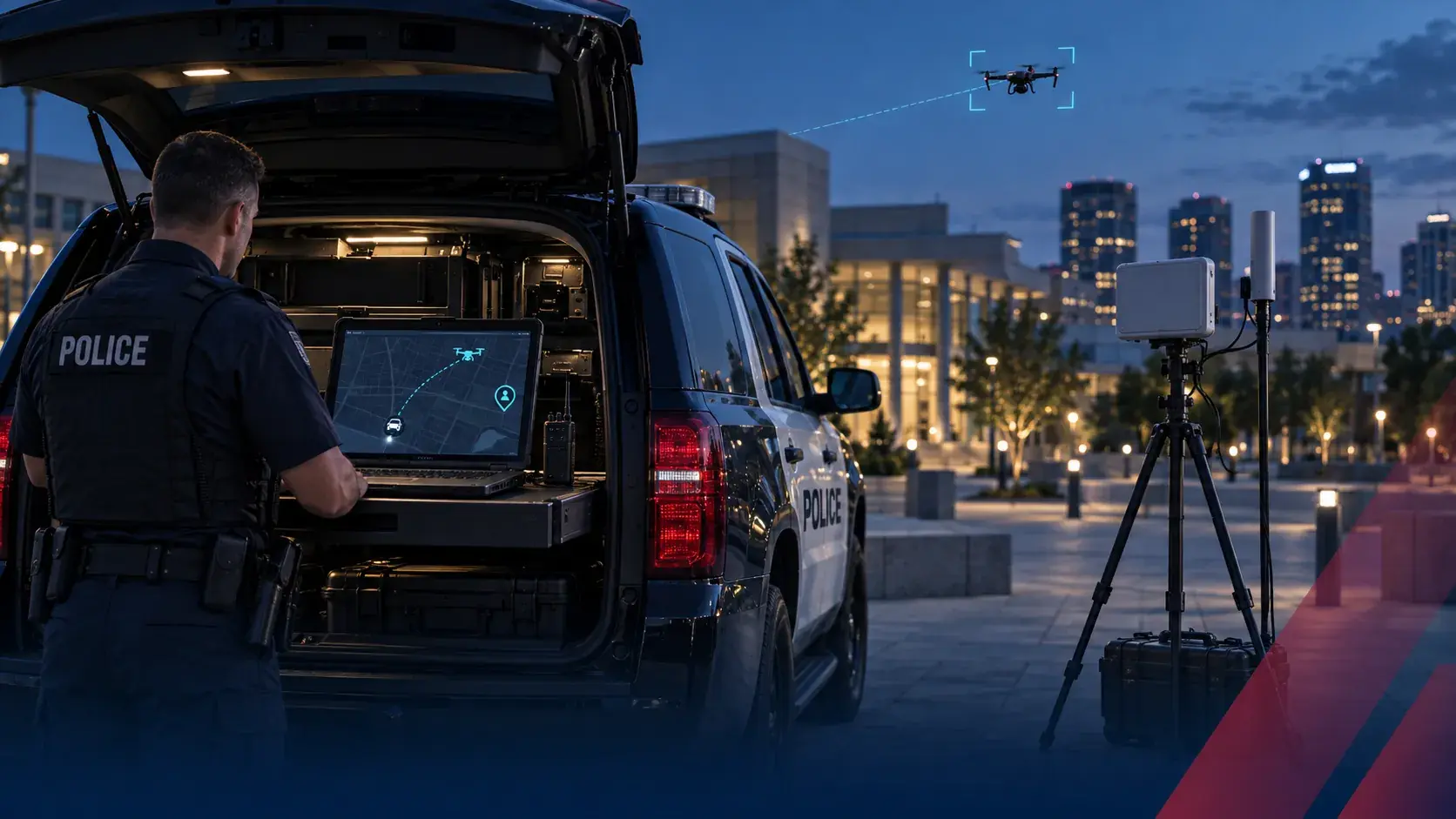
Mix fixed and portable coverage. Fixed sites such as a jail or a stadium call for coverage around the clock. Events, incidents, and mutual aid call for detection that travels. Applicants for FEMA's FY 2026 counter-drone grants certified that they were willing to support special events outside their normal jurisdiction and to provide mutual aid, which is exactly the work portable detection is built for.
-
Choose detection that leads to the operator. Officers need a person to talk to, not just a dot on a map. Under the FAA's Remote ID rules, most drones broadcast an identifier and their position, along with the control station location or, for add-on broadcast modules, the takeoff location. RF sensors add detection for drones that transmit, and radar covers drones that transmit nothing. Our guide to how a drone detection system works explains how these layers combine into one picture.
-
Write the playbook. Decide who receives alerts, who responds, how officers approach an operator, and when an incident is handed to federal partners. A clear playbook makes every encounter quick and consistent. Our guide to drone monitoring covers alert workflows that keep a team focused.
-
Train the team. Detection is only as strong as the people using it. Operator training on the system, plus the federal training that certification requires for agencies pursuing mitigation authority, builds a team that can act with confidence.
-
Record everything. Tracks, operator locations, and outcomes become evidence for enforcement and data for planning. FEMA's FY 2026 counter-drone grants, for example, asked recipients to report hours of active use, cumulative detections, distinct drones identified, and investigations launched from system data.
What Good Looks Like in the Field
When detection works, the response looks routine. A drone appears near a venue, the system shows its track and the operator's location, officers make contact quickly, and the record is saved. Cases that need more follow a documented trail: in Dallas, federal prosecutors announced an indictment in October 2026 over alleged drone flights at Dallas Love Field and DFW, investigated by the FBI and the Federal Air Marshal Service with help from the FAA. An indictment is an allegation, and the defendant is presumed innocent. Our coverage of the drone incident at a Baltimore playoff game shows how quickly responders can move when an operator can be located.
Funding the Program
Funding is within reach for agencies everywhere. FEMA's Counter-UAS Grant Program provides $500 million over two years. The first $250 million went to the states and the National Capital Region hosting World Cup and America 250 events, and the remaining $250 million, plus any unallocated first-round funds, will be distributed to all states and territories, according to FEMA. Our FEMA Counter-UAS Grant Program guide covers how the program works, and our post on preparing for the next $250 million covers what to have ready before the next notice of funding opportunity publishes.
Ready for the Next Call
Drone calls are becoming part of everyday policing, and the agencies that handle them well share the same foundation: they see the drone first, they reach the operator fast, and they keep a record that strengthens every case and every budget request. With new authority, proven training, and nationwide funding on the way, there has never been a better time to build that foundation.
Building a drone detection program for your agency? Talk to our team.
Related reading: