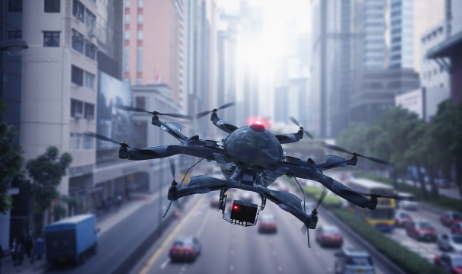
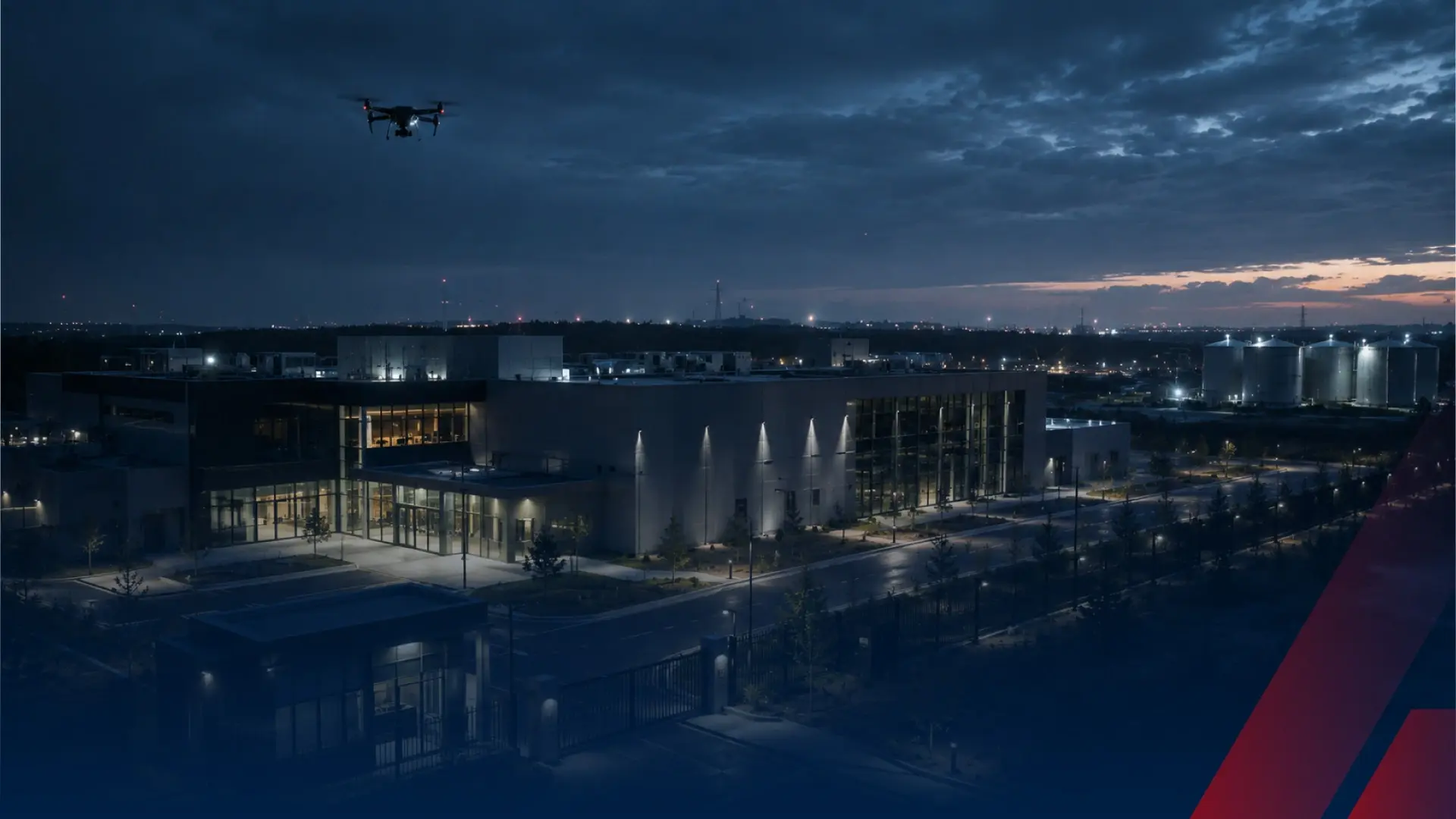
In November 2024, a suspect was arrested and charged with attempting to attach an explosive device to a drone and fly it into a critical infrastructure site. That is not speculation from a threat briefing. That is a federal arrest reported by CISA's Be Air Aware campaign. In November 2025, CISA released three new guides for critical infrastructure owners and operators covering UAS detection technology, suspicious drone activity reporting, and safe handling of downed aircraft. In May 2026, the FAA proposed a new rule allowing critical infrastructure sites to apply for drone flight restrictions over their facilities. The federal government is telling facility managers, in increasingly direct terms, that drone security is now their responsibility.
If you manage security at a prison, an airport, a stadium, a power plant, a water treatment facility, or a corporate campus, drone threats have likely appeared on your risk register in the past 12 months. The challenge is that most facility security programs were designed for ground-based and cyber threats. Drones introduce a vertical axis that existing camera systems, access control, and perimeter fencing were not built to address. This guide translates the counter-drone landscape into the language of facility security operations: threat assessments, security plans, incident response, and vendor selection.
Why Drone Security Landed on the Facility Manager's Desk
Three trends converged to make drone security a facility management responsibility:
-
Drone volume is growing faster than regulation can keep up. The FAA projects the commercial drone fleet will reach nearly 860,000 aircraft by 2026. More drones in the air means more incursions, both accidental and intentional. The FAA receives over 100 drone sighting reports near airports every month. The NFL documents over 2,000 drone incursions per season into restricted stadium airspace.
-
DJI removed mandatory geofencing. In January 2025, DJI eliminated enforced no-fly zones from its products after processing over one million override requests. Drone operators now bear sole responsibility for avoiding restricted airspace, with only voluntary advisory alerts.
-
Federal guidance now explicitly addresses facility managers. CISA's UAS Detection Technology Guidance and the JIATF-401 physical protection guide are written for facility operators, not military commanders. The audience has shifted. If you manage a facility with overhead exposure, these documents are addressed to you.
Step 1: Conduct a Drone Threat Assessment
Before purchasing any technology, facility managers need to understand their specific drone threat. CISA recommends that stakeholders identify case-specific threat actors and areas of vulnerability. A drone threat assessment should answer five questions:
-
What assets are exposed from above? Map every area of your facility that is visible or accessible from the air. Exercise yards at prisons. Loading docks at distribution centers. Parking structures at stadiums. Server rooms with rooftop HVAC access. Outdoor assembly areas at corporate campuses. These are your exposure points.
-
What could a drone do here? The four drone threat vectors are surveillance (capturing facility layouts, security patterns, and vulnerabilities), delivery (contraband at prisons, weapons or hazardous materials at events), disruption (interfering with operations, causing evacuations), and cyber intrusion (carrying Wi-Fi exploitation tools or rogue access points to penetrate network perimeters from above).
-
Who would target this facility? A correctional facility faces organized smuggling operations. An airport faces hobbyist incursions and potential terrorist reconnaissance. A corporate campus faces industrial espionage. The threat actor determines the sophistication of the drone and the detection capabilities needed to counter it.
-
What is the current detection capability? Most facilities have zero drone detection capability. Security cameras are not positioned to see the sky. Guards are not trained to identify drone sounds. There is no sensor monitoring the airspace. Documenting this gap is the first step toward funding a solution.
-
What is the regulatory and funding environment? The SAFER SKIES Act provides the legal framework for agencies exercising counter-drone authority. The FEMA C-UAS Grant Program provides 100% federal funding for detection equipment. Senator Cotton's Critical Infrastructure Airspace Defense Act would extend mitigation authority directly to critical infrastructure operators. Understanding what you can legally deploy today and what may be authorized soon shapes your procurement timeline.
Step 2: Add Drone Security to Your Facility Security Plan
A drone security plan should integrate with your existing facility security plan, not replace it. The components that need to be added or updated:
-
Airspace zones: Define alert zones based on your threat assessment. A layered protection approach typically includes a monitoring zone (early warning, no immediate response), an alert zone (drone approaching sensitive areas, increased monitoring), and a restricted zone (drone over critical assets, immediate response required).
-
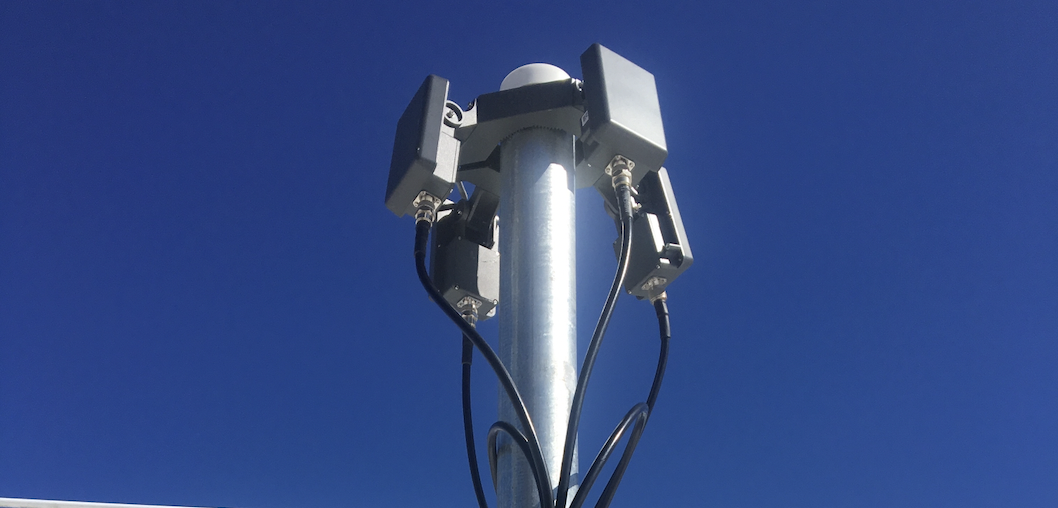
Detection capability: Specify the sensor architecture needed for each zone. For most facilities, RF scanning is the foundation. Facilities near airports or military installations may need radar for autonomous drone coverage. For a comparison of every sensor type, read our guide on how drone detectors work.
-
Response protocols: Define what happens at each alert level. Who gets notified? What actions are authorized? When does law enforcement get called? When does the facility go to lockdown? These protocols should be documented, trained, and exercised just like fire or active shooter procedures.
-
Reporting requirements: Under the SAFER SKIES Act, agencies exercising counter-drone authority must report each action within 48 hours. Even without mitigation authority, documenting drone incidents creates the evidence base needed for FEMA grant applications, law enforcement investigations, and insurance claims.
-
Training curriculum: Security staff need to know what a drone looks like, what it sounds like, how to document an incursion, and how to operate the detection system if one is deployed. CISA's Be Air Aware resources provide a starting point for facility-level awareness training.
Step 3: Select the Right Technology for Your Facility
The counter-drone vendor landscape in 2026 includes hundreds of companies across detection, command-and-control, and mitigation categories. For facility managers evaluating this market for the first time, three principles simplify the decision:
Start with detection, not mitigation. Detection is universally legal and tells you what is happening in your airspace. Mitigation requires federal certification and depends entirely on detection data to function. A detection system is immediately valuable. A mitigation system without detection is dangerous. Our equipment buyer's guide covers the full procurement framework.
Buy the platform, not just the sensors. Individual sensors generate individual data streams. A command-and-control platform fuses those streams into a single screen, manages alerts by zone, logs every detection for reporting, and exports data for compliance. The platform is what makes the sensors useful to your security operations, rather than just another screen to monitor.
Demand a site survey. Every facility has unique electromagnetic characteristics, terrain, building clutter, and wildlife that affect sensor performance. A vendor that quotes equipment without visiting your site is guessing. Credible vendors conduct site surveys before recommending configurations. If they skip this step, that is a disqualifying red flag.
Step 4: Fund the Program
Drone security has never been easier to fund. Active federal programs include:
-
FEMA C-UAS Grant Program ($500M): Detection equipment at 100% federal funding through State Administrative Agencies. For a full procurement guide including FEMA application details, read our UAV detection solution guide.
-
FIFA World Cup Grant Program ($625M): Counter-drone equipment for World Cup venue cities. Equipment becomes permanent local infrastructure after the tournament.
-
Port Security Grant Program ($90M): For maritime critical infrastructure including ports, terminals, and waterways.
-
Urban Areas Security Initiative (UASI): For high-threat, high-density urban areas. UASI funds are frequently used by law enforcement to procure drone detection technology.
-
Critical Infrastructure Airspace Defense Act: If enacted, would authorize $250 million over five years for infrastructure operators to purchase counter-drone systems. Currently in the legislative process.
For most facility types, the budget is not the constraint. The constraint is administrative readiness: understanding which grant program applies, coordinating with the State Administrative Agency, and meeting application deadlines that do not wait.
What Facility Managers Should Do This Month
The drone security landscape is moving fast. Here is a prioritized action list:
-
Read the CISA guidance. The UAS Detection Technology Guidance and the JIATF-401 physical protection guide are free, practical, and written for facility operators. They provide the framework that FEMA's grant NOFO references.
-
Document current drone activity. Start logging any drone sightings, complaints, or incidents at your facility. Even without detection technology, visual reports from security staff create the evidence base for grant applications and vendor discussions.
-
Identify your State Administrative Agency. FEMA grants flow through SAAs. Contact yours to understand the application timeline for FY2027 C-UAS funding. The National League of Cities recommends early engagement.
-
Request vendor site surveys. Invite 2 to 3 vendors to conduct site surveys at your facility. Site surveys are typically free and give you specific, defensible recommendations rather than generic proposals. Our vendor evaluation framework provides the four questions to ask every vendor.
-
Brief leadership. Summarize the threat, the regulatory environment, the funding available, and the recommended first investment. Decision-makers respond to specifics: "We had 12 drone sightings in Q1, FEMA will cover 100% of detection equipment costs, and three vendors have conducted site surveys with proposals ranging from $50K to $200K" is a different conversation than "we should look into drones."
Need a site survey or a vendor-neutral assessment of your drone security posture? Talk to our team.
Related reading: