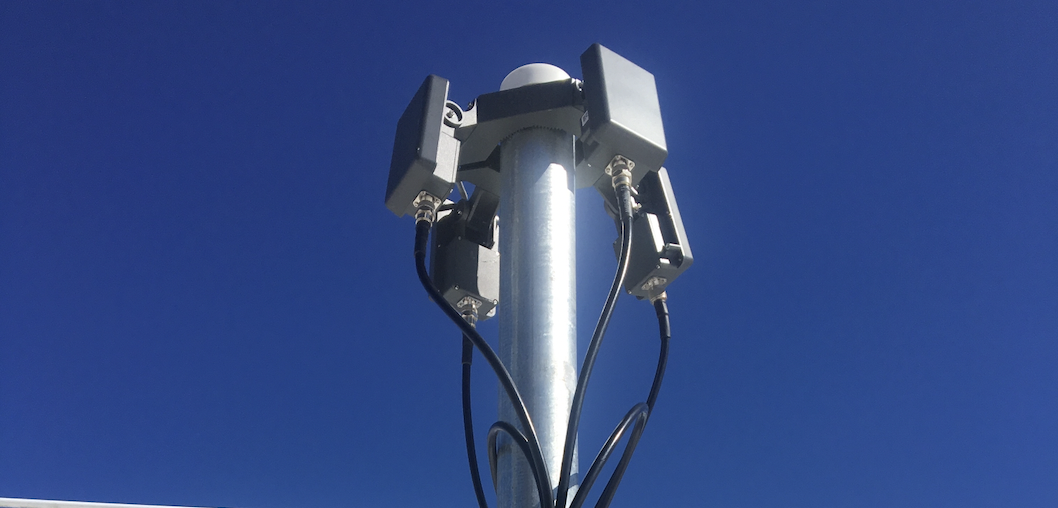

Almost every commercial drone detection method assumes the drone is talking. Radio frequency sensors listen for the link between a drone and its controller. Remote ID readers capture the identification a compliant drone broadcasts. Jammers attack the control signal to sever it. All of these depend on the drone emitting something. Anti-drone radar does not, and that is why it has become the essential layer against the fastest-growing category of threat: the drone that emits no signal at all.
Autonomous drones flying pre-programmed routes, drones whose control links have been cut, and fiber-optic tethered drones all present zero radio signature to a passive sensor. They cannot be heard, and they cannot be jammed, because there is nothing on the air to hear or jam. What they cannot do is escape physics: they are still solid objects moving through the sky, and a solid object reflects radar energy. This guide explains why non-emitting drones defeat RF-based defenses, why radar is the only passive sensor that can find them, and what it takes to detect them reliably. We build multi-sensor systems with radar at their core, and this is the threat that makes radar non-negotiable.
The Drones RF Cannot See
Radio frequency detection is the foundational layer of most counter-drone programs, and for good reason: it is passive, affordable, and can often locate the operator. But it has one absolute limitation. As one counter-UAS technical analysis puts it plainly, autonomous drones on pre-programmed waypoint missions, drones with failed communication links, and fiber-optic controlled drones all present zero RF signature to passive detection systems. If there is no signal, RF detection has nothing to detect. Our guide to how RF drone detection works covers that blind spot in depth.
Three categories of drone fall into this gap. Autonomous drones execute a flight plan loaded before takeoff, navigating by GPS or onboard vision with no live control link. Drones that lose or deliberately cut their radio link continue on a failsafe routine. And fiber-optic drones, the most significant recent development, are physically tethered to their operators by an ultra-thin optical cable that carries control and video as light pulses inside the fiber. They transmit real-time commands and high-resolution video without emitting any radio-frequency signal, over cables that now reach 20 to 30 kilometers.
The Fiber-Optic Threat Is Not Staying on the Battlefield
Fiber-optic drones emerged at scale during the Ukraine conflict around August 2024, specifically to defeat the dense radio jamming both sides had built. A jammer can flood the entire RF spectrum and a drone with no radio receiver is simply unaffected. The scale of adoption has been rapid: by 2025, reporting indicated more than 80 distinct Ukrainian fiber-optic drone models had been fielded, with Russia extending the concept to larger fixed-wing strike drones.
This matters for domestic security because drone tactics proven in conflict migrate into civilian airspace faster than regulation adapts, a dynamic we examine in our analysis of military drone detection. The manufacturing base is already moving. US makers are scaling vertically integrated fiber-drone production to meet projected 2026 demand. The technology also has legitimate uses in mines, tunnels, and enclosed inspection where radio does not propagate, which means fiber components will become widely available. A security team that assumes every threatening drone will broadcast a signal is planning for the last threat, not the next one.
Why Jamming Fails and Radar Does Not
The defining feature of a non-emitting drone is that it removes the target every electronic defense is built to attack. As one counter-UAS assessment states, without a radio link to disrupt, electronic systems simply have nothing to target. The drone flies normally through even a heavily jammed environment. The same source warns that this creates a dangerous false sense of security: a facility relying only on RF detection and jamming may believe it is protected while a non-emitting drone passes through undetected and unaffected.
Radar breaks that stalemate because it does not care whether the drone is transmitting. It detects the physical airframe by the energy it reflects. This is not theoretical. Ukrainian forces facing the fiber-optic threat turned to mobile short-range radars to detect incoming fiber-optic drones several kilometers out, then launched interceptors against them. The counter-UAS field has reached a clear consensus on the point: radar integration addresses the fundamental limitation of RF detection, that it cannot detect drones which emit no radio signals. Against the non-emitting threat, radar is not one option among several. It is the only passive detection method that works.
How Anti-Drone Radar Detects a Silent Drone
Radar finds a non-emitting drone the same way it finds any drone: it transmits radio energy, measures the echo that reflects off the airframe, and derives the object's range and velocity. Because the detection depends on the physical object rather than any emission, an autonomous or fiber-optic drone is just as visible to radar as a radio-controlled one. For the full mechanics, see our guide to drone detection radar.
The critical capability is classification. A drone hovering or loitering produces almost no bulk Doppler shift, so a conventional radar can discard it as clutter. Purpose-built anti-drone radar uses micro-Doppler analysis to read the rapid frequency modulations from the spinning rotor blades, which lets it detect and identify even a stationary or autonomous drone and separate it from birds. This is the same processing that makes radar effective across the whole drone threat spectrum, and it is what turns a faint reflection from a small, silent aircraft into a confirmed track.
The Honest Limitation: Silent Does Not Mean Easy
Radar is the answer to the non-emitting drone, but it is not an effortless one, and any vendor who tells you otherwise is overselling. The same design choices that make fiber-optic and autonomous drones hard to hear also tend to make them hard to see. They are often small, fly low and slow, and use composite airframes that reflect less energy than metal. Industry analysis notes that fiber-optic drones can be harder for large-aperture radars to detect because they minimize their overall signature.
The answer is not to abandon radar but to use the right radar. Detecting small, non-emitting drones requires a system designed for low, slow, small targets: appropriate frequency bands, high sensitivity, strong clutter rejection, and micro-Doppler classification, rather than a repurposed air-traffic radar built for airliners. The US Government Accountability Office has cautioned that some counter-drone technologies have a limited ability to detect and track small UAS under 55 pounds, which is exactly why radar selection and placement matter so much for this threat. The right radar sees these drones. The wrong one does not.
Radar Is Necessary, but Not Sufficient Alone
Detecting a non-emitting drone creates a second challenge: you cannot identify it the way you would a cooperative one. Radar delivers a track, position, altitude, heading, and, with micro-Doppler, confirmation that the object is a drone. It does not deliver a serial number or an operator location, because there is no signal carrying that data. This shapes the entire response.
With a radio-controlled drone, RF detection can point security toward the pilot. With an autonomous drone, there is no pilot on site to find, only a pre-loaded flight plan executing. With a fiber-optic drone, the operator sits at the far end of a cable that may run for kilometers. In each case, radar tracking paired with camera confirmation becomes the core of situational awareness, and the response shifts toward interdiction of the aircraft and forensic recovery rather than locating a nearby operator. This is why a layered drone detection system fuses radar with RF, Remote ID, and cameras: radar covers the silent drones, RF and Remote ID identify the cooperative ones and locate their operators, and a command-and-control platform merges everything into one picture. Our guide to how drone detectors work compares each sensor's role.
What This Means for Your Facility
For most civilian sites today, the everyday drone threat is still a radio-controlled consumer aircraft, and RF detection remains the efficient first layer. But the trajectory is clear, and the facilities with the most to protect cannot afford to be blind to the non-emitting case:
-
Correctional facilities: Contraband operators adapt quickly to countermeasures. As jamming and RF detection spread, the incentive to fly pre-programmed autonomous drop routes with no live link grows. Radar on a prison perimeter closes that gap.
-
Critical infrastructure: A deliberate attack on a substation, pipeline, or refinery is exactly the scenario where an adversary would choose an autonomous or fiber-optic drone to defeat electronic defenses. Critical infrastructure sites need the radar layer.
-
Airports: Autonomous drones flying GPS waypoints through approach corridors present no RF signature to detect. Radar coverage of airport airspace is what catches them.
The good news on cost is that detection equipment, including radar, is covered at 100 percent federal funding for eligible agencies through the FEMA Counter-UAS Grant Program. For a view of the vendors building these systems, see our counter-drone vendor landscape.
The Legal Line Still Applies
One point does not change with the threat. Using radar to detect, track, and classify a non-emitting drone is lawful for any organization in the United States. Actively defeating that drone by jamming, interception, or kinetic means is restricted under federal law to the Departments of Defense, Energy, Justice, and Homeland Security, with narrow authorities now extended to certain law enforcement agencies under the SAFER SKIES Act. Notably, jamming is useless against a non-emitting drone anyway, which pushes the entire response toward detection, tracking, documentation, and coordinated law enforcement action. Detection is not just the legal posture here. It is the effective one.
You Cannot Jam What You Cannot Hear, but You Can See It
The drone threat is evolving in one clear direction: away from the radio link that electronic defenses were built to exploit. Autonomous flight and fiber-optic control were engineered specifically to be unjammable and undetectable to RF, and they are spreading from the battlefield into the commercial and industrial world. Against that trajectory, a detection program built only on RF and jamming has an expiration date.
We believe radar is the layer that keeps a detection program honest as the threat changes, because it detects the drone as a physical object rather than as a cooperative signal. It is not a magic answer, small silent drones are genuinely hard targets, but it is the only passive sensor that can see them at all, and paired with RF, cameras, and a unified operating picture it delivers coverage that no single-sensor approach can match. The drones of the next decade will not announce themselves. Radar is how you see them anyway.
Worried about the drones your current system cannot hear? Talk to our team about adding a radar layer built for small, non-emitting targets.
Related reading: