After the wave of drone sighting reports across New Jersey and the eastern seaboard in late 2024, one of the most common questions we received was simple: how do I know if what I am seeing in the sky is actually a drone? At night, the answer is harder than most people think. Stars, satellites, aircraft, and even atmospheric effects all create lights that can be mistaken for drones, and vice versa.
This guide starts with what anyone can do - recognizing the visual and audio signatures of drones at night. Then it explains why visual spotting has hard limits, and when professional detection equipment becomes necessary. Whether you are a homeowner concerned about a drone over your property or a security director responsible for protecting a facility, the physics of nighttime drone identification are the same. The difference is how far you need the identification to go.
What Drones Look Like in the Night Sky
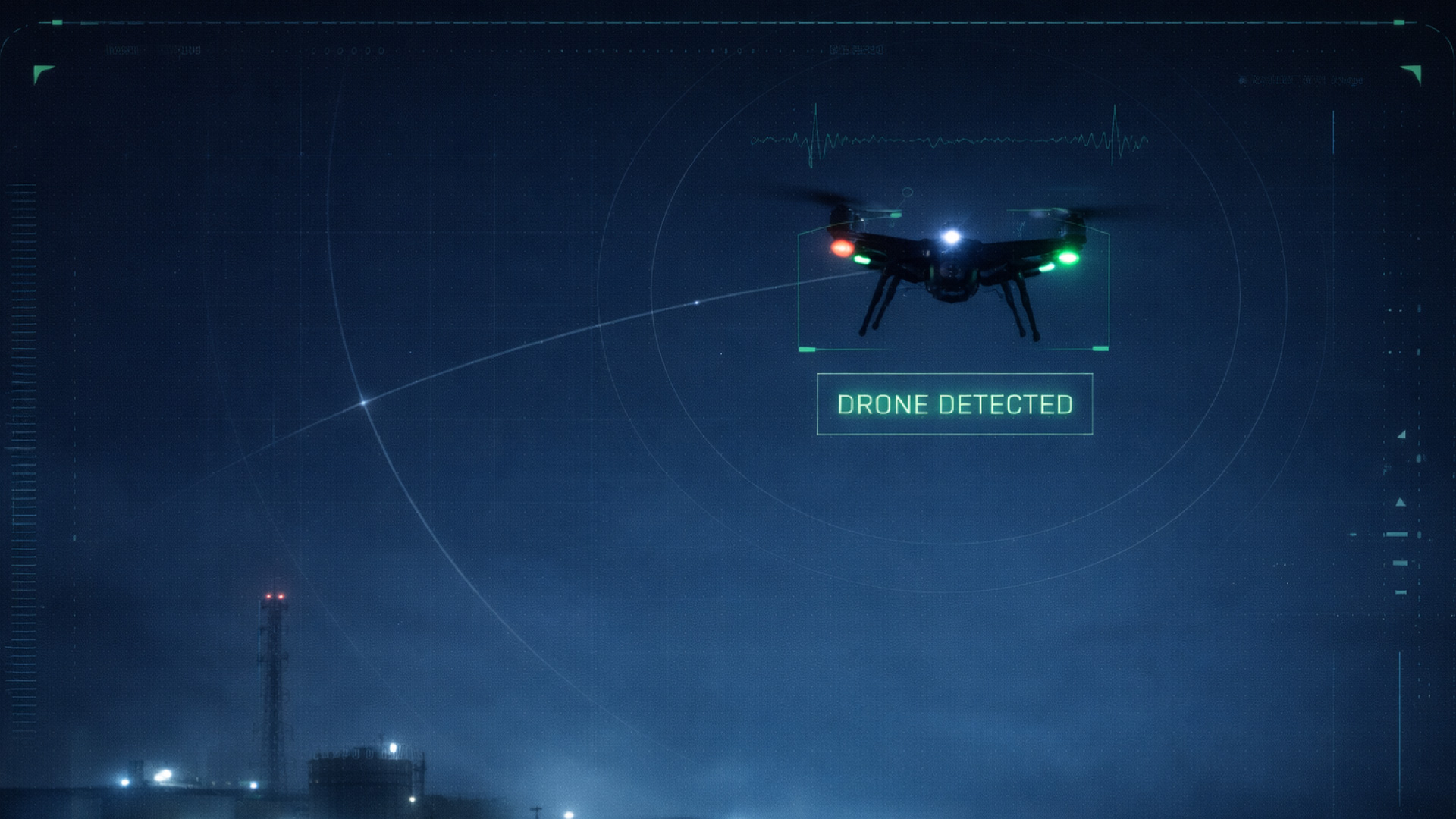
Most consumer drones flying legally at night will be visible because the FAA requires anti-collision lighting visible from at least 3 statute miles under 14 CFR Part 107.29. Under this regulation, any drone operating after civil twilight (30 minutes after sunset) must carry these lights. Here is what to look for:
Light patterns: Compliant drones display a white strobe that flashes at a regular interval, typically 40 to 100 cycles per minute. Many also have red and green navigation lights on opposite sides of the frame (red on the left, green on the right) following standard aviation convention. DJI drones add colored LED status indicators at each motor arm that show battery level and flight mode through color sequences.
Movement behavior: The single clearest indicator that a light is a drone rather than an aircraft or satellite is hovering. Airplanes and satellites cannot hover. Helicopters can, but they produce dramatically more noise. If a light in the sky holds position for several seconds, moves in short bursts, makes sharp directional changes, or ascends and descends vertically, it is almost certainly a drone.
Sound: Drones produce a distinctive buzzing or humming from their propellers, typically in a higher pitch than aircraft engines. This sound is most audible within a few hundred feet. At distances beyond 500 feet, most consumer drones are too quiet to hear, especially in environments with ambient noise.
How to distinguish drones from other objects at night:
- vs. aircraft: Planes move in steady, linear paths and produce consistent engine noise. Drones hover, change direction sharply, and buzz
- vs. satellites: Satellites appear as steady, non-blinking points moving at constant speed across the entire sky. They never hover or change direction
- vs. stars/planets: Stars twinkle and stay fixed. If a light moves laterally or vertically, it is not a star. The optical illusion called autokinesis can make a fixed point of light appear to drift when stared at in darkness - look away briefly and back to confirm movement
Why Visual Spotting Has Hard Limits
Everything above works for compliant drones operating legally with FAA-required lighting. But the drones that pose the greatest security risk are precisely the ones that will not cooperate with visual identification:
Lights can be disabled. A hobbyist flying legally keeps their anti-collision strobes on. A threat actor conducting surveillance or smuggling contraband into a correctional facility will turn them off. At that point, the drone becomes a small, dark object against a dark sky - essentially invisible to the naked eye beyond a few hundred feet.
Altitude defeats visual detection. Even with lights on, a drone at 400 feet (the FAA ceiling for most operations) appears as a tiny point of light indistinguishable from dozens of other objects. At 200 feet without lights, it is invisible. The FAA receives more than 100 unauthorized drone sighting reports near airports each month, and the DHS 2025 Homeland Threat Assessment confirms ongoing UAS activity over sensitive critical infrastructure sites where many operators remain unidentified. Most of these detections at critical infrastructure sites and event venues occur at altitudes where visual identification is unreliable.
Sound is range-limited. Consumer drones are audible at close range, but wind, traffic, HVAC systems, and crowd noise easily mask them beyond a few hundred feet. Acoustic detection works best in quiet, rural environments - not the urban and suburban settings where most unauthorized drone activity occurs.
The core problem: visual and audio spotting tells you a drone might be nearby. It cannot tell you the drone's exact position, altitude, heading, speed, model, operator location, or whether it is authorized. For homeowners, visual spotting is often sufficient to confirm that a drone was present and to report it. For organizations responsible for protecting people and assets, it is not enough.
How Professional Detection Works in Darkness
Professional drone detection equipment does not depend on visible light. The CISA UAS Detection Technology Guidance for Critical Infrastructure outlines how different sensor modalities perform across conditions. Each works differently in nighttime environments:
Radar is completely unaffected by darkness. Drone detection radar transmits electromagnetic waves and analyzes reflections, providing range, bearing, altitude, and velocity regardless of ambient light. FMCW radar can detect a commercial drone at 1 to 3 km day or night, and micro-Doppler processing distinguishes drones from birds even when the operator cannot see either.
RF sensors are unaffected by darkness. They detect the radio communication signals between a drone and its controller, identifying drone type and operator location without any dependence on visibility. The limitation remains the same day or night: RF sensors are blind to drones operating autonomously without a radio link.
Thermal (IR) cameras are actually more effective at night than during the day. Drones generate heat from motors and batteries that creates a clear thermal contrast against a cool night sky. During the day, solar heating of the atmosphere and surrounding objects reduces this contrast. At night, a drone's thermal signature stands out sharply, making thermal cameras the preferred visual confirmation tool for nighttime detection. PTZ thermal cameras with auto-tracking can be cued by radar or RF sensors to automatically follow a detected drone across the sky without an operator manually searching.
Remote ID receivers work identically day and night, capturing broadcast identification from compliant drones. Five sensor modalities covering different detection methods ensure that a layered system has no single point of failure, regardless of time of day.
When You Need More Than Your Eyes
For most individuals who see a drone over their property at night, the appropriate response is to document what you observed (time, location, light color, movement pattern, approximate altitude) and report it to local law enforcement or the FAA via the B4UFLY app. Visual identification is usually sufficient to confirm a drone was present.
Professional detection becomes necessary when:
- You need to detect drones that are not cooperating - lights off, no Remote ID broadcast, operating outside standard frequencies
- You need continuous monitoring - not just spotting a drone when it happens to pass overhead, but maintaining 24/7 airspace awareness over a facility or event
- You need tracking and identification - knowing not just that a drone is present, but where it is heading, what model it is, and where the operator is located. This is the DTIM workflow that professional systems follow
- You need forensic records - timestamped logs, sensor data, and camera footage that can support law enforcement action or regulatory reporting
- You are protecting a high-value target - airports, prisons, power plants, stadiums, and military facilities cannot rely on security guards scanning the sky with binoculars
If any of these apply, the question is not "how do I spot a drone at night" but "how do I build a detection system that works around the clock?" Our three-tier protection framework helps organizations determine which level of detection matches their threat profile and budget.
What to Do If You See a Drone Over Your Property
If you observe a drone at night and are concerned about your privacy or safety:
- Document the sighting. Note the time, your location, the drone's approximate altitude and direction, the color and pattern of any lights, and whether you heard propeller noise
- Do not attempt to interfere with the drone. Shooting, throwing objects, or using any device to disable a drone is a federal crime under the Communications Act and FAA regulations, regardless of where the drone is flying
- Report to local law enforcement if the drone appears to be conducting surveillance, flying recklessly, or operating near restricted areas
- File a report with the FAA if you believe the operation violates airspace rules. Under the SAFER SKIES Act, local law enforcement now has expanded authority to investigate and respond to unauthorized drone activity
This is part of our series on counter-drone detection and mitigation. Explore the full library:
- Drone Detection Equipment: A Buyer's Guide
- Drone Detection Radar: How It Works, What It Costs, and Which Type You Need
- Drone Jammers: How They Work and Who Can Legally Use Them
Responsible for protecting a facility or event? Talk to our team about 24/7 airspace detection that works day and night.