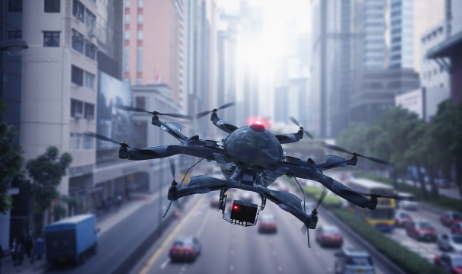

The drone detection market is projected to grow from $659 million in 2024 to $2.32 billion by 2029, a compound annual growth rate of nearly 29%. Behind that growth curve is a simple reality: no single detection technology can reliably identify every drone threat across all operational environments. The organizations making the smartest procurement decisions in 2026 are the ones that understand what each sensor modality actually does - and, more importantly, what it cannot do.
We built AirSight’s platform around this principle. Every facility, every airspace, and every threat profile is different, which is why we believe security buyers deserve a clear, vendor-neutral understanding of the technology landscape before making investment decisions. This guide breaks down the five core sensor modalities used in drone detection, explains their strengths and limitations, and outlines how they work together in a multi-sensor fusion architecture.
1. Radar Detection: The Long-Range Backbone
Radar systems detect objects by emitting radio waves and analyzing the reflections that return. In drone detection, radar provides the widest volumetric coverage of any sensor modality - modern phased-array systems can detect small drones at ranges of 5 to 30 kilometers, even in rain, fog, and complete darkness. TSA’s C-UAS Test Bed Program at Miami International Airport and LAX evaluates radar as one of the primary detection technologies for airport environments, testing its effectiveness against real-world UAS incursions in operational settings.
Where radar excels:
- Wide-area surveillance across large perimeters and airfields
- All-weather, day-and-night operation independent of visual conditions
- Range and altitude tracking that feeds downstream classification systems
- Detection of drones that are not emitting any RF signal - including fully autonomous platforms
Where radar struggles:
Small commercial drones present extremely low radar cross-sections (RCS) - often comparable to birds. This makes distinguishing a 1-kilogram quadcopter from a flock of starlings one of the hardest problems in detection engineering. As we examined in our analysis of RCS and FPV stealth drone detection challenges, carbon-fiber airframes and composite construction further reduce RCS, pushing some drones below the noise floor of general-purpose surveillance radar. Ground clutter in urban environments, multipath reflections from buildings, and the altitude limitations of horizon-line physics all add complexity. Radar is the backbone of any serious detection architecture - but it is not the whole skeleton.
Radar tells you something is in the air. But when the drone goes silent - no active control link, no cooperative broadcast - what fills the identification gap?
2. RF Detection: Listening to the Control Link
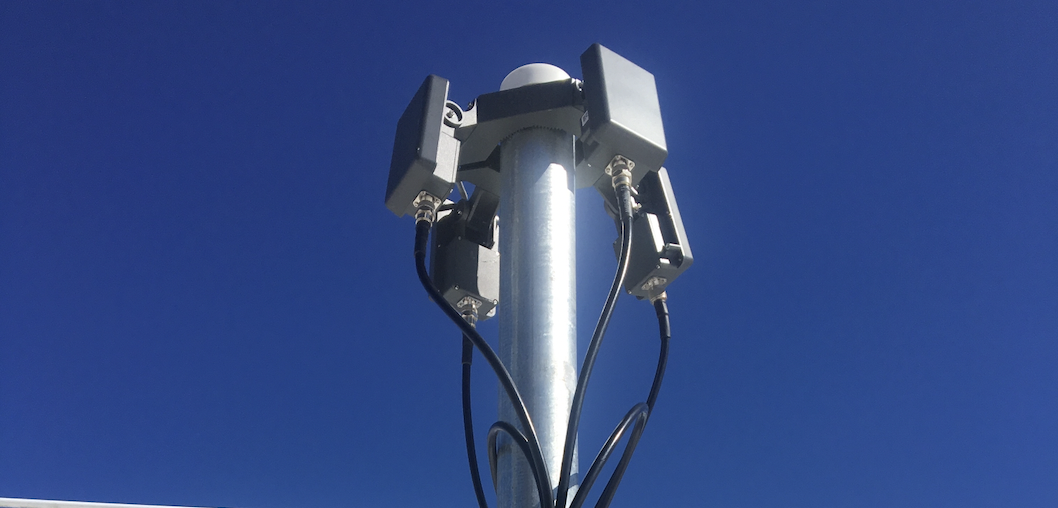
Radio frequency detection systems work passively - they do not emit signals. Instead, they monitor the electromagnetic spectrum for the communication links between drones and their controllers. When a drone communicates using known protocols (DJI’s OcuSync, standard Wi-Fi, or proprietary control links), RF sensors can identify the drone’s presence, its manufacturer, its model family, and sometimes the position of both the drone and its operator. This classification capability is what makes RF detection uniquely valuable in the kill chain.
Where RF excels:
- Identifying drone make, model, and protocol - critical for threat classification under SAFER SKIES Act requirements
- Locating the operator on the ground, not just the drone in the air
- Passive operation requiring no emissions licenses or spectrum coordination
- Low false-alarm rates against non-drone RF sources when protocol parsing is used
Where RF struggles:
The fundamental limitation of RF detection is its dependence on the drone actively transmitting. A drone operating on a pre-programmed GPS waypoint mission with no active control link will be invisible to RF sensors. Encrypted or non-standard frequencies reduce accuracy. Dense urban RF environments - cell towers, Wi-Fi routers, Bluetooth devices - create noise that can degrade signal-to-noise ratios. And as DHS’s Science and Technology Directorate has noted in its C-UAS assessment work, the emergence of autonomous “dark” drones operating without any RF emissions represents a growing gap that RF-only systems cannot close.
RF detection excels at classifying what it can hear. But security operators also need to see and confirm what they’re tracking - and that requires a different kind of sensor entirely.
3. Electro-Optical and Infrared (EO/IR) Sensors: Visual Confirmation
Electro-optical (EO) cameras operate in visible light; infrared (IR) sensors detect heat signatures. Together, they provide what no other modality can: visual confirmation of the target. In the counter-UAS kill chain, EO/IR is the “eyes” - the sensor that turns a radar blip or an RF alert into a confirmed drone with visual evidence suitable for threat assessment, post-incident reporting, and - where authorized - engagement decisions.
Modern EO/IR systems integrate AI-based image recognition that can classify drones and distinguish them from birds, debris, or other airborne objects. However, as a recent Teledyne FLIR technical analysis published in Inside Unmanned Systems demonstrates, most neural networks lose reliable shape and texture cues when targets fall below approximately 10×10 pixels - a critical constraint that determines the effective classification range of any camera-based system.
Where EO/IR excels:
- Positive visual identification of drone type, payload, and behavior
- Evidentiary-grade imagery for incident reporting and legal proceedings
- Day/night operation when visible-light and thermal cameras are paired
- AI-driven classification reduces false positives from radar or RF cueing
Where EO/IR struggles:
EO/IR sensors require line of sight and are limited by range - effective classification typically drops beyond 1–2 kilometers depending on optics. Environmental conditions including darkness, fog, and rain can significantly hinder EO/IR effectiveness, and thermal cameras face particularly strong atmospheric attenuation under dense fog or heavy precipitation. EO/IR works best as a confirmation and tracking layer cued by a wide-area sensor like radar or RF - not as a standalone detection system.
Cameras confirm what you can see. But what about the threats you can only hear?
4. Acoustic Detection: The Close-Range Listener
Acoustic sensors use microphone arrays to detect the distinctive sound signatures of drone motors and propellers. Every drone model produces a unique acoustic fingerprint, and pattern-matching algorithms compare captured audio against libraries of known profiles. Ukraine’s combat-proven acoustic detection network - over 24,000 sensors deployed at under $500 per unit - demonstrates that this modality can achieve massive scale at a fraction of the cost of radar or RF systems.
Where acoustic excels:
- Detects autonomous drones with no RF emissions and minimal RCS - closing the “dark drone” gap
- Passive, covert operation - drones cannot detect or evade acoustic sensors
- Extremely low cost per unit, enabling dense deployment across large perimeters
- Effective in rural, low-noise environments and as a cueing sensor for other modalities
Where acoustic struggles:
Range is the primary constraint - most acoustic systems are effective to approximately 300–500 meters under favorable conditions, with performance degrading significantly in wind or noisy environments. Airports, stadiums, highways, and urban areas generate ambient noise that can mask drone signatures. Newer drone models are also being designed with quieter motors and propellers, reducing the acoustic signature available for detection. Acoustic is a valuable supplementary layer - but no serious detection architecture relies on it as a primary modality.
Acoustic and radar detect threats. RF classifies them. Cameras confirm them. But there is a fifth data layer that changes the classification equation entirely.
5. Remote ID Receivers: The Cooperative Data Layer
Remote ID is the newest addition to the drone detection toolkit. Under current FAA enforcement of Remote ID regulations, all registered drones must broadcast identification and telemetry data via Bluetooth or Wi-Fi during flight. Remote ID receivers capture this broadcast data, providing the drone’s serial number, operator location, altitude, velocity, and flight path in real time.
Where Remote ID excels:
- Instant identification of cooperative (compliant) drones with zero ambiguity
- Operator location data - the only modality that can pinpoint the pilot’s position with certainty on compliant drones
- Integration with UAS Traffic Management (UTM) systems for authorized-vs-unauthorized classification
- Low infrastructure cost - receivers are relatively inexpensive to deploy at scale
Where Remote ID struggles:
Remote ID is a cooperative system - it only works when the drone is broadcasting. A malicious actor who disables or never installs Remote ID equipment will be invisible to this modality. This is the fundamental distinction: Remote ID tells you about the drones that are playing by the rules. The drones that pose the greatest threat - modified, autonomous, or purpose-built for hostile operations - are precisely the ones that will not broadcast. Remote ID is essential as a classification and filtering layer (quickly identifying authorized drones so operators can focus on unknowns), but it cannot serve as a security-grade detection system on its own.
Each of these five modalities has a critical blind spot. The question is not which one to choose - it is how to combine them.
Why Multi-Sensor Fusion Is the Only Viable Architecture
The pattern across all five modalities is clear: each one has a critical blind spot that another modality covers. Radar cannot classify. RF cannot detect autonomous drones. EO/IR has limited range. Acoustic is range-constrained and noise-sensitive. Remote ID only sees compliant platforms. Peer-reviewed research consistently confirms that multi-sensor fusion systems deliver the most reliable detection performance across operational environments - combining modalities to reduce false positives while expanding the threat envelope covered.
This is the architecture that federal evaluations are validating. The TSA’s UAS Test Bed Program tests multi-modal detection systems in live airport environments. The DHS Science and Technology Directorate assesses integrated solutions that combine detection, tracking, and identification capabilities. The FEMA C-UAS Grant Program funds equipment across the full detection spectrum: radar, EO/IR, passive acoustic, and RF monitoring platforms.
The operational principle is straightforward: radar provides the wide-area early warning; RF identifies and classifies commercial drones using protocol analysis; EO/IR visually confirms the target; acoustic covers the near-field and detects RF-silent platforms; Remote ID filters cooperative traffic. A unified C2 platform fuses all five data streams into a single operating picture - giving security operators the situational awareness they need to assess threats and make informed decisions under the SAFER SKIES Act’s “credible threat” standard.
What to Ask Any Drone Detection Vendor
Whether you are a security director evaluating systems for a correctional facility, an airport operations manager preparing for FAA and TSA detection requirements, or a state agency deploying FEMA C-UAS grant funding, these are the questions that separate serious detection platforms from single-sensor solutions:
- How many sensor modalities does the platform integrate? A system built around one sensor type will always have a structural blind spot.
- Can it detect autonomous, RF-silent drones? If the system relies solely on RF detection, it cannot see the most dangerous category of threats.
- What is the false-positive rate in your target environment? Airport, stadium, and urban environments all produce different interference profiles.
- Does it provide a unified operating picture? Separate sensor feeds without a C2 integration layer create information overload, not situational awareness.
- Is it compatible with Remote ID and future UTM integration? The airspace is about to get denser as BVLOS operations scale under Part 108.
- What is the total cost of ownership - not just hardware? Factor in installation, training, maintenance, software licensing, and integration services.
Want a deeper dive into procurement strategy? Read our companion guide: Drone Detection Companies: How to Evaluate Vendors for Your Security Mission.
The Right Sensor for the Right Job
There is no single “best” drone detection technology. There is only the right combination of technologies for a specific site, threat profile, and operational mission. The organizations that invest in understanding these modalities - and deploy them in a layered, fused architecture - will be the ones best positioned to detect, classify, and respond to the drone threats that are already here and the more sophisticated ones that are coming.
As drone operations scale under new FAA frameworks and counter-UAS authority expands to state and local agencies under SAFER SKIES, the demand for multi-sensor detection infrastructure is only going to accelerate. The time to understand the technology landscape is now - before the next procurement cycle, the next major event, or the next drone incident that nobody saw coming.
See how five sensor streams come together in one operating picture - book a live AirGuard walkthrough.