Yes, a drone can legally fly over your private property, and no, that does not mean you have no rights. The confusion comes from two systems that overlap without ever quite agreeing: federal aviation law, which gives the FAA jurisdiction over all airspace and treats drones as aircraft free to fly above the immediate reaches of your land, and state law, which increasingly treats persistent low-altitude flights as trespassing and drone surveillance as invasion of privacy. The legal answer depends entirely on what the drone is doing, how low it is flying, and which state you live in.
This guide covers both sides honestly: what drone operators are allowed to do under FAA rules, where property owners' rights begin, the state laws that have changed the equation since the FAA wrote its rules, and the practical steps that actually stop unwanted flights. We build drone detection systems for the facilities where this question is not academic, so we will be direct about where the law helps and where it falls short.
The Federal Rule: The FAA Controls All Airspace
The baseline is simple and surprises most property owners. The FAA holds jurisdiction over the entire national airspace system, starting from the ground up, and under FAA rules there is no minimum altitude restriction specific to drones over private property. A registered drone flying under visual line of sight, below 400 feet, and complying with Part 107 or recreational rules is technically legal under federal law even at 50 feet over your backyard, provided it is not over people or moving vehicles without a waiver.
Manned aircraft have clear minimums: 500 feet above ground in suburban areas, 1,000 feet over congested areas. Drones have no equivalent floor. This asymmetry is the root of the tension: a drone can legally do things at low altitude that would be a violation for a Cessna, and the FAA has not drawn the line that property owners are waiting for.
How Low Can You Fly a Drone Over Private Property?
There is no single federal answer, but the legal framework that courts apply starts with a Supreme Court case from 1946. In United States v. Causby, the Court held that a landowner owns at least the immediate reaches of the airspace above their land, the space they can occupy or use in connection with the surface. Flights through that zone by government aircraft amounted to a taking of property. What Causby did not do is specify an altitude, and no federal court has definitively ruled where the immediate reaches end for a drone hovering at 50 or 100 feet. States are filling that gap unevenly.
Virginia is the most specific: its statute makes it a Class 1 misdemeanor to knowingly fly a drone within 50 feet of another person's dwelling after being told to stop. Utah treats a fence as sufficient notice against aerial entry of private property. Other states address the question through broader privacy or trespass statutes that courts are applying to drones case by case. The practical threshold that is emerging across the patchwork is that flights below roughly 50 to 100 feet over residential property, particularly repeated or hovering flights, face increasing legal exposure to trespass and nuisance claims.
When a Drone Over Your Property Becomes Trespassing
A single overflight at altitude is almost certainly legal. A drone hovering 30 feet over your pool is almost certainly not, at least under state law. The line between them depends on three factors that courts are applying with increasing consistency:
-
Altitude and duration. The lower and longer the flight, the stronger the trespass argument. A transit at 200 feet rarely triggers legal exposure. A hover at rooftop height for several minutes invades the Causby immediate reaches in most jurisdictions.
-
Notice and persistence. Several state statutes, including Virginia's and Utah's, hinge on whether the operator continued flying after being told to stop. A first overflight may be excused. Returning after notice is deliberate trespass in the states that have drawn the line.
-
Intent and surveillance. A drone transiting your airspace to reach a job site is different from one that lingers over your backyard with a camera pointed at your windows. Courts treat the latter as far more actionable, and the states with the strongest protections make that distinction explicitly.
Several states have enacted drone-specific trespass statutes that directly address these scenarios, and more than 17 states now have some form of drone-specific privacy legislation. Even without a drone statute, property owners in any state can pursue civil claims under three traditional theories: airspace trespass, private nuisance, and invasion of privacy.
Drone Privacy Laws: What States Are Actually Enforcing
Privacy is where state law has moved fastest, because the drone-with-a-camera scenario triggers protections that predate drones entirely. The core principle is reasonable expectation of privacy: if you are in your backyard, behind a fence, in a space the law considers private, a camera overhead violates that expectation whether it is on a drone or a ladder.
California goes furthest. Under Civil Code 1708.8, using any visual or auditory enhancing device, which the legislature explicitly extended to include drones, to capture images of a person engaged in private activity constitutes constructive invasion of privacy, even without physically entering the property. Damages include general and special damages, up to treble damages, disgorgement of commercial proceeds, and punitive damages. An operator does not have to land on your land. The statute reaches airspace.
Texas criminalizes drone surveillance of private property without consent. Florida prohibits law enforcement from using drones for surveillance without a warrant and restricts private drone surveillance as well. Oregon, Tennessee, and Nevada have similar protections. The patchwork is wide, which is why knowing your state's specific provisions matters, but the trajectory is one-directional: states are adding protections, not removing them.
What Property Owners Can Actually Do
Here is the action list that works within the law. It applies whether you are a homeowner, a corporate campus, or a facility manager:
-
Document every incursion. Dates, times, altitude estimates, flight duration, direction, and video. A pattern is stronger than a single event in every legal forum: FAA complaint, police report, civil suit, and insurance claim.
-
Identify the operator. FAA Remote ID requires most drones to broadcast identification. A drone detection system reads Remote ID automatically, providing operator location and aircraft serial number for every compliant drone in your airspace.
-
Report to the FAA and local police. FAA complaints address flight-rule violations (reckless operation, unauthorized night flights, flights over people). Police reports invoke state trespass, privacy, harassment, and stalking statutes. Both paths are stronger with documented evidence.
-
Send a formal notice. In states with notice-and-persist statutes like Virginia, a written demand to a known operator to cease overflights converts the next flight into a criminal offense. For commercial campuses and HOAs, posting no-drone signage and including aerial restrictions in community rules creates a documented record of notice.
-
Pursue civil remedies. Trespass, nuisance, and invasion of privacy all support civil claims with compensatory and, in states like California, treble and punitive damages. An attorney can evaluate whether your evidence supports a claim, and the detection record is the evidence file. Our pillar guide to legally responding to drones over your property covers every step in detail.
For Facilities: When a Privacy Problem Becomes a Security Problem
For individual homeowners, drones over property are a privacy and nuisance issue. For facilities, the same drone is a security threat, and the response scales accordingly. A drone conducting pre-attack surveillance on a substation, mapping a prison yard's blind spots, or photographing a corporate R&D campus is not a neighborly annoyance. It is operational intelligence collection, and the response needs to be systematic.
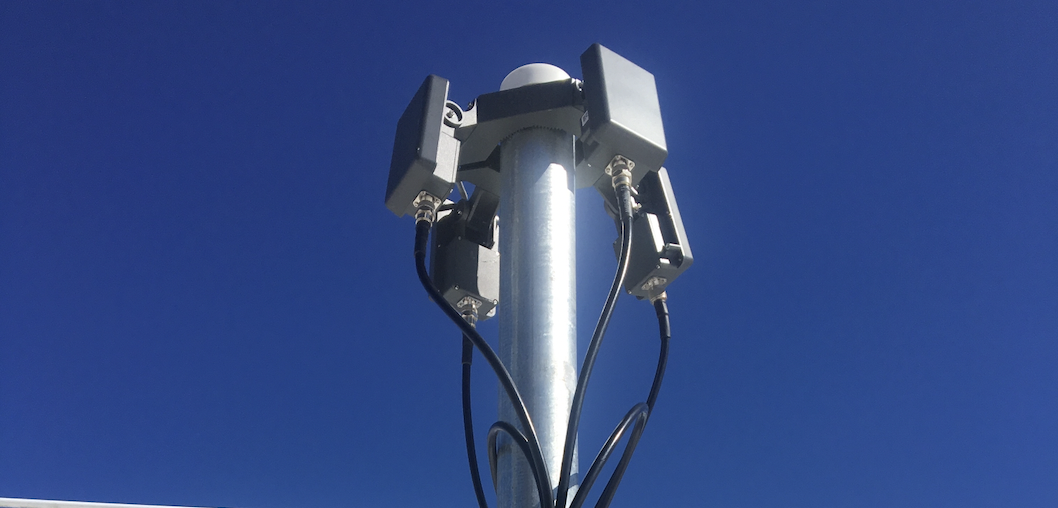
The facility-grade response adds layers the homeowner does not need. Radar detection catches drones that are not broadcasting Remote ID, including the autonomous and non-emitting aircraft that carry the highest risk. RF sensors capture the Remote ID data and operator location when available. Cameras confirm the drone visually. A fused detection system generates the continuous, time-stamped evidence trail that supports FAA complaints, law enforcement referrals, facility insurance claims, and now the FAA's new petition process for drone flight restrictions over fixed sites.
Detection equipment for eligible public agencies is covered at 100 percent federal funding through the FEMA Counter-UAS Grant Program. For critical infrastructure, airports, and correctional facilities, the combination of detection, documentation, and law enforcement coordination is not a workaround for the inability to shoot. It is the only approach that actually works, scales, and survives legal scrutiny.
What You Cannot Do
Three things that feel logical and are all illegal:
-
Shoot the drone. A drone is an aircraft. Destroying one is a federal felony under 18 U.S.C. 32, with penalties up to 20 years. We cover the full picture in our guide to whether you can legally shoot down a drone.
-
Jam the signal. FCC prohibits private use of jammers, with fines up to $112,500 per violation and criminal sanctions. See our guide to anti-drone guns.
-
Intercept the feed. Accessing the drone's video or data stream without authorization violates the Computer Fraud and Abuse Act. Observe the drone with your own eyes and cameras. Do not intercept what it sees.
In every case, the person who breaks the law to stop a drone ends up in more legal trouble than the pilot. The legal response is documentation, identification, and enforcement through agencies with authority. For law enforcement agencies gaining that authority, our guide to drone mitigation and the SAFER SKIES certification path covers what is now possible.
Your Rights Are Real. Use Them the Right Way.
Can someone fly a drone over your private property? Under federal aviation rules, often yes. Under state trespass and privacy law, increasingly no, especially when the flight is low, persistent, or involves surveillance. The rights exist. The remedies are real. What does not work is vigilante enforcement, because every form of it is its own federal offense.
We believe the property owners and facility managers who handle drones effectively are the ones who invest in awareness rather than weaponry. Know what is flying over your property. Know who is flying it. Document the pattern. And use the legal tools that are available, from state privacy statutes to FAA complaints to the new UAFR petition process, with evidence that makes each one work. The law is catching up. Your job is to be ready with the data when it does.
Need to know what is flying over your facility and who is flying it? Talk to our team about detection and Remote ID monitoring for your site.
Related reading: