
Finding your SAA is the easy part.
Every FEMA counter-UAS grant flows through your state's State Administrative Agency. FEMA lists all 56 in one place. Here's how to work with yours once you know who they are.
What an SAA is, and why it decides your application
FEMA does not accept counter-UAS applications from individual agencies. Every application flows through the state's State Administrative Agency (SAA), which packages sub-applicant requests into the state's single Investment Justification.
Two consequences. First, at least 97% of funding passes through the SAA to sub-recipients, so once you're in the state's package, you're in the funding. Second, states run their own sub-application windows that close well before FEMA's federal deadline. Miss the state window and you're out for the cycle.
Find yours in FEMA's directory
State Administrative Agency Contacts
All 56 states and territories, with the current point-of-contact name, phone, and email. Maintained by FEMA. Bookmark it. You'll come back.
Five moves after you find your SAA
Knowing the agency name is table stakes. These five moves are what separate the sub-applications that get funded from the ones that get thanked for their submission.
Contact them before the NOFO drops
State sub-application windows close weeks before FEMA's federal deadline. Get on your SAA's list now, not when the NOFO publishes.
Bring a facility-specific risk assessment
FEMA rewards threats tied to specific sites, not jurisdiction-wide requests. Come to your SAA with the assessment done, not with a wish list.
Frame it against FEMA's scoring criteria
FEMA rewards multi-sensor detection, integration with your state's existing systems, standing capability beyond one-off events, and building a statewide intelligence network coordinated across agencies.
Understand your state's priority hazards
Read your state's THIRA. Frame your project as a solution to airspace exposure sitting under existing priorities, not alongside them.
Draft the Investment Justification early
The IJ is what FEMA reviews. Drafting yours before the NOFO publishes is the biggest signal your project is serious.
What FEMA will fund
The Counter-UAS Grant Program funds five categories, together. Applications that ask only for equipment consistently score lower than those showing planning, training, and exercises alongside the buy. Here's what fits in each.
Planning
UAS response plans, risk assessments, standard operating procedures, and information-sharing protocols with federal partners.
Organization
Program management costs. Operational overtime for coverage during major events.
Equipment
Radar, EO/IR cameras, passive RF sensors, Remote ID receivers, sensor fusion software, third-party SaaS.
Training
System operation and scenario-based drills. FBI NCUTC required for mitigation only, not for detection or tracking.
Exercises
Tabletop, functional, and full-scale. Multi-jurisdictional coordination is scored heavily.
By the numbers
Phase 1 as your reference
Oct 28, 2025
Phase 2 is expected to follow a similar accelerated timeline. If FY 2027 opens in October 2026, agencies that start preparing now will be application-ready; those that wait for the NOFO will not.
Not fundable
Weapons, ammunition, and weaponized aircraft, vessels, or vehicles. Non-weaponized drones for monitoring and data collection are permitted. Mitigation technology is limited to select jurisdictions and requires personnel trained at the FBI National Counter-UAS Training Center. Full unallowable costs list →
Talk to the rep who knows your territory
Every state and territory maps to a regional AirSight representative who knows your state's SAA, priority hazards, and what other agencies in your area are building. Find yours below.
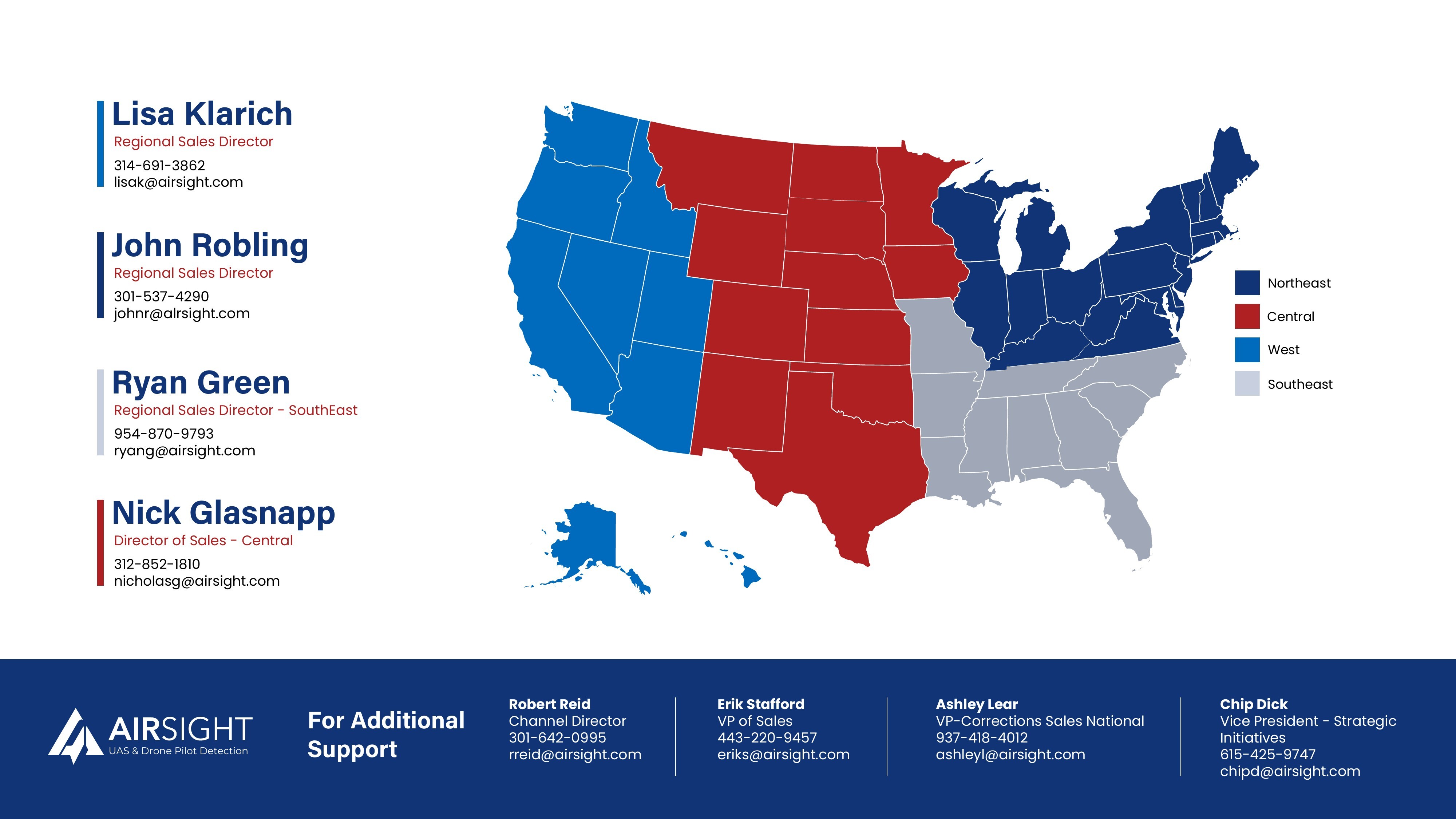
Click the map to view the full contact directory (PDF).
We help agencies work through all five.
Airsight's team has helped state and local agencies scope risk assessments, frame projects for FEMA scoring, and draft Investment Justifications that survive state review. Book 30 minutes with the team.
Book a consultationFunds to keep an eye on: DOJ's BIDEN Grant
Not every counter-UAS dollar runs through FEMA. The DOJ Bureau of Justice Assistance is releasing $3B through a separate program — formally the Bridging Immigration-Related Deficits Experienced Nationwide ("BIDEN") Program — across three rolling application rounds. If your agency maintains or is pursuing a 287(g) partnership or HSTF involvement, it's worth a look alongside your FEMA plans.
Why Drone Detection Belongs in Your BIDEN Application
A 3-page brief covering program eligibility, why drone detection fits BIDEN's funding priorities, the full application timeline across all three rounds, and what to do now to be ready when funds clear.
- ✓ Eligibility & 287(g)/HSTF requirements
- ✓ Round 1–3 dates: NOFO, Grants.gov, JustGrants
- ✓ What to prepare before an award lands
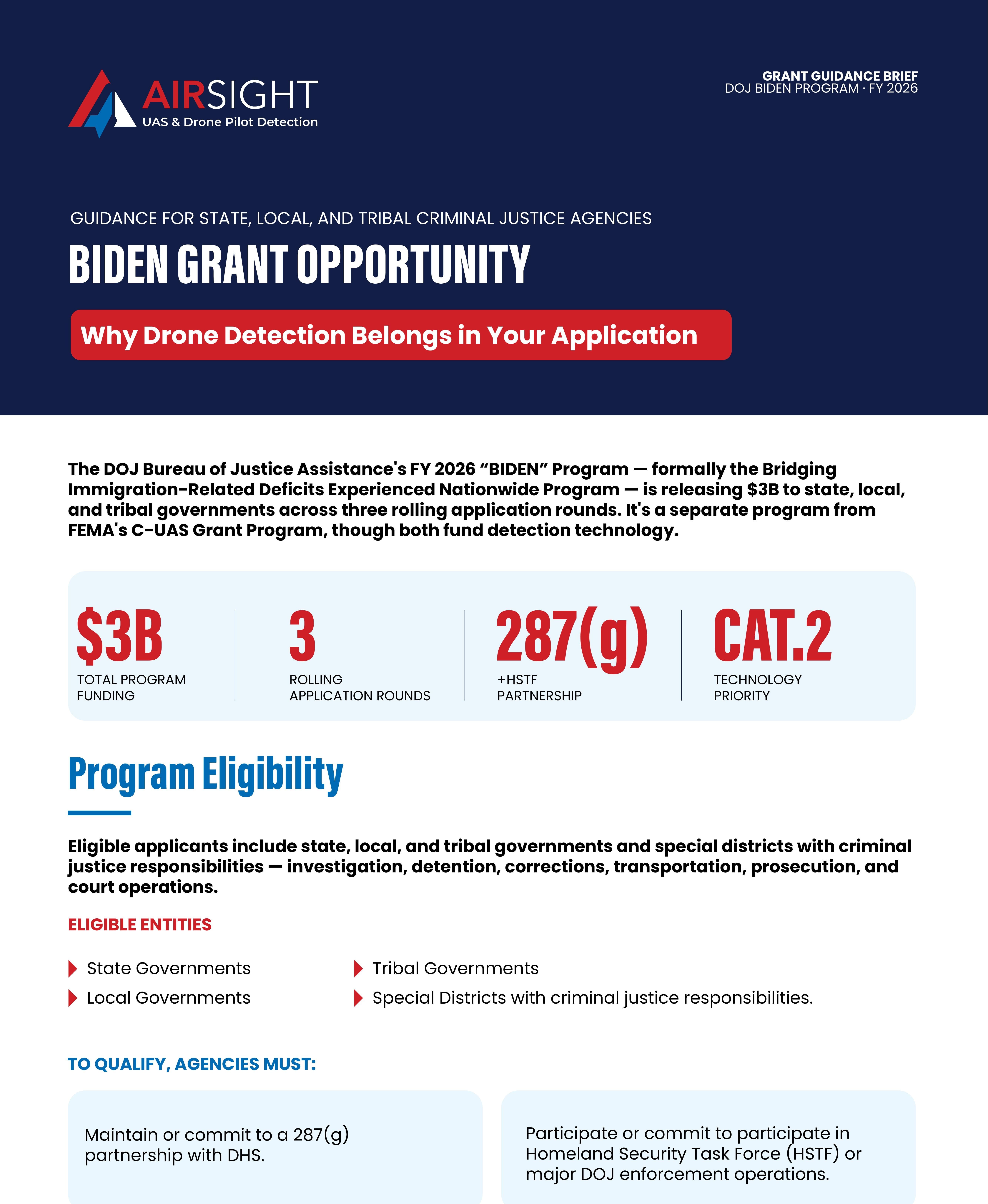
Get the BIDEN Grant Guide
Enter your work email and we'll unlock the download.
Watch the full FEMA Phase 2 briefing
The FEMA Phase 2 Playbook: Winning Your Share of $250M in Counter-Drone Funding
A 45-minute session covering how Phase 1 was scored, how to engage your SAA in practice, the risk assessment FEMA expects, and how detection and coordination become one fundable application. Every question we took live, with the answer on record.
