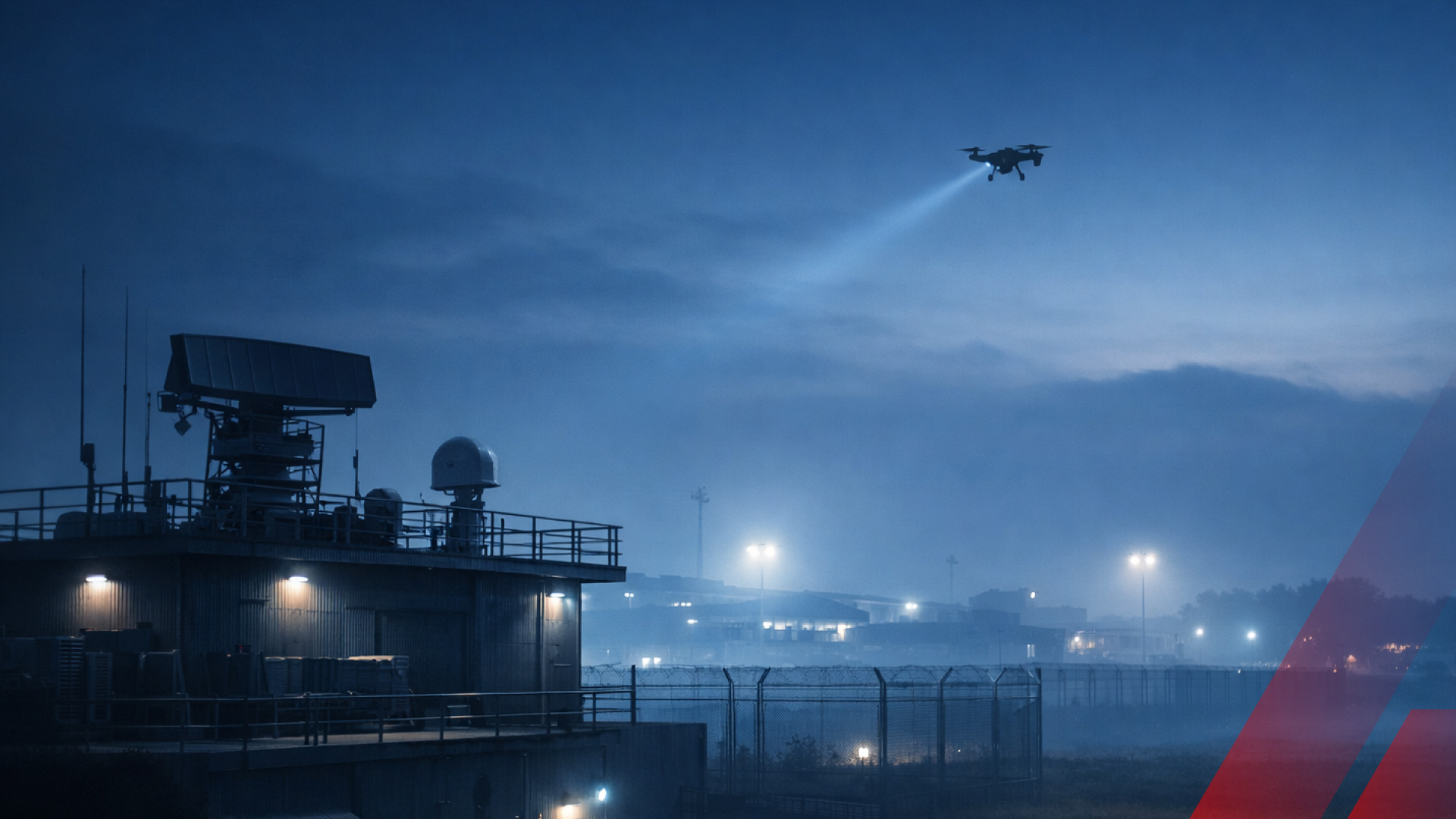
Radar is the foundation of every serious counter-drone deployment. It is the only sensor that can detect a drone regardless of whether it is broadcasting a radio signal, and the only one that works in darkness, fog, rain, and smoke. That is why the DHS Program Executive Office for UAS and Counter-UAS has prioritized radar-based detection across its $115 million investment in counter-drone capabilities, and why FEMA's $500 million C-UAS Grant Program lists radar systems among the top eligible equipment categories for state and local agencies.
We build our detection platform around radar as the backbone layer because it gives security teams something no other sensor can: the ability to see objects in the airspace that are trying not to be seen. But radar is also the most misunderstood technology in the counter-drone toolkit. Not all radar detects drones equally, and the physics of detecting small, slow, low-flying objects are fundamentally different from tracking aircraft. This guide explains how drone detection radar actually works, what separates the different types, what they cost, and how to choose the right one for your facility.
Why Detecting Drones with Radar Is So Difficult
The core challenge comes down to physics. A drone's detectability by radar is determined by its radar cross-section (RCS), which measures how much electromagnetic energy the object reflects back to the radar antenna. Commercial quadcopters present RCS values of just 0.01 to 0.1 square meters, roughly the same as a large bird. Fixed-wing drones built with carbon fiber or foam can be even stealthier, with RCS as low as -22 dBsm depending on angle and frequency.
This creates three compounding problems. First, the radar range equation dictates that detection range scales with the fourth root of RCS, meaning that halving a drone's radar reflectivity only reduces detection range by about 16%, but a drone with 1/100th the RCS of a conventional aircraft target cuts detection range by roughly 70%. Second, drones fly at altitudes (50 to 200 meters) where ground clutter from trees, vehicles, buildings, and terrain can overwhelm the faint drone return signal. Third, birds produce radar signatures nearly identical to drones in both RCS magnitude and flight speed, creating persistent false alarm problems that can paralyze security operations if not addressed.
These constraints explain why traditional air surveillance radar, designed for large aircraft moving at high speed and high altitude, is essentially blind to the drone threat. Purpose-built drone detection radar exists specifically to solve these three problems through specialized waveforms, signal processing, and classification algorithms.
Types of Drone Detection Radar
There are three primary radar architectures used in counter-drone systems today. Each has distinct strengths and trade-offs that matter for different deployment scenarios.
FMCW (Frequency Modulated Continuous Wave) Radar
FMCW radar has become the preferred architecture for tactical and commercial counter-drone systems because it solves one of radar's fundamental limitations: blind range. Pulse radars cannot detect targets that are too close (a radar with a 1-microsecond pulse has a minimum detection range of approximately 150 meters). FMCW radar transmits a continuous frequency-swept signal and measures the difference between transmitted and received frequencies to determine both range and velocity simultaneously. Because it transmits continuously, there is no minimum range, making it critical for perimeter defense where a drone could launch from just outside a fence line. FMCW systems are compact, low-power, and well suited for fixed installations at critical infrastructure sites, correctional facilities, and corporate campuses.
Pulse Doppler Radar
Pulse Doppler systems transmit discrete bursts of energy and analyze the Doppler shift of returning signals to measure target velocity. They excel at longer ranges and are better at rejecting ground clutter through moving target indication (MTI) processing. Airport surveillance radars and military air defense systems typically use pulse Doppler architecture. For drone detection, pulse Doppler radar provides the best long-range performance, typically 5 to 20 kilometers depending on target RCS and system power. The trade-off is larger size, higher power consumption, and the minimum-range blind zone inherent to pulsed systems.
Phased Array Radar
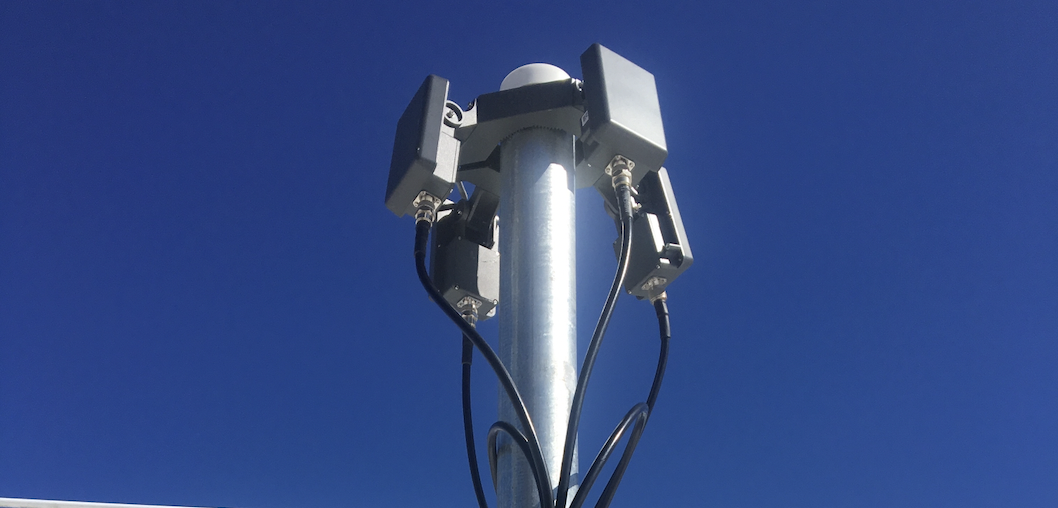
Phased array radar uses multiple antenna elements with individually controlled phase relationships to electronically steer the radar beam without mechanical rotation. This enables 360-degree coverage without moving parts, scanning speeds tens of times faster than mechanical antennas, and the ability to track multiple targets simultaneously. Modern phased array systems combine FMCW waveforms with electronic beam steering to deliver both close-range sensitivity and wide-area coverage. This combination has made phased array the architecture of choice for high-value fixed sites like airports and stadiums where multiple threats may appear from different directions simultaneously.
For a broader look at how radar fits alongside RF sensors, cameras, acoustic detectors, and Remote ID receivers, read our guide on drone detection technology and the five sensor modalities.
How Radar Tells Drones from Birds: Micro-Doppler Classification
The breakthrough that transformed radar from a frustrated sensor into an effective drone classifier is micro-Doppler analysis. Spinning propeller blades create time-varying Doppler shifts that appear as unique sidebands around the main radar return. A typical DJI quadcopter with 13 cm blades spinning at approximately 100 Hz produces micro-Doppler signatures that are continuous and symmetric around the main Doppler frequency. Birds, by contrast, produce periodic, asymmetric modulation at much lower frequencies (4 to 10 Hz) from their wingbeats.
This difference is consistent enough that modern radar systems equipped with AI-powered classification algorithms can distinguish drones from birds using range-Doppler map analysis and convolutional neural networks, achieving classification accuracy above 97% in controlled conditions. In real-world deployments with clutter, wind, and multiple targets, accuracy is lower but still sufficient to dramatically reduce false alarm rates compared to systems relying on RCS or flight path alone.
The practical implication: any drone detection radar you evaluate should include micro-Doppler classification capability. Without it, a radar installation at a site with bird activity will generate so many false alarms that operators will either ignore alerts or turn the system off entirely.
What Drone Detection Radar Costs
Drone detection radar pricing spans a wide range depending on architecture, coverage area, and integration complexity. Within the three-tier anti-drone system framework, radar typically appears at Tier 2 and Tier 3:
| Radar Type | Price Range | Typical Range | Best For |
|---|---|---|---|
| Single FMCW unit | $30K - $80K | 500m - 3km | Perimeter protection, campuses, prisons |
| Phased array (single sector) | $80K - $200K | 2km - 10km | Airports, stadiums, power plants |
| Multi-panel phased array (360-degree) | $200K - $500K+ | 5km - 20km | Military bases, critical infrastructure, major events |
| Pulse Doppler surveillance | $300K - $1M+ | 10km - 30km+ | Wide-area air surveillance, border zones |
These prices are for the radar hardware itself. Total system cost including C2 integration, installation, calibration, and training will be higher. Under the FEMA C-UAS Grant Program, radar systems are eligible for 100% federal funding with no local match required. For the complete federal funding picture, including the $625 million FIFA World Cup Grant Program and JIATF-401 marketplace, read our analysis of the anti-drone market and federal funding landscape.
Why Radar Alone Is Not Enough
Radar is indispensable but incomplete. It cannot tell you who is operating a drone, whether the drone is authorized, or what payload it carries. It struggles with hovering targets that blend into stationary clutter, and it will miss RF-silent drones that other sensors would catch through visual or acoustic signatures. As the Pentagon's JIATF-401 guidance on counter-drone testing emphasizes, effective counter-drone systems require standardized, multi-sensor approaches that layer different detection methods.
The strongest deployments use radar as the primary search sensor, with RF analyzers providing operator identification and Remote ID compliance data, and EO/IR cameras delivering visual confirmation. A command-and-control platform fuses data from all sensors into a single operating picture, so that when radar detects an object, the system automatically cues cameras to verify and RF sensors to identify. This is the layered detection model that drives our own architecture, and it is the approach the integrated vs. point-solution decision framework is designed to help you evaluate.
How to Choose the Right Drone Detection Radar
The right radar depends on four variables:
- Coverage area: A single FMCW unit covers a few kilometers. An airport or military base needs multi-panel phased array or networked sensors for full perimeter coverage.
- Threat profile: If your primary risk is commercial drones (DJI-class), FMCW radar with micro-Doppler provides excellent detection. If you face modified or autonomous drones without RF signatures, you need radar with the sensitivity and classification algorithms to separate them from clutter.
- Environment: Urban sites with buildings and road traffic generate heavy clutter that demands advanced processing. Open sites like borders and airfields allow radar to perform at maximum range with fewer false alarms.
- Integration: Radar should never be evaluated in isolation. The question is how well it integrates with your other sensors and your C2 platform. A radar with excellent detection range but no API or data export capability will create a standalone silo instead of a security layer.
Once you know which protection tier fits your facility, use our four-question vendor evaluation framework to assess specific radar providers. The best radar is the one that fits your threat, your site, and your existing security infrastructure.
This is part of our series on deploying anti-drone systems by protection level and vertical. Explore our full content library for the technical and procurement foundation:
- Sensor Technology: The Five Detection Modalities Explained
- Anti-Drone Systems: What Works at Every Protection Level
- Integrated Platforms vs. Point Solutions: The Architecture Decision
Ready to evaluate radar options for your site? Talk to our team about your airspace and threat profile.