The counter-drone equipment market has shifted from a handful of military-grade options to an overwhelming catalog of commercial products. The Pentagon's Counter-UAS Marketplace now lists more than 1,600 counter-drone items, and that number is growing monthly. With $500 million in FEMA counter-drone grants now flowing to state and local agencies, many security teams are making their first equipment procurement decision, often without in-house expertise on what to buy, how to spec it, or what questions to ask.
We work with organizations across every stage of this process, from agencies submitting their first FEMA grant application to enterprises expanding multi-site deployments. The most common mistake we see is buying equipment before defining the problem. This guide walks through the core drone detection equipment categories, explains what each component does in the field, and provides a framework for building an equipment package that matches your actual threat profile and budget.
The Five Equipment Categories in a Drone Detection System
Every drone detection deployment is built from some combination of five equipment categories. Understanding what each one does, and what it cannot do, is the foundation of smart procurement. For a detailed technical breakdown of how each sensor modality works, read our guide on the five drone detection sensor technologies.
1. RF Analyzers (Radio Frequency Sensors)
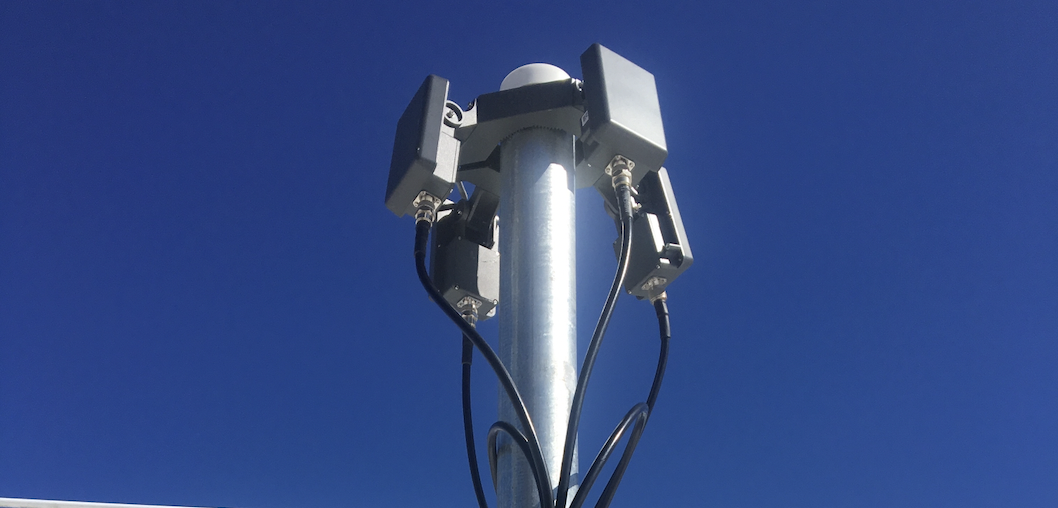
RF sensors are the most common starting point because they detect the communication signals between a drone and its operator. A single RF analyzer can identify drone type, model, and in many cases the operator's location. They are passive (meaning they emit no signal of their own), relatively affordable ($15,000 to $60,000 per unit), and fast to deploy. The limitation: RF sensors are blind to drones operating autonomously or with modified communications. If a drone is not broadcasting, RF will not see it.
2. Radar Systems
Radar detects objects by their physical presence in the airspace, regardless of whether they emit a signal. This makes radar the only sensor that can reliably detect autonomous, modified, or RF-silent drones. As we covered in our drone detection radar guide, FMCW radar is the preferred architecture for close-range perimeter defense, while phased array systems cover wider areas. Radar units range from $30,000 for a basic FMCW sensor to $500,000+ for multi-panel phased array coverage. The limitation: radar struggles with hovering targets in cluttered environments and requires micro-Doppler processing to distinguish drones from birds.
3. Electro-Optical and Infrared (EO/IR) Cameras
Cameras provide visual confirmation of detected objects. When radar or RF triggers an alert, EO/IR cameras verify whether the target is actually a drone, assess its size and payload, and record forensic evidence. PTZ (pan-tilt-zoom) cameras with auto-tracking capability can be cued directly by the detection platform. Thermal cameras add the ability to detect drones at night or in low-visibility conditions. Camera systems range from $10,000 to $80,000 depending on resolution, thermal capability, and tracking features. The limitation: cameras have limited range, are affected by weather, and cannot serve as primary detection sensors.
4. Acoustic Sensors
Acoustic detectors listen for the sound signatures of drone propellers. They are fully passive and can detect drones that evade both RF and radar in certain environments. A US firm recently deployed a system built around AI-powered acoustic sensing for tracking small drone threats. Acoustic sensors cost $10,000 to $40,000 per unit but are limited by range (typically under 500 meters) and environmental noise interference.
5. Remote ID Receivers
Remote ID receivers capture the broadcast identification signals that the FAA now requires on most drones. They provide the drone's serial number, location, altitude, velocity, and operator position. Remote ID equipment is the least expensive detection layer ($2,000 to $15,000 per receiver) and the fastest to deploy. The critical limitation: Remote ID only works on compliant drones. Hostile or modified drones will not broadcast.
What Equipment You Actually Need: Matching Your Threat Profile
The right equipment depends on what you are protecting and what threats are realistic. Within the three-tier anti-drone system framework, here is what each tier typically requires:
| Tier | Equipment | Total Hardware Cost | Best For |
|---|---|---|---|
| Tier 1: Basic | RF sensor + Remote ID receiver + alerting software | $20K - $80K | Prisons, campuses, local PDs |
| Tier 2: Layered | RF + radar + EO/IR camera + C2 platform | $100K - $350K | Airports, stadiums, power plants |
| Tier 3: Full-Spectrum | Multi-radar + RF array + PTZ thermal + acoustic + enterprise C2 | $350K - $1.5M+ | Military bases, critical infra, major events |
The equipment is only half the investment. Installation, site survey, calibration, training, software licensing, and ongoing maintenance can add 30% to 60% to the hardware cost. Under the FEMA C-UAS Grant Program, all of these costs are eligible for 100% federal funding, including training and personnel time.
The Equipment Procurement Mistakes That Waste Budgets
After working with dozens of organizations on detection deployments, we see the same procurement mistakes repeated across verticals:
- Buying sensors before defining the detection mission. The question is not "which sensor should I buy?" but "what drone behavior am I trying to detect, at what range, in what environment?" A correctional facility dealing with DJI delivery drones needs different equipment than an airport defending against RF-silent autonomous threats.
- Evaluating equipment in isolation instead of as a system. A radar with excellent detection range is worthless if it cannot feed data to your C2 platform. A camera with beautiful imagery is useless if it cannot be automatically cued by your detection layer. Every piece of equipment must be evaluated on how well it integrates with the rest of the system, not just its standalone specifications.
- Ignoring total cost of ownership. Hardware is often less than half the lifetime cost. Software licenses, firmware updates, calibration visits, spare parts, and operator training accumulate year over year. Ask vendors for a 5-year total cost of ownership estimate, not just a unit price.
- Skipping the site survey. Detection range in a vendor's datasheet assumes ideal conditions. Your site has buildings, terrain, electromagnetic interference, and bird populations that will degrade performance. Any credible vendor will conduct a site survey before recommending equipment. If they skip this step, that is a red flag.
- Buying mitigation equipment without legal authority. Under the SAFER SKIES Act, only certified law enforcement personnel can operate mitigation equipment. Purchasing jammers or other countermeasures without the proper legal authorization and FBI training certification exposes your organization to federal liability.
For a deeper dive into vendor selection criteria, use our four-question framework for evaluating drone detection companies.
How Equipment Connects: The Role of the C2 Platform
Individual sensors generate data. A command-and-control (C2) platform turns that data into actionable intelligence. The C2 platform is the central nervous system of any drone detection deployment, responsible for fusing inputs from every sensor, correlating tracks, classifying targets, triggering alerts, cueing cameras, and logging events for after-action review.
When evaluating C2 platforms, the critical questions are:
- Sensor compatibility: Does the platform support the specific radar, RF, and camera models you are deploying? Or does it lock you into a single vendor's hardware ecosystem?
- Multi-site management: Can a single operator monitor multiple locations from one dashboard? This matters for organizations with distributed facilities.
- API and export capability: Can the platform share data with your existing security infrastructure, including video management systems, access control, and incident management platforms?
- Scalability: Can you start with a basic sensor set and add more equipment over time without replacing the C2 platform?
The integrated platform vs. point-solution decision is ultimately a question about the C2 layer. An integrated platform like AirGuard unifies radar, RF, cameras, and Remote ID into one operating picture, so security teams see one fused track per target instead of four separate alerts from four separate screens.
Funding Your Equipment: Where the Money Is
Three federal funding channels are available for drone detection equipment in 2026:
- FEMA C-UAS Grant Program ($500M): $250 million awarded to 11 FIFA World Cup host states in FY2026. Another $250 million opens to all 56 states and territories in FY2027. Covers detection, tracking, identification, and monitoring equipment at 100% federal funding.
- FIFA World Cup Grant Program ($625M): A separate FEMA-managed program specifically for counter-drone equipment and personnel at World Cup venues.
- JIATF-401 Counter-UAS Marketplace: For military and federal buyers, the Pentagon's online procurement platform offers expedited purchasing of 1,600+ counter-drone items.
For the complete federal funding landscape, including grant timelines and eligibility requirements, read our analysis of the anti-drone market and federal funding in 2026.
Start with the Mission, Then Buy the Equipment
The organizations that get the most value from their drone detection equipment are the ones that start with a clear detection mission, conduct a site survey, define their integration requirements, and then select hardware that fits all three. The ones that waste budget are the ones that start with a vendor's product catalog.
With federal funding at historic levels and new legal authorities under the SAFER SKIES Act, the barrier to entry has never been lower. But the window is time-bound: FY2027 grant applications will open soon, and agencies that have already defined their equipment requirements will move faster than those still researching options.
This is part of our series on deploying anti-drone systems by protection level and vertical. Explore the full library:
- Anti-Drone Systems: What Works at Every Protection Level
- Drone Detection Radar: How It Works, What It Costs, and Which Type You Need
- Sensor Technology: The Five Detection Modalities Explained
Ready to define your equipment requirements? Talk to our team about your site, threat profile, and budget.