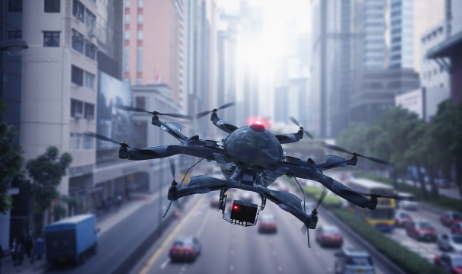
In the world of drone detection, we are witnessing a "stealth revolution" that has nothing to do with expensive military coatings and everything to do with material science. While security teams are often looking for the "large radar shadow" of a commercial DJI Matrice, the most dangerous threats today - custom-built FPV (First-Person View) drones - are designed to slip through the gaps.
To understand why these drones are so difficult to detect, we have to look at the physics of Radar Cross Section (RCS) and how high-frequency sensors are changing the game in 2026.
The Physics of the "Ghost": What is RCS?
Radar Cross Section (RCS) is essentially a measure of how "visible" an object is to radar. It isn't just about physical size; it's a combination of shape, material, and the wavelength of the radar hitting it.
- The Comparison: A Boeing 747 has an RCS of roughly 10,000 $m^2$. A standard commercial drone like a DJI Phantom has an RCS of about 0.01 $m^2$ (similar to a large bird).
- The FPV Threat: A custom-built FPV racing drone, however, can have an RCS as low as 0.001 $m^2$ or even 0.0001 $m^2$. At this level, the drone is effectively "radar-transparent," leaving a signature no larger than a medium-sized insect.
Why Carbon-Fiber Drones Defeat Standard Radar
Traditional security radars typically operate in the S-band ($2$ to $4\text{ GHz}$) or X-band ($8$ to $12\text{ GHz}$). While excellent for long-range aircraft tracking, these wavelengths struggle with FPV drones for two primary reasons:
- Material Absorption and Refraction
Standard radar relies on radio waves bouncing off metallic surfaces. However, FPV drones are predominantly constructed from carbon fiber and high-density plastics.
- Absorption: Carbon fiber is a "lossy" material; instead of reflecting radar energy back to the receiver, it absorbs a significant portion of the signal, converting it into heat.
- Refraction: Non-metallic materials can act like glass to visible light. Instead of reflecting the signal, they refract (bend) the radar waves around the airframe, causing the signal to scatter away from the radar antenna.
- The "Spider-Web" Geometry
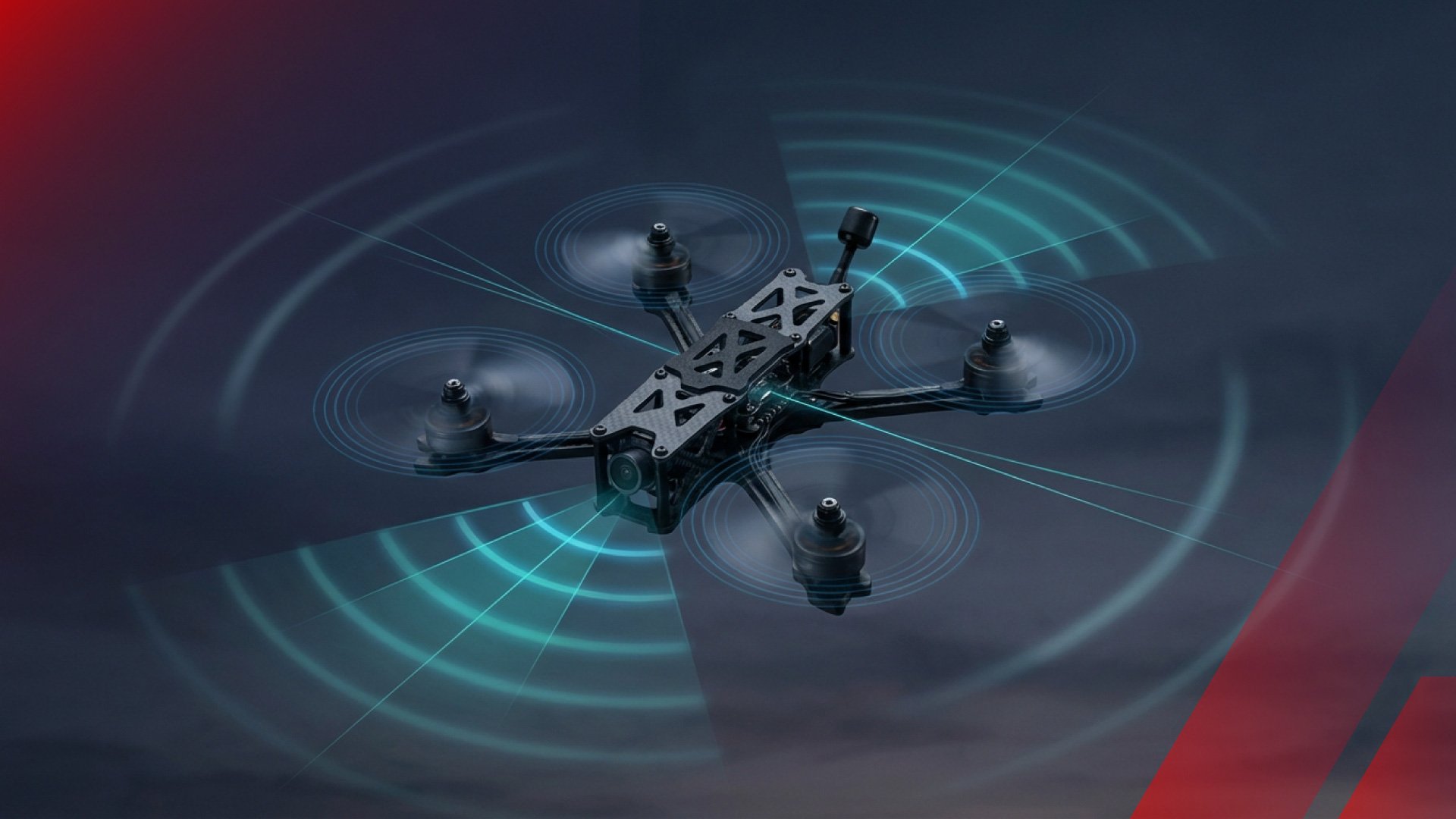
Unlike commercial drones with large, flat plastic shells, FPV drones use open-frame "spider-web" designs. There are very few flat surfaces to reflect a signal back. Most of the radar energy simply passes through the frame, hitting only the tiny motors and wiring, which produce a return signal too small for standard algorithms to distinguish from environmental noise or "clutter."
How High-Frequency (mmWave) Sensors Solve the Problem
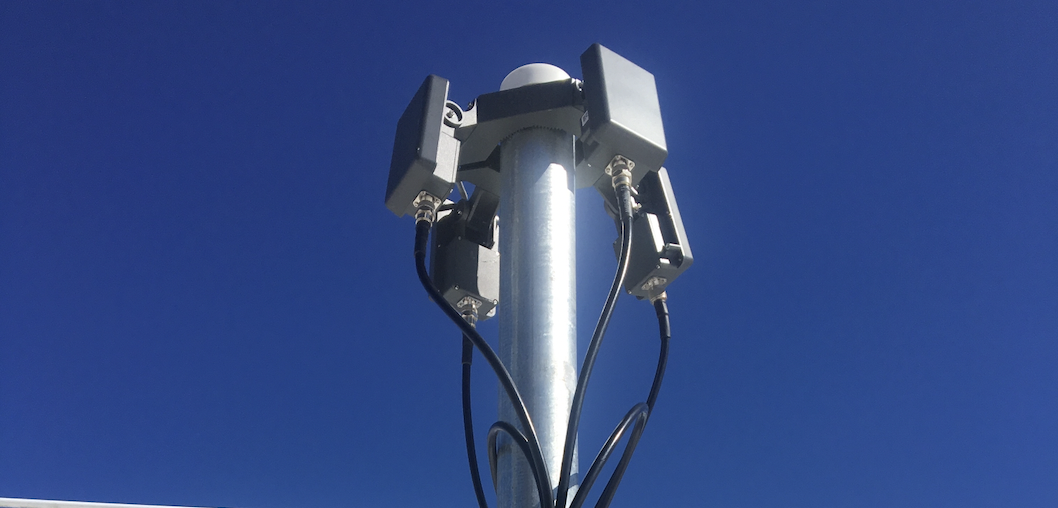
To catch these "ghost drones," the industry has shifted toward Millimeter-Wave (mmWave) Radar, typically operating in the 24 GHz, 60 GHz, or 77–81 GHz bands.
Shorter Wavelengths = Higher Resolution
The higher the frequency, the shorter the wavelength. At 77 GHz, the wavelength is only about $3.9\text{mm}$. This allows the radar to "see" the tiny features of an FPV drone that lower-frequency radars miss. It can detect the minute reflections from the carbon fiber arms, the internal circuit boards, and even the spinning propeller blades.
Micro-Doppler Classification
High-frequency sensors excel at detecting Micro-Doppler signatures - the tiny frequency shifts caused by the rotation of the drone's motors.
- Even if the FPV frame is "stealthy," the propellers must spin at thousands of RPM to maintain flight.
- mmWave radar can isolate these high-speed micro-motions and use AI algorithms to verify: "This is not a bird; this is a quadcopter moving at 100 km/h".
The Airsight Multi-Layered Advantage
Detection is never about a single "silver bullet" sensor. Because FPV drones can also be "RF-silent" (flying via waypoint or fiber-optic tether), Airsight’s AirGuard platform utilizes a multi-layered approach:
- High-Frequency Radar: To track the low-RCS physical frame and micro-Doppler signature of the rotors.
- Acoustic & Optical Fusion: To pick up the high-pitched "whine" of FPV motors and visually track the aircraft when it enters the line of sight.
- RF Intelligence: To intercept the high-bandwidth video feeds typically used by FPV pilots.
By fusing these data points, we eliminate the "stealth" advantage of carbon fiber, ensuring that no matter how small or silent the threat, it is detected, classified, and logged for legal action.
Securing Your Airspace is a Proactive Measure
The drone threat is not a theoretical future problem; it is a present reality that demands a sophisticated response. Implementing a comprehensive and intelligent drone detection solution is the most effective way to address this challenge head-on.
Airsight is committed to empowering organizations with the tools and expertise needed to meet this challenge.