Search "drone jammer" online and you will find hundreds of devices for sale, YouTube reviews of handheld jamming guns, and forums debating which frequencies to block. What you will not find in most of those results is the single most important fact about drone jammers in the United States: operating, marketing, or selling RF jamming equipment is a federal crime unless you are an authorized government entity.
Under the Communications Act of 1934 (47 U.S.C. 301, 302a, 333), the FCC prohibits the operation, marketing, or sale of devices designed to block, jam, or interfere with authorized radio communications. Violations carry fines up to $112,500 per incident and potential criminal prosecution. The FEMA C-UAS Grant Program explicitly prohibits purchasing weapons with grant funds, and mitigation equipment is only available to certified law enforcement personnel.
We include this context upfront because we sell drone jamming hardware as part of our detection-to-mitigation platform, and we take the legal framework seriously. Our Smart and Autonomous Jammer is available only to qualified US federal government agencies or other entities expressly authorized by federal law. This guide explains how drone jammers work, who can legally operate them, what the SAFER SKIES Act changes, and why detection must come before mitigation in any responsible deployment.
How Drone Jammers Work
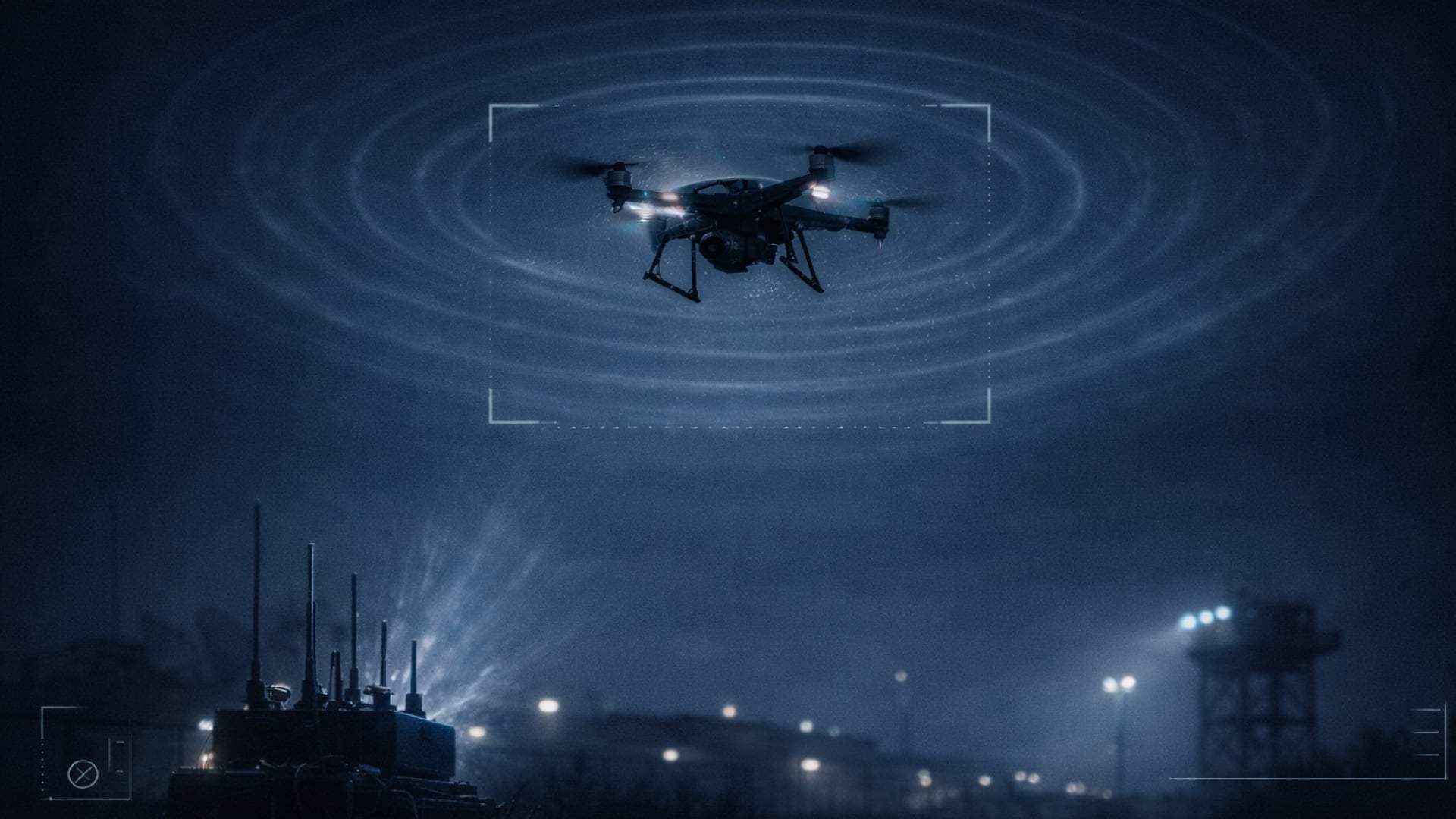
A drone jammer is a radio frequency transmitter that overwhelms the communication link between a drone and its operator. By broadcasting a powerful signal on the same frequencies the drone uses for command, control, video, and navigation, the jammer forces the drone into a fail-safe mode. Depending on the drone's programming, it will either return to its launch point, hover in place, or descend to the ground.
Modern drone jammers target multiple frequency bands simultaneously:
- 433 MHz and 900 MHz - Used by many commercial and DIY drone control systems
- 1.2 GHz and 1.5 GHz - Common video transmission and telemetry frequencies
- 2.4 GHz and 5.8 GHz - The primary command-and-control bands for DJI and most commercial drones
- GNSS bands (GPS, GLONASS, Galileo, BeiDou) - Disrupting satellite navigation forces the drone to lose its position fix, triggering emergency landing protocols
The challenge is that these same frequencies are used by Wi-Fi networks, Bluetooth devices, cellular communications, and aviation navigation systems. This is precisely why the FCC restricts jamming equipment - an improperly deployed jammer does not just stop a drone. It can disrupt emergency communications, interfere with nearby aircraft, and knock out wireless infrastructure across a wide area.
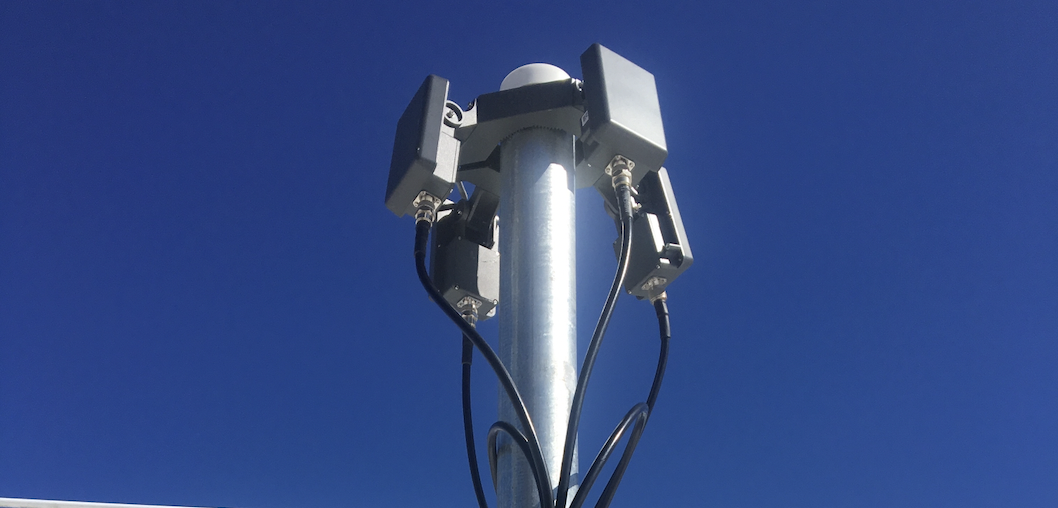
Smart jamming systems address this by using directional antennas that focus the jamming energy toward the target rather than broadcasting in all directions, and selective frequency targeting that jams only the specific bands the detected drone is using. Our Smart and Autonomous Jammer provides full 360-degree defense coverage out to 1.9 miles while operating across the key drone frequency bands, with both manual and automatic activation modes. It mounts on fixed positions, tripods, or vehicles and integrates directly with our AirGuard detection platform, so the jammer is cued by the sensors rather than operated blindly.
Who Can Legally Operate a Drone Jammer in the United States
The legal landscape for drone jamming has shifted significantly, but the restrictions remain strict. Here is who can and cannot operate jamming equipment:
Authorized under existing federal law:
- Department of Defense and military installations (under Title 10 authority, expanded by JIATF-401's updated guidance in January 2026)
- Department of Homeland Security, including CBP and Secret Service
- Department of Justice, including the FBI
- Department of Energy for nuclear facility protection
- Coast Guard for maritime security
Newly authorized under the SAFER SKIES Act (FY2026 NDAA):
- State and local law enforcement agencies - but only after personnel complete training at the FBI's National Counter-UAS Training Center in Huntsville, Alabama
- Correctional facility security agencies meeting federal certification requirements
- Agencies protecting National Special Security Events (NSSEs) and SEAR-rated events like the FIFA World Cup 2026
NOT authorized:
- Private companies (including critical infrastructure operators) unless operating under direct federal authority
- Individual property owners
- Private security firms unless contracted by an authorized agency
- Anyone purchasing from overseas vendors or consumer marketplaces
The penalties for unauthorized jamming are severe. The FCC can impose fines of up to $112,500 per violation, and the FAA treats interference with aircraft communications as a federal offense carrying criminal prosecution. The devices marketed as "drone jammers" on consumer websites are illegal to operate in the United States regardless of the stated purpose.
What the SAFER SKIES Act Actually Changes
The SAFER SKIES Act, signed into law as part of the FY2026 NDAA, is the most significant expansion of domestic counter-drone authority since the original 2018 legislation. For jamming specifically, it creates a path for state and local agencies to operate mitigation equipment that was previously restricted to federal entities.
However, the path comes with requirements:
- Training certification at the FBI's National Counter-UAS Training Center is mandatory before any agency can operate mitigation equipment
- Federal coordination through JIATF-401 is required for operational deployment
- Privacy protections are built into the framework - counter-UAS RF systems must be designed to identify signal characteristics without decoding communication content, as outlined in JIATF-401's privacy guidance
- Reporting requirements mandate documentation of every mitigation event
The practical implication: even agencies with legal authority need detection infrastructure before they can justify mitigation. You cannot jam what you have not detected, tracked, and classified. This is why the DTIM workflow matters - jamming is the last step, not the first.
Why Detection Must Come Before Jamming
The most dangerous misconception in the counter-drone market is that a jammer alone solves the drone problem. It does not. Activating a jammer without first detecting, tracking, and classifying the target creates several immediate risks:
- Collateral interference: Jamming without knowing the target's exact location and frequencies means broadcasting disruption across a wide area, potentially affecting emergency services, airport operations, and civilian communications
- Legal exposure: Mitigation without documented detection and classification evidence exposes the operator to FCC enforcement action. The SAFER SKIES framework requires that mitigation be justified by a tracked, classified threat
- Operational blindness: A jammer that is not integrated with detection sensors cannot tell the operator whether the jamming is working. Did the drone land? Did it return to its operator? Did it switch to an autonomous mode? Without tracking, you are guessing
This is why we built our jammer as an add-on to our detection platform, not as a standalone product. The Smart and Autonomous Jammer integrates with AirGuard's multi-sensor detection architecture - when radar, RF, and cameras confirm a hostile drone, the system can activate jamming automatically or on operator command, targeting only the frequencies the specific drone is using. Detection cues the jammer. The jammer does not operate alone.
For organizations evaluating their protection tier, jamming capability is a Tier 3 (Full-Spectrum C2) addition. Tier 1 and Tier 2 deployments focus exclusively on detection and tracking. Mitigation only enters the picture when legal authority, training certification, and detection infrastructure are all in place.
What to Look for in a Drone Jamming System
For agencies that do have mitigation authority, these are the critical evaluation criteria:
- Multi-band coverage: The system must jam all standard drone frequencies (433 MHz through 5.8 GHz) plus GNSS. A jammer that covers only 2.4 GHz and 5.8 GHz will miss drones operating on non-standard or lower-frequency bands
- Directional capability: Smart, directional jamming minimizes collateral interference. Omnidirectional jammers are appropriate for wide-area denial; directional systems are better for surgical response in populated environments
- Sensor integration: The jammer must connect to your C2 platform and be cued by detection sensors. Standalone jammers that require manual activation are too slow for real threats and too imprecise for legal compliance
- Automatic and manual modes: Some scenarios require human-in-the-loop activation; others demand autonomous response when reaction time is critical
- Environmental hardening: IP66 weather protection, wide operating temperature range (-4°F to 140°F), and mounting flexibility (fixed, tripod, vehicle) are essential for field deployment
Use our four-question vendor evaluation framework to assess jamming providers alongside detection vendors. The best system is one where detection and mitigation come from the same platform, ensuring seamless handoff from track to response.
The Bottom Line: Know the Law Before You Buy
Drone jammers are powerful tools with severe legal restrictions. The SAFER SKIES Act has expanded who can use them, but the requirements for training, certification, federal coordination, and detection infrastructure mean that mitigation is the endpoint of a process, not the starting point.
If your organization has mitigation authority, the question is not "which jammer should I buy?" but "do I have the detection equipment, the tracking workflow, and the legal authority to justify activating one?" If the answer to any of those is no, start there.
This is part of our series on deploying anti-drone systems by protection level and vertical. Explore the full library:
- Anti-Drone Systems: What Works at Every Protection Level
- Drone Detection and Tracking: How the Full DTIM Workflow Works
- SAFER SKIES Act: Counter-Drone Authority for Law Enforcement
Important Legal Notice: The marketing, sale, possession, and use of RF jamming equipment is strictly regulated under US federal law. Products described in this article are available only to qualified US federal government agencies or other entities expressly authorized by federal law. These products are not available for purchase by state or local agencies, private entities, or individual consumers unless expressly permitted by applicable federal law.
Authorized agency looking to evaluate integrated detection and mitigation? Talk to our team about your mission requirements.